 Svalbard
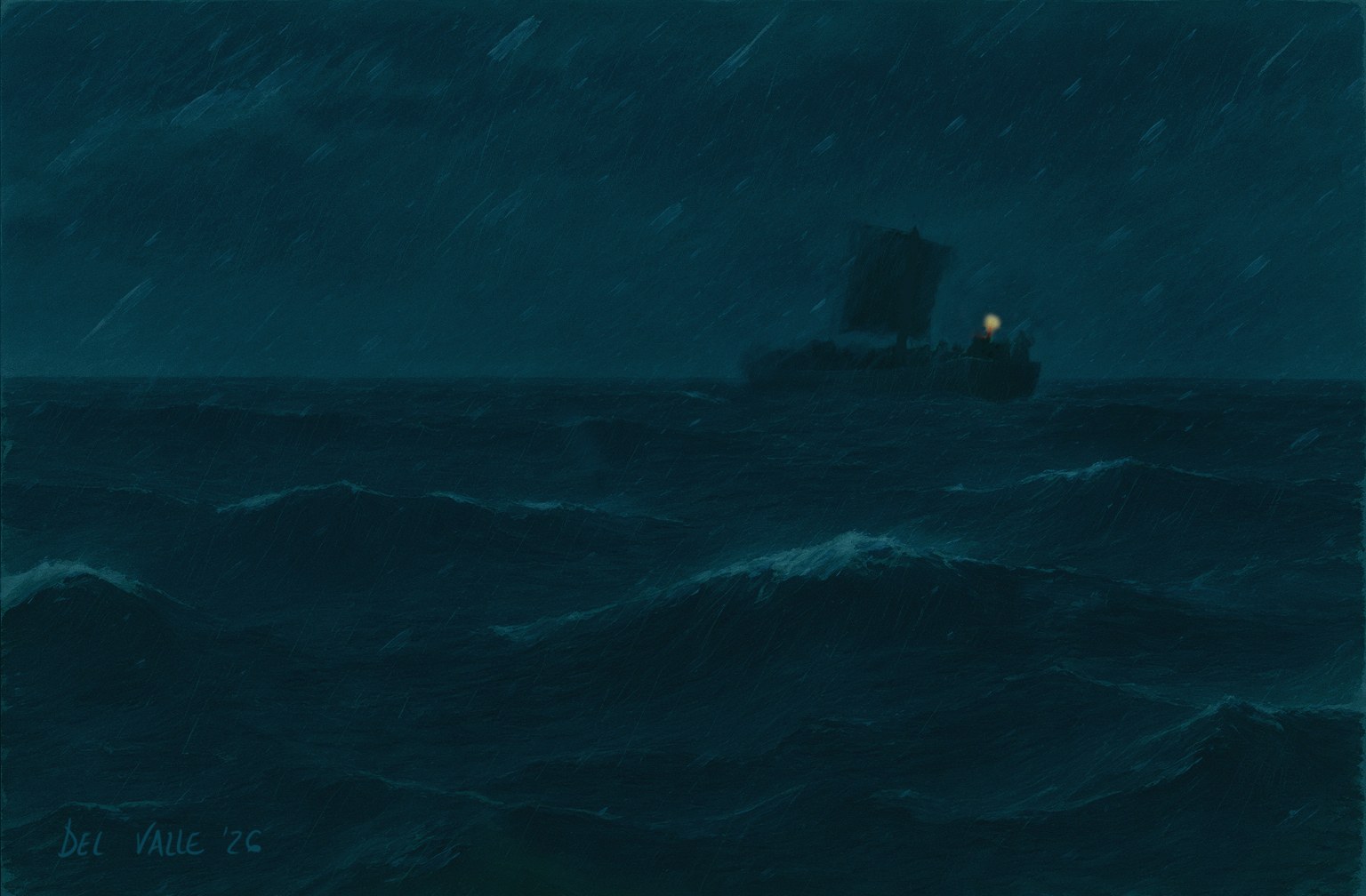

That Friday, the first day in the boats, the smallest of them had begun to fall behind while the wreck was still in sight. Two hours later she was a scrap of grey sail a long way down the coast, and each time Clark looked back for her he was longer in finding her.
He had the tiller. The captain had given it to him when the sail went up, by moving along the bench to make room, and had sat since then with his face to the land.
“She has dropped back again, sir,” Clark said. “A mile, or near it.”
Williams turned round and looked at her for some time.
“She was built to take men off a ship’s side,” he said. “Nobody asked her to sail.” He stood up and called across the water. “Mr Fenn! We go back for her. I’ll have her people out of her and into the two of us.”
They took in the sails and rowed back along their own course, and it cost them the better part of an hour. There were four hours of grey in a day up here. Clark had begun to count them.
The three boats came together on the swell with the small one in the middle. The second mate had her. Men on both sides took hold of her and held on, and the swell lifted the three and dropped them one after another, so that a man stepping across had to choose his moment.
“The water first,” Williams said. “Then the biscuit. Then the men, one at a time, on my word.”
The water was in a small cask. Davies, the chief steward, passed it over himself with both arms round it, came after it, and sat down beside it in the middle of the motor boat with one hand on the bung. He had fed fifty-eight men since Iceland. He looked along the benches now as he had looked along the tables.
“Mr Davies,” Williams said. “The water is yours. Nobody draws it but you, and every man has the same.”
“Every man the same, sir,” Davies said.
“Engine room to me,” Williams said. “The motor is here, and the men who know it stay with it. Deck hands to Mr Fenn. He has only his sail.”
They came across one at a time. The carpenter, who was the oldest man in the ship, had to be taken by both arms and lifted. The other apprentice landed on his knees beside Pounder, and the two boys looked at each other and found nothing to say. The donkeyman came last of the engine room. His name was Suttie, and his work in the Chulmleigh had been the small boiler that drove her winches. He stepped over three benches without a look at the men on them and sat down beside the motor, on the side away from Colvin.
“What does she burn, chief?”
“Petrol. And not much of it.”
Suttie laid his hand on the cover, as Colvin had his.
On the far side the second mate and the seamen were going over into the mate’s boat, and Fenn was seating them with the stem of his pipe. Hardy was watching one of them. It was Nicolson, who had stood lookout on the night of the reef. He said something across the water that Clark could make no English of, and Hardy answered him in the same, and both went back to what they were doing.
When the small boat was empty Hardy went into her with his knife. He came back with her oars, with a coat that somebody had left under a bench, and with her sail rolled under his arm.
“Canvas,” he said. “It’ll keep something off somebody.”
Colvin held out his hand for it. He folded the sail in four and laid it over the cover of the motor, and pressed the edges down all round.
“He’s put it to bed,” said one of the firemen, a man named Russell, and got a laugh for it.
“I have,” Colvin said. “And you’ll keep your boots off it.”
Hardy let go the small boat’s rope. She lay where they left her, riding high, and turned slowly until she was sideways to the swell. It was the second boat Clark had seen left empty since midnight.
“Count your boat, Mr Clark.”
He counted from the bow back, each head. He had no book to write it in, so he counted twice.
“Twenty-eight, sir. With ourselves.”
“Mr Fenn?”
“Twenty-nine, sir.”
It was the same fifty-seven the mate had counted along the rail in the night. Williams said the two figures over once, to himself.
“Mr Fenn, your course is north, with the land on your right hand. You will keep within hail of me while there is light. When it goes, Mr Clark will show the torch on the hour, and you will answer it.”
“With what, sir? I’ve no light.”
“With your voice, Mr Fenn. I have heard it carry.”
Somebody in the mate’s boat laughed, and Fenn lifted his pipe to the captain.
The sails went up again. The wind was still in the south and pushed them along the land. With twenty-eight in her the boat sat deep, and the spray came in over the side at every swell and froze where it fell, on the benches and on the coats, and a man who moved his arm could hear it. They sat packed thigh against thigh. It was warmer than the night under the ship’s side had been, and that was all the comfort there was in the boat.
Davies gave out the first water before the light went. He had a tin dipper tied to the cask by a string, and he filled it to the same mark for every man, the captain and the two boys alike, and watched it drunk. Russell held his out a second time.
“Same for the master, same for you,” Davies said, and put the bung back.
By two in the afternoon the grey had gone, and the land with it.
At three Clark took the torch from inside his coat, held it up over the stern and counted five.
“Aye aye!” It came from close by on the left, Fenn’s whole voice, and some of the men turned their heads toward it.
At four it came again from the same place. After that the snow began, fine and dry, driving along the water from behind them. The answer to the five o’clock light was further off, and further back. The one at six Clark could not be sure of. Hardy, in the bow, said he had heard it and pointed, and two other men pointed somewhere else.
At seven Clark held the light up at the full stretch of his arm and counted ten.
They listened, all twenty-eight of them. The water ran along the boat’s side, and the sail creaked with the ice in it.
“Again, Mr Clark.”
He showed it again. Williams stood up in the stern and shouted the mate’s name twice, and the snow took it.
No voice came back.
“Put it away,” Williams said. He sat down. “Mr Fenn has his course, and so have we. Steer north.”
“North, sir.”
Clark put the torch back inside his coat and took the tiller in both hands. In the morning the captain had said that no boat was to lose the others. Nobody reminded him of it.
It was seven in the evening, and fifteen hours to the next grey.
II
Saturday, the second day, gave them nothing. The wind died in the morning, and the boat lay all day on a long swell with her sail hanging, in sight of a white coast that stayed where it was. Of the mate’s boat there was no sign.
On Sunday the wind came back before the grey did. Clark felt the boat lean and heard the water begin to run along her side, and for a quarter of an hour it seemed a good thing. Then the first sea came in over the side in one piece and filled her to the men’s shins.
“Get the sail off her,” Williams said. “Hardy, the sea anchor.”
It was a canvas bag as long as a man, open at both ends, on thirty yards of rope. Hardy put it over the bow. It filled and dragged, and the boat swung round until her bow pointed into the wind, and lay there, held by the nose. She would go now where the gale sent her. All they could do was keep her afloat while it did.
“Leave the tiller, Mr Clark. It is no use to you. Every man with a tin or a boot or a cap will bale. The rest will sit close and keep the next man warm.”
They baled. The boat had one baler and a bucket. Beyond those there were the empty tins from her stores. The seas were short and steep, and one in every five or six came aboard. A man threw out a capful and the sea put back a bucket. Davies sat with both arms round the cask. Colvin lay across the motor on the folded sail and took the water on his back.
The grey came and went. By the end of it Clark had stopped feeling his feet. They were down in the water with everybody else’s. He knew about his hands because he could see them.
The first man stopped baling a little after dark. It was Russell, who had made them laugh about the motor. He let his tin go, leaned back against the knees of the man behind him and began to unbutton his coat.
“I’m all right now,” he said. “I’ve got warm.”
“Give that man his tin,” Williams said.
“I don’t want it, sir. I’m warm. Let me be.”
Williams went to him down the middle of the boat, over the benches, on his hands and knees. He took Russell by the collar in both fists and sat him up.
“You are not warm. You are freezing, and that is how it feels near the end of it. Do up that coat.”
Russell looked at him.
“I will not have a man go to sleep in my boat,” Williams said. “If you want to die warm, do it ashore. Bale.”
Russell did up the coat. Somebody put the tin in his hands, and he baled.
Williams stayed where he was, kneeling in the water with a hand on a bench at either side, and raised his voice.
“Now hear me, all of you. A man who sleeps tonight will not wake. While you bale you are awake, and I mean to keep every one of you awake until the grey. Mr Clark counted you when we emptied the small boat. We shall count again, and go on counting, so that I can hear which of you is falling asleep. Hardy is one. Each man calls his number after the man in front of him, down the boat to Mr Clark, who is twenty-seven. I am twenty-eight. Any man who is late with his number takes a tin and bales. Hardy!”
“One.”
“Two,” said Whiteside.
“Three.” That was Peyer, the sergeant of the army gunners, who had his men round him on one bench.
It went down the boat from bench to bench. The carpenter gave eleven. Davies gave twelve from behind the cask, and Suttie thirteen. The two apprentices said nineteen and twenty one on top of the other. The radio officer said twenty-six in Clark’s ear.
“Twenty-seven,” Clark said.
“Again.”
They counted all that night. The numbers came out of the dark in the order of the benches, some shouted and some hardly spoken, and Clark came to know each one as a man on watch knows the lights of his own coast. Whiteside’s two was a bark. The carpenter took a breath before his eleven. When a number was late the whole boat waited for it, and the wait was worse than the sea. Then the captain said the man’s name, and the number came thick and slow, and a tin went back along the benches to the man who had said it.
Some time after midnight it was twelve.
“Davies!”
“Twelve, sir.” The voice was quite clear. “I beg your pardon.”
Toward morning the wait came at the other end. The radio officer said his twenty-six. Clark said twenty-seven and listened for the word that started them again.
He looked. Williams was still on his knees in the middle of the boat, holding on with both hands. His mouth was moving. What came out of it was a croak with no word in it.
The captain looked down the boat at him and nodded, once.
“Again,” Clark called. It came out higher than he had meant. “Hardy!”
“One,” Hardy said, as he had said it all night.
The grey found them still at it. The wind was going down with the dark, and the seas had drawn out longer, and fewer of them came aboard. Every number had answered at the last count. Clark got to his feet with a hand on the radio officer’s shoulder and looked to the right for the land.
The land was gone. Where the white coast had stood all Saturday there was sea. He turned the whole way round and found grey water on every side, to the edge of the light.
Williams had seen it too. He got himself back to the stern, one bench at a time, and sat down and pointed at the motor. He had to try twice for the word.
“Chief,” he said. “Uncover her.”
III
By Monday morning, the fourth day, the sail had frozen to the motor cover, and Colvin had to break it free with the heel of his hand before it would lift. He opened the petrol, bent down and took hold of the starting handle. Suttie knelt on the other side with both hands cupped round the pipe that fed her, breathing into them.
Every man in the boat watched his back.
At the first swing there was nothing. At the second the motor coughed once, like a man woken too early. At the fourth it caught. Blue smoke blew back over the stern, and with it a smell of burnt petrol, warm, like the ship’s galley.
“That’s the first thing gone right since Iceland,” Russell said.
“East, Mr Clark,” Williams said. His voice had come back in the night as a hoarse whisper, and he saved it. “The land is where we left it.”
Clark put the tiller over. The boat came round against the swell and went where he pointed her, and he had forgotten that a boat could. The men had stopped baling to listen. Nobody told them to go on.
In the second hour the land came up, a white line first and then a coast, with black rock showing under the snow. A little after that Hardy stood up in the bow.
“Sail!” He pointed ahead and to the right, close in under the land. “It’s the mate, sir.”
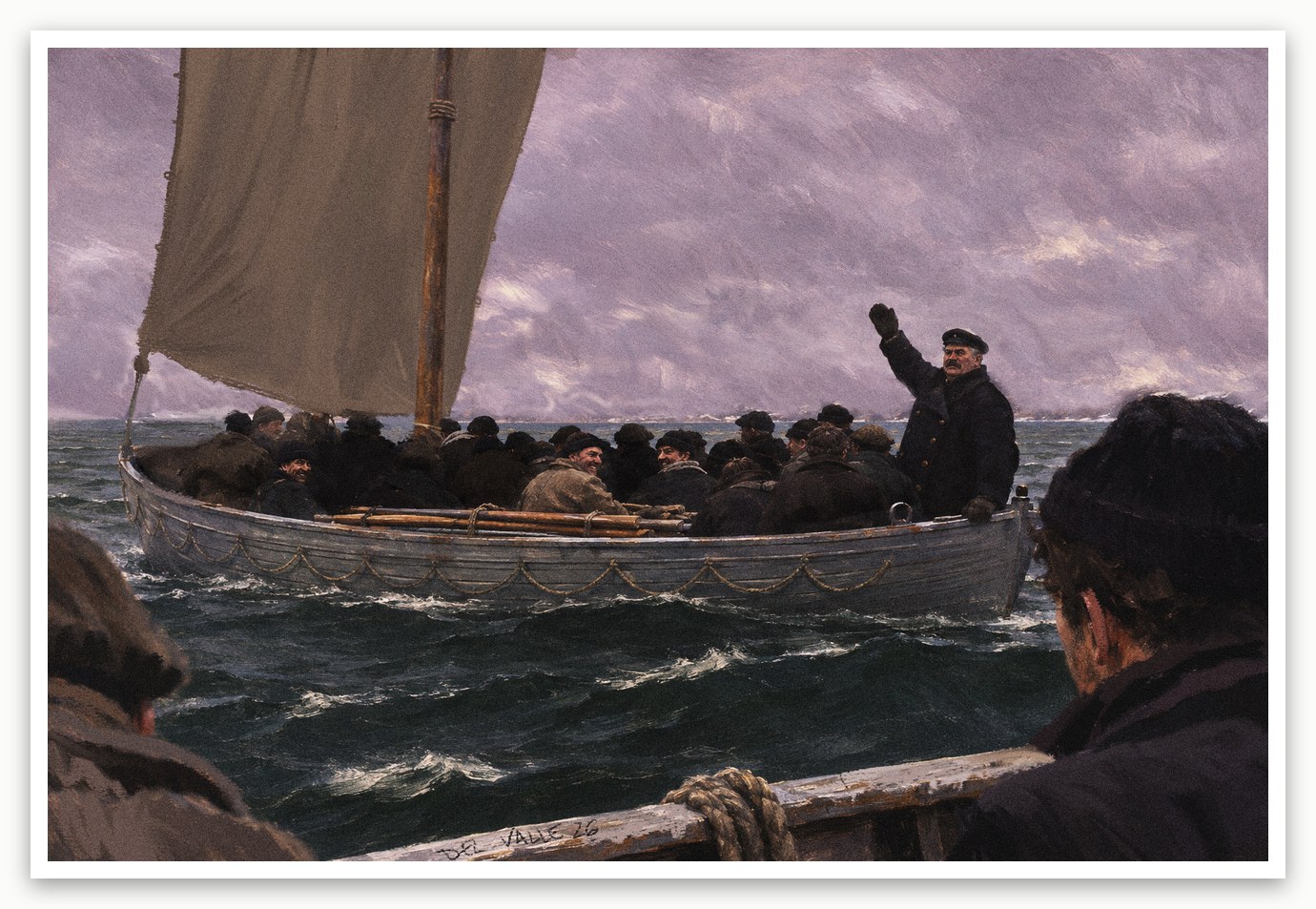
They ran down to her. Fenn was standing in the stern with his pipe in his mouth and ice in his eyebrows, and his men had turned on their benches to watch the motor boat come. Clark laid her alongside, and hands on both boats took hold.
“Good morning, sir,” Fenn said. “We heard you before we saw you. I thought it was the Germans come back.”
“Where did you ride it out?”
“On a sea anchor, the same as yourself, with a boatful of men telling me what they thought of the gale.”
Men laughed in both boats. Clark saw faces he knew. The second mate lifted a hand to him. The boatswain had a rag tied over his ears and under his chin, and somebody near him was asking the firemen whether they had kept warm.
“Where do you put us, Mr Fenn?”
Fenn took the pipe out of his mouth and looked up the coast.
“Eighty miles short of Ice Fjord, sir, from what land I’ve seen. I’d not make it more.”
“I make it the same.” Williams waited for his breath. “I have a motor and you have none. With the motor by day and the sail by night I can be in Barentsburg in fourteen hours. Fifteen. Under sail alone you want two days, and more if it blows again. I mean to go ahead and send them down the coast for you.”
Fenn did not answer at once. He looked along his own boat, bench by bench, and the talk in her stopped. Then he looked at the motor.
“It’s what I should have asked you to do, sir,” he said.
“Keep the land on your right hand, and keep off it. They will come down this coast looking for a sail.”
“Then we’ll show them one.”
Williams put out his hand across the two gunwales, and Fenn took it. It was the first time Clark had seen the captain shake hands with anyone aboard.
Hardy had not sat down. He was looking across at the bow of the other boat, where Nicolson was looking back at him. They were both Shetlanders, and neither wasted words on the other.
“Andy!” Nicolson called. “You’ll have the kettle on.”
“I’ll have it boiled dry, the time you’ll take,” Hardy said.
The men laughed again, and it went on longer than the joke was worth. The hands let go. Colvin opened the motor up, and the water widened between the two boats. Fenn had his sail filling before they were a hundred yards off. He stood in his stern with one arm up, and kept it up.
Clark steered north. Fourteen hours. They would run the motor while there was light to see the land by, and sail through the dark, and the motor again at the next grey. By this hour tomorrow there would be a quay, and a roof over it somewhere, and men who could send a ship. He worked it through twice and found nothing wrong with it.
By the time the grey went, the mate’s boat was a scrap of sail a long way down the coast, as the small one had been on the first day. Hardy watched it longer than anyone. When the dark took it he turned round and faced the way they were going.
Williams had the motor stopped for the night. Colvin put the canvas back over it while it was still warm.
 “Then we’ll show them one.”
IV
On Monday night the wind went into the north, and the cold came down with it. The spray froze as it landed. By midnight the sail stood as stiff as a door and knocked against the mast, and a man’s sleeve would not bend at the elbow. Hardy leaned out over the bow and struck the outside of the boat with an oar. It rang. She was carrying two inches of ice from end to end.
Davies began to talk a little after that.
“There’s the eggs to come,” he said. “Twelve boxes. I signed for twelve.”
Nobody answered him. He said it again, louder, and took his hand off the cask and tried to stand.
“I must go to the gangway. They’ll leave them on the quay.”
“Sit him down,” Williams said. The whisper carried the length of the boat. “Mr Davies. The stores are aboard. I saw them come.”
Davies turned his head toward the voice.
“Twelve boxes, sir?”
“Twelve.”
“Then that’s right,” Davies said, and sat.
There was a spare coat that had come over from the small boat, and one blanket more than there were men to claim it. They put the coat on him over his own and wrapped the blanket round the two. He was quiet after that. The baling went on and the count went on, and he gave his twelve when it came to him, and then once he gave it before eleven, and then it was late.
“Davies!”
The boat waited.
Clark went forward to him over the benches. The steward sat as he had sat since the first day, upright behind the cask, but the hand had come away from the bung and lay open on his knee. Williams was there already. He put two fingers under the man’s jaw and kept them there for some time.
“He is dead,” Williams said.
It took four men to lift him, Peyer and Whiteside and two of the firemen, and all the strength the four had. Williams said, “We commit his body to the deep,” in the voice that was left to him, and they let him go over the side away from the wind. Clark heard him enter the water.
“The coat and the blanket stay in the boat,” Williams said. “He would be the first to say so. Mr Clark, the water is yours now. Every man the same measure, as he gave it.”
Clark sat down where the steward had been. The bench was dry in the shape of a man. He put his hand on the bung.
“Thirteen,” Suttie said, behind him, and the count went on from there.
At the next grey, on Tuesday, Colvin swung the handle nine times before the motor caught, with Suttie’s hands round the pipe again. They ran north. Nobody spoke of hours now. In the boat they watched the land go by on the right hand, and those who had the water in their minds watched Clark.
The grey was nearly gone when Hardy called from the bow.
“High land ahead, sir. Standing out to sea.”
It rose out of the dusk ahead of them and to the left, dark, with snow on its shoulders, a long way off. Williams looked at it for as long as he had looked at the chart on the night of the reef.
“Prince Charles Foreland,” he said. “Ice Fjord opens under it. Steer for the foot of it, Mr Clark.”
“How far, sir?”
“Two hours of this.”
It went down the boat from mouth to mouth. Men who had sat bent since the gale straightened their backs. Pounder turned right round on his bench.
“Is that it, sir?”
“That is it,” Clark said.
They held on toward it, and the high land grew a little. The motor missed a beat. It ran on, and missed two. Colvin had his ear down to it before the third. It stopped.
The boat went on a little way by herself, and the water along her side grew quiet.
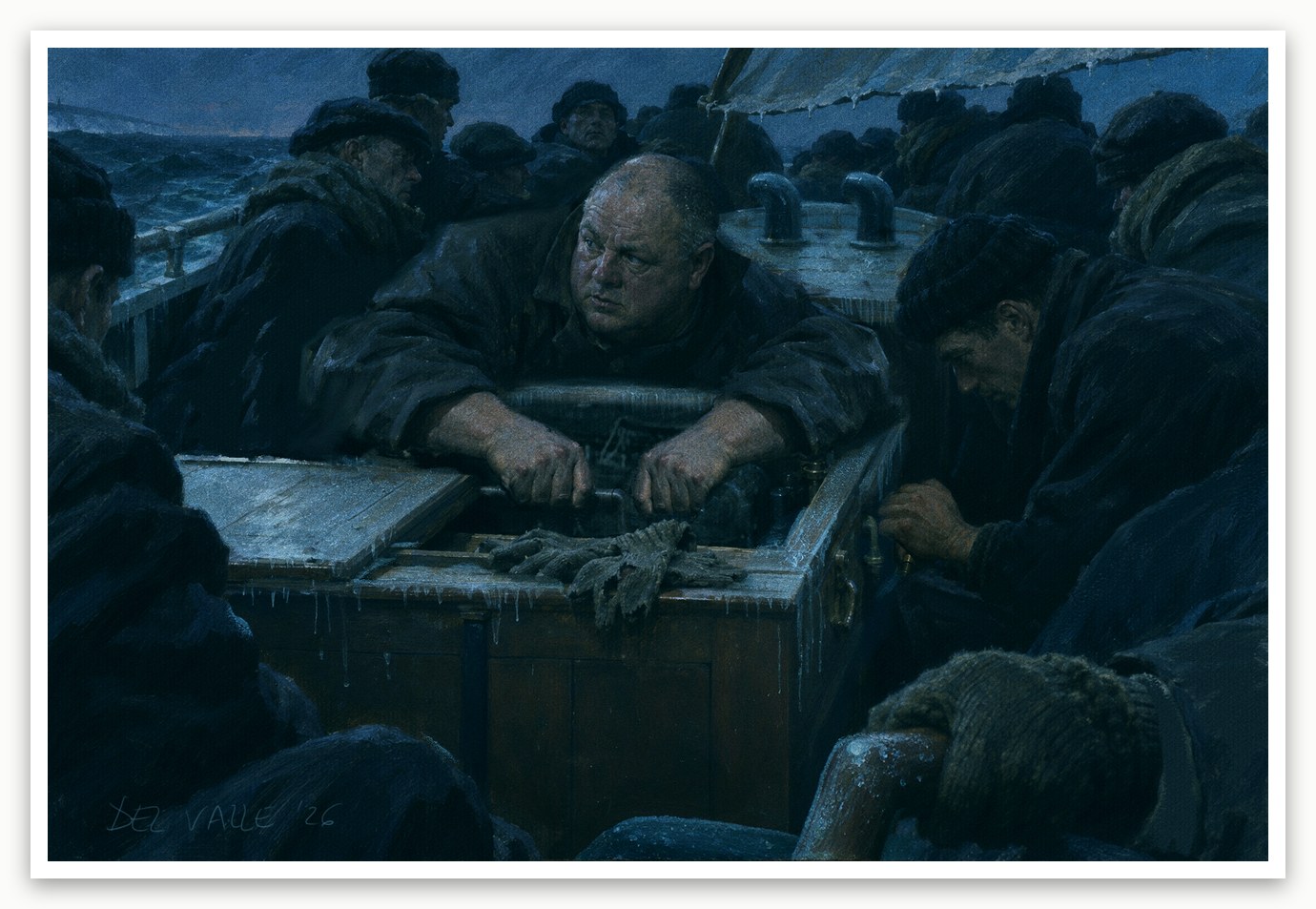
Colvin swung the handle. He swung it again. He pulled off what was left of his gloves and went into the motor with his bare hands, and where his fingers touched the metal they stuck to it, and he pulled them away and went on. He took something off and blew through it and spat. He swung the handle until his breath came in sobs.
“Is it the petrol?” Williams asked.
“No, sir. There’s petrol in her yet.” Colvin stayed bent over the motor. “She’s frozen. There’s ice in the pipe that feeds her, in a place I cannot get to. I could clear it with a flame.”
“Have you a flame?”
“I have matches. I’ll not put a match to petrol in a boat full of men.”
“No,” Williams said.
Colvin lay down across the motor with his coat open and his chest against the metal. He stayed there. From time to time he reached under himself and tried the handle. Suttie stayed on his knees beside him. He had the feed pipe in his two bare hands, and he held it as long as the light lasted and for some time after.
The Foreland had been ahead of them. Clark watched it slide away to one side as the wind took the boat and turned her. He put the tiller hard over and the boat paid no attention to it. They tried to get the sail to draw, and it stood on the mast like a board. By the time the dark was whole the high land was a shape he had to search for, and then it was one he could not find.
That night Suttie began to talk, as Davies had.
“The donkey boiler wants water,” he said. “Somebody see to her water.”
He said it to the man beside him and then to the boat at large, reasonably at first, as a thing that had been overlooked.
“She’ll burn dry. Who’s got her water?”
Clark gave him a drink from the cask. He drank it and thanked him and said it again. Every man in the boat wanted water by then, and none wanted the biscuit. Clark gave each of them the steward’s measure, to the mark. The dipper froze to the cask between one man and the next.
Williams sat beside him in the stern with his coat collar up.
“When you get a wind you can use, Mr Clark,” he whispered, “you will keep her head north-east. The fjord is there. You will raise the land again in the grey.”
He stopped there, and Clark waited for the rest of it.
The captain leaned against him. It came slowly, the whole weight of the man, and his head went down on Clark’s shoulder, and his cap fell off into the bottom of the boat.
“Sir,” Clark said. “Captain Williams.”
Colvin came aft over the benches. He put his cheek to the captain’s mouth and held it there.
“He’s breathing. He’s worn out, that’s all it is. I never saw him sleep since Iceland.” He looked at Clark. “Did you?”
“No.”
They laid him along the bottom boards in the stern, on the oars, out of the water. Clark fetched the steward’s blanket. He tucked it under the captain’s shoulder, and down his left side, and there his hand met something hard under the coat. It was the pistol he had seen go in there, at the cabin door. The holster had frozen like wood. He took his hand away and drew the blanket over it, up to the chin, and put the cap under the edge.
When he sat up the boat was looking at him. He could not see their faces. He could see that they were turned his way, all of them.
“I’m an engineer, Mr Clark,” Colvin said. “I can’t tell one star from another. You are the deck officer. It’s your boat.”
Behind them Suttie asked who had her water.
“What do we do now, sir?” It was Pounder.
Clark looked once more for the Foreland.
“We bale,” he said. “And we count. Hardy!”
“One,” Hardy said.
 “She’s frozen. There’s ice in the pipe that feeds her, in a place I cannot get to.”
V
Suttie stopped asking for water some time before the grey. When the light came on Wednesday, the sixth day, Clark saw why. The donkeyman sat upright on his bench with his eyes half open and frost on the lashes, and three benches behind him Russell sat the same way, with his coat done up to the neck, as he had been told.
Nobody had the strength to move them, and Clark did not ask it. The count went round them. It stopped at twelve, where there was nobody, and at thirteen, and at twenty-two, and each time the boat waited out of habit and then went on.
There was no land. The sky lightened a little before noon, and under it lay the same grey water as on Monday.
“Hardy. Get the sail on her.”
“She’s froze solid, sir.”
“Then beat it till it bends.”
It took most of an hour. Hardy did it with Whiteside and Peyer, the three who could still stand in a boat. They laid the sail across the benches and beat it with oars, a foot at a time, and hauled it up cracking. It drew. Clark put her head to the east, having no better guess, and gave out the water.
An hour later the land came up. It was low and white, with a line along the foot of it that was whiter still and moved.
“Reef,” Hardy said. “All along, sir.”
It was the horseshoe over again, seen from the outside. Clark ran south down the edge of it, as near as he dared, looking for a place where the swell went through whole. The wind was getting up behind him. The grey went while he was still looking.
It was full dark when Hardy called again, in another voice.
“A light! There’s a light, sir. On the land.”
Clark found it. It was red, low down, a long way inland to the north-east, and it stayed where it was.
“Barentsburg,” he said.
The word went forward through the boat. A sound came back that was meant for a cheer. Even the men who had stopped answering to their numbers lifted their heads for it.
“Sail down. Oars out, every man who can pull one.”
Seven could. He took the torch from inside his coat. I may want both hands, the captain had said. Clark switched it on. Where the swell struck the reef it broke white, and where the water stayed dark it was deep enough for a boat. He ran the beam along the white, slowly, from the near side outward, looking for the dark.
The beam found a gap, black between two lines of white. They pulled for it, and at thirty yards the black had rock in it. He took them out again and along. It found another. That one closed as the first had. The third time he let the oars rest and watched the place through four swells before he believed it, and at the fifth the whole gap stood up white from side to side.
The light in his hand had gone yellow. He shook it. It shrank to a brown thread behind the glass and went out, and he held the cold weight of it a moment longer before he put it back in his coat.
After that he had only the sound to steer by. The men at the oars stopped one at a time, and he had no heart to name them. He called the count and got nine numbers, and later five. Later still he found that he had not called it for a long while. He sat with the tiller under his arm and the captain against his feet. The boat lifted and fell. It was somebody else’s watch now.
The crash came from under the bow. She stopped dead, and timber split, and the sea broke over the stern and across his back. He thought, very clearly: the reef, at half past eleven.
Then the swell came in under her. He felt her go up, higher than a boat should go, and forward with it, and whatever had held her passed away beneath. She came down in water that was nearly still. Her keel ground on stones. She ran on, and stopped, and leaned over on one side, and the oars and the cask and the men slid down into the low part of her in a heap.
It was about two in the morning of Thursday the twelfth of November.
Clark went over the side on his hands and knees. His feet were no use to him. There was snow under his hands, and stones under the snow, and he crawled up out of the reach of the water and lay there. The wind had gone. The land had taken it. After the boat it was like coming into a warm room.
All round him men were coming up the beach the same way. They put their faces down into the snow and ate it by the handful.
“Sir! Mr Clark, sir!” It was Whiteside, on his feet, higher up. “There’s huts here. Wooden huts. Twenty yards.”
“Get them in,” Clark said. “Every man that breathes.”
Whiteside and Peyer did most of it, and another of the gunners. They dragged men by the collar and by the arms. Clark saw Whiteside, who came no higher than the captain’s chest, take the captain under the armpits and go backward up the beach with him, a step at a time, with the captain’s heels cutting two lines in the snow.
Williams’s eyes were open when they passed.
“Where is this, Mr Clark?”
“Ashore, sir.”
“Which shore?”
“I don’t know, sir.”
The captain’s eyes closed again.
Peyer came back down for the next man. He bent over one who lay at the edge of the water, and straightened up.
“This one’s gone, sir. He was breathing when I got him out of the boat.”
They left him where he lay. In the boat there were three who would not be moved that night, Suttie and Russell and a fireman who had gone quiet beside them in the dark. She lay on her side with the sea breaking into her, and the motor was in her still, under the chief’s canvas.
Clark got to the hut on his knees. It was black inside and smelled of old smoke, and the floor was covered with men lying as they had dropped. He went round them by touch. He put his hand on each one and waited to feel him breathe, and counted.
Twenty-two, and himself.
Before he lay down he looked out of the door for the red light. There was a rise of ground behind the huts, white against the sky, and the light was on the far side of it. That was for the grey.
The floor was still. He noticed that it was still, and slept.
To be continuedPart four, “The stove”, on Saturday 5 December.
Illustrated by the author
Published