 Svalbard

At one in the morning Captain Williams came out to the top of the bridge ladder and waited for the men below him to stop talking. The Chulmleigh had been on the rock for an hour and a half. They stood on her boat deck in whatever they had pulled on when she struck, and David Clark, the third mate, stood among them.
“We shall put the boats in the water and lie off until daylight,” Williams said. “As a precaution. Mr Fenn, you and Mr Middlemiss remain aboard with me. If she can be got off, I want a mate and an engineer here to do it.”
“How long are we in the boats, sir?” Starkey asked.
“Until I can see what she is sitting on.”
He went back into the chartroom and left the door open. From the boat deck Clark could see him in the lamplight, down on one knee beside two wooden boxes, with the signal books stacked at his elbow. Those were the Navy’s secret books, and the order was that they went to the bottom of the sea before an enemy could come aboard and read them. He took a folded sheet from his pocket. Clark had seen it on the table in there at Hvalfjord, under the captain’s hand. Williams held it a moment and put it in with the rest.
Clark went down to his cabin for his heavy coat. His blanket lay folded at the foot of the bunk, and he stood for a moment with his hand on it and then left it there. The captain had said until daylight. By daylight the swell might have gone down, and they would see what held her, and a man who carried his bedding into a boat was a man who did not expect to sleep aboard again.
On deck the cold had hardened. A full breath of it hurt, and the men took the air in a little at a time.
Three boats went down without trouble and pulled off a little way, and Clark could hear their oars long after the dark had taken them. Most of the deck hands had gone with them. The fourth boat was Clark’s.
She hung out over the water on two ropes, one at her front and one at her back, each led round an iron post on the deck. Two men let those ropes out together, a foot at a time, and she went down level; that was the whole of it. It was the first job they taught an apprentice, and Clark meant to do it as the book said.
The ropes had frozen in their coils. The one Hardy picked up came off the deck in one piece, in the shape it had lain in, and he beat it against the rail and trod on it, a length at a time, until it would go round the post. For the other rope Clark had a fireman, who had come up from the boiler room a few minutes before and took hold of it with bare hands.
There was a splash under the bridge, small for its weight, and a second after it. The boxes had iron in them and went straight down.
Hardy had stopped with the rope in his hands.
“That’s the books gone,” he said. “He’ll not be wanting those back.”
Clark told him to mind his rope.
Two of the gunners climbed into the boat to ride her down and keep her off the ship’s side with the oars. The younger one stood swaying in the middle of her, looking down at the water.
“Sit down, son,” the other said. “You’ll have us over.”
That was Willoughby, the sergeant of marines. He had his cap on square, as he had it every morning at the guns. When the boy was down on the bench he took up an oar and looked up at Clark.
“Ready when you are, sir.”
“Lower away,” Clark said.
For the first few feet she went down as she should. Clark was watching the fireman’s hands when the rope moved in them. It sprang off its post in a single stiff loop. The man had one turn on it, where the book wanted three, and after that there was nothing holding it but his hands, and it went through them and over the side faster than he could shout. The back of the boat fell away. She swung down and stopped on her front rope with a jerk that Clark felt through the rail in both hands, and hung there end up against the ship’s plates, empty.
It was a long drop from the boat deck, with the stern standing as high as it did. The two splashes came up late, one after the other. Then a man began to shout down there. Clark could not make out any words in it.
The fireman held his hands out in front of him and looked at them.
Clark was still looking at them when the captain came past from the bridge. He went down the ladder without a word, quickly for him, and Clark followed because he could think of nothing else to do.
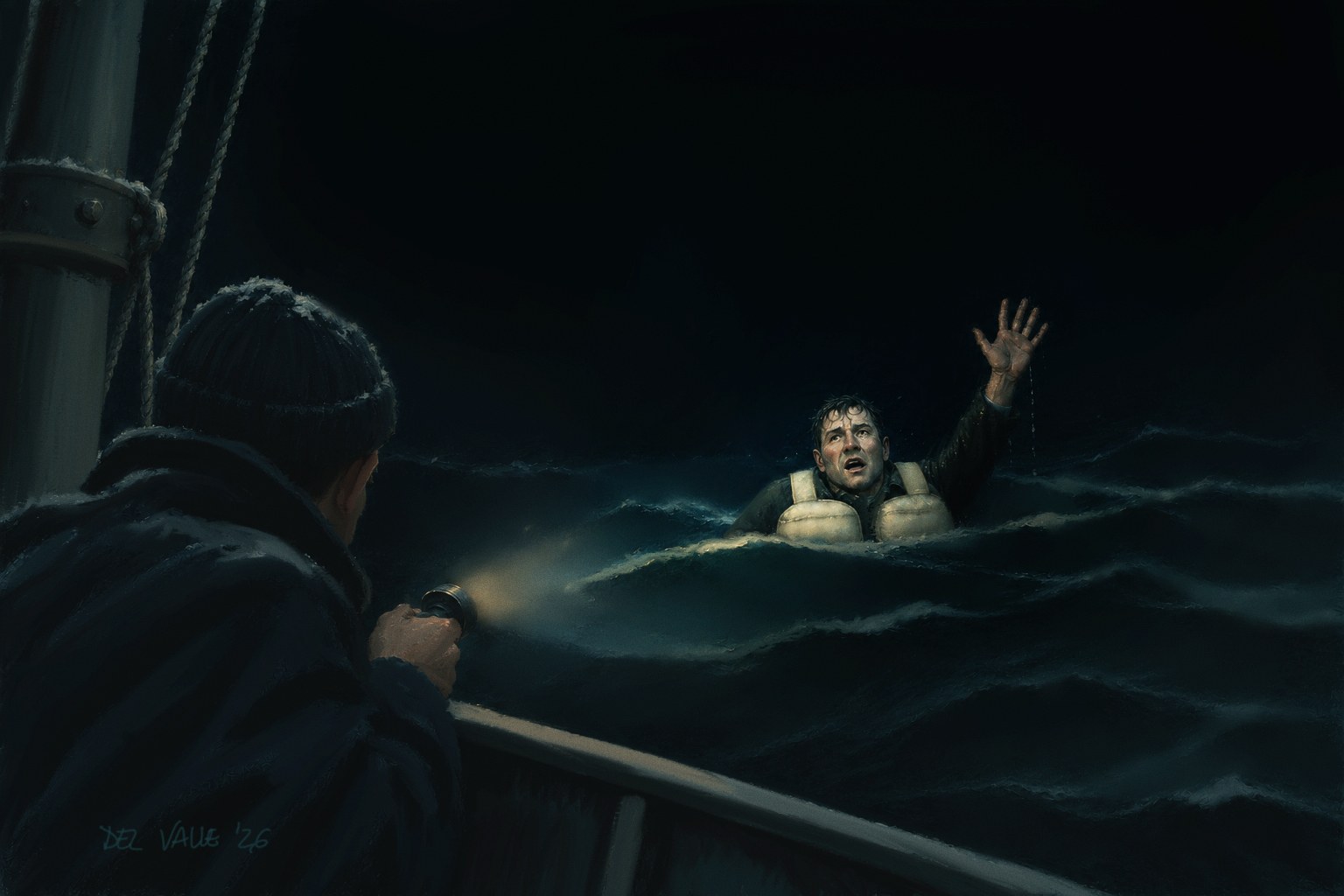
The front half of the ship ran downhill into the sea. By the foremast the deck was only a few feet above the water, and each swell came up level with the rail, hung there and drew back. Williams stopped where the deck was still dry, switched on a torch and began to search the water with it, slowly, from the ship’s side outward. The beam showed how much snow was falling. It found a man close in, striking out with both arms and getting nowhere. It went on past him and found the second further out, a head and the pale collar of a lifebelt, going up one side of a swell and down the other.
“Bosun! A rope here.”
MacLennan, the boatswain, came down the deck at a run with a coil over his shoulder and the apprentice Pounder behind him.
“Mr Clark, take the light.” Williams put it in his hand. “Keep it on the far man. The boats must see him.” He turned to the dark and raised his voice. “You in the boat there! Two men in the water. Bring her in under my light.”
No answer came back out of the dark. He called it again.
The torch was warm where the captain had held it. Clark laid the beam on the far man and tried to keep it there. The ship stood still on her rock and the sea did not. Every swell that came in lifted the man into the light, carried him a few yards and dropped him behind it, and for the space of a breath or two the beam lay on bare black water, and Clark had to hold it where the man ought to come up, and wait.
He came up. He was swimming, as a man swims in a heavy coat and sea boots, with short quick strokes that hardly moved him, and his face was toward the ship. The cap was gone. When the light settled on him he stopped and raised one arm. It was the sergeant.
“Sergeant!” Clark shouted. “The boat is coming for you. Keep moving.”
“Sir!”
It came back thin across the water, but it was a word, and it was the voice of a man answering an order.
Beside Clark the boatswain was throwing the rope. At the second throw it fell across the near man’s shoulders. He got both arms over it and lay there.
“Take a turn round your wrist, man,” MacLennan shouted. “Round your wrist!”
“He cannot shut his hands,” Williams said. “Look at him. We want the boat.”
Clark heard the boat before she came, and he kept his eyes where they were. He heard her brought in under the ship’s side and carried past by the swell, and brought in again. He heard MacLennan shout “Hold her!” and the captain’s boots on the rail, and three men landing in her one after another.
“Mr Clark!” The captain’s voice came up from the water now. “That light stays on him. And talk to him.”
“Aye, sir.”
A swell had taken the sergeant down, and it was a long time giving him back. When he rose into the light again he had stopped swimming. The lifebelt held him, and he lay back in it with his arms spread on the sea, and as the swell turned him his face came round, white, with the eyes open, looking straight up the beam at whoever was holding it.
“Have you got the lad, sir?”
The words came one at a time, with a wait between them. Down in the boat somebody said, “I have his collar,” and something heavy came in over her side.
“They have him, Sergeant,” Clark shouted. “He’s in the boat. Keep moving. They are coming for you now.”
One arm came up out of the water as far as the elbow, slowly, and went down again.
“Is he alive, sir?” That was Pounder, in the boat.
“Ask me in a minute,” Williams said. “Pull, all of you. Along the light.”
The boat pushed off from the ship’s side. Clark could hear the oars working and the boatswain calling the stroke, and under it the captain’s voice, low and even, telling a man to drink. The sound of the oars stayed where it was. Whatever the men gained between two swells, the next one took from them.
“Sergeant!” Clark shouted. “That’s the boat. Can you hear the oars? Sergeant!”
The arm stayed down. A swell took the man out of the light and brought him back with his head over on one side and his cheek in the water, and the next one washed across his face, and he let it.
Clark called again. He began to count the swells, because it was something to do with them, and he called once to each. The oars were still working out there in the dark. At the ninth swell he did not call. He kept the light where it was.
From the boat there came a wet cough, and another, and the sound of a man fighting for air and getting it.
It was some minutes more before the bow of the boat came into the light. Two men leaned out over her side and took the sergeant by the collar and the belt, and the captain leaned out beside them. They held him against the boat and looked at him.
“He’s dead, sir,” MacLennan said. Clark heard it plainly across the water.
“Very well,” Williams said. “Let him go. Back to the ship.”
The two men opened their hands. The lifebelt kept him up, and the next swell carried him out of the light.
The boat turned. When she had gone out of the beam there was a cap in it, floating upside down. Clark held the light on the cap, having been given no other order.
They got the living man up over the rail between them, and MacLennan carried him off to the galley across his shoulder. Williams came aboard last. He put one leg over the rail and stopped there, and Clark saw that he could not lift the other. He took the captain under the arm and brought him in.
Williams sat down on the deck with his back against the rail. His breath came in long pulls.
“Put that light out, Mr Clark. The battery has to last us.”
Clark switched it off, and the cap and the water went, and there was only the noise of the swell on the reef. The torch had gone as cold as the rail.
After a while the captain spoke again, out of the dark.
“What was his name?”
“Willoughby, sir.”
“His Christian name.”
“I don’t know, sir. I never heard anyone use it.”
“Find it out. It goes in the log.”
“Yes, sir.”
Clark stood beside him with the torch in his hand. It was some time before the captain got up and held out his hand for it.
II
At half past two Captain Williams had the three boats called back to the ship. They came in one behind another and lay under her side, lifting and dropping against the plates, and the men in them turned their faces up.
Clark was at the rail with the log under his arm. He had been sent for a name, and this was his first chance of getting it.
“The gunners,” he called down. “Which boat has the gunners?”
“Here, sir. Some of us.”
“Sergeant Willoughby. What was his Christian name?”
There was talk in the boat, low, and then a small man stood up among the others with a hand on his neighbour’s head to steady himself. It was Whiteside.
“Frederick, sir. Frederick William.” He kept his face turned up. “Is that for his people?”
“It is for the log,” Clark said, and heard how it sounded.
Clark wrote it standing, with the book open on the rail and the pencil held in his fist, since his fingers would no longer hold it any other way. 0115. Sgt Frederick William Willoughby, Royal Marines, drowned. It went under the last line he had written in that book, which was one word long.
Fenn had been going along the rail above the boats, pointing with the stem of his pipe.
“Fifty-seven, sir,” he said. “With ourselves.”
“Fifty-seven,” Williams said.
He stood at the rail until the boats were quiet.
“I mean to try her once more. There is more swell now, and every one that comes in lifts her stern. If the engine is going full astern as she lifts, she may come away.” He stopped for breath. He was still short of it. “Mr Middlemiss tells me the fires are low and the steam has gone down with them. He cannot fire two boilers by himself. I want firemen.”
Nobody answered him. The firemen were in the motor boat, the captain’s own, sitting close together on one bench as they sat at their meals.
“I am not ordering any man below,” Williams said. “I am asking.”
In six days at sea Clark had never heard him ask a man for anything. He looked at the captain’s face and learned nothing from it.
One of the firemen got up, holding on by the next man’s shoulder.
“I was paid fifty pounds to sail in her, sir,” he said. “Well, I’ve sailed in her. Nobody paid me to go down inside her on a rock, with the front of her full of water.”
“No,” Williams said. “Nobody did.”
“And if she goes while we’re below?” the fireman said.
“Then you come up. Mr Fenn will stand at the head of the ladder, and that door stays open.”
The fireman sat down again. Nobody else moved. The boats went on lifting and dropping, and somewhere among them a man coughed and could not stop. Williams stood at the rail and let the quiet go on.
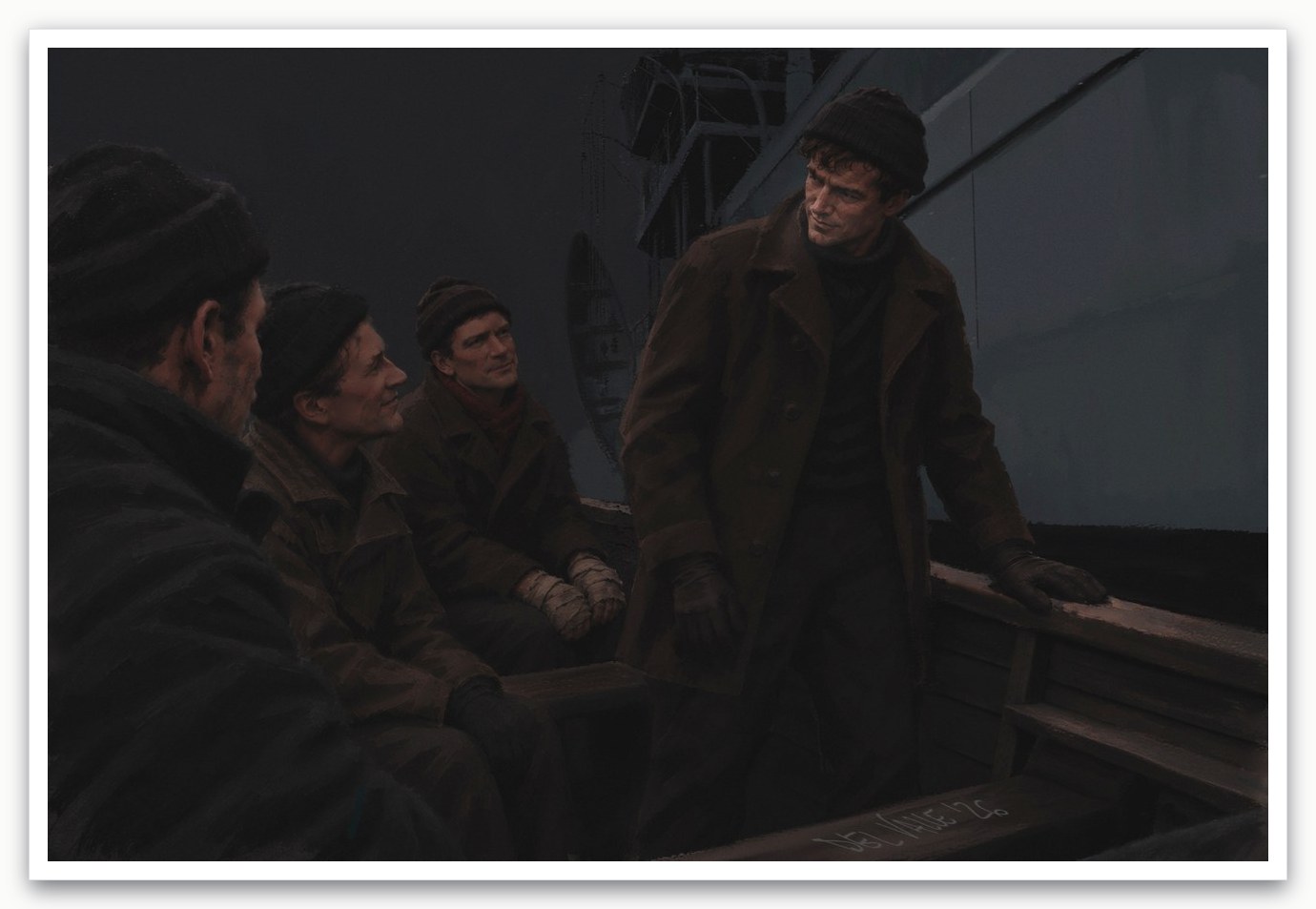
Then another of the firemen got up, a man of twenty-eight named Alexander. He stood with his feet apart on the bottom boards and looked up the black side of the ship as a man looks at a job.
“It’ll be warm down there, at any rate,” he said.
He said it to the men beside him and not to the captain. One of them laughed, a single short sound, and cut it off. It was the first laugh Clark had heard since she struck. Alexander climbed over their knees to the ladder that hung down the ship’s side and came up it quickly, like a man glad to be moving. At the rail he nodded to the captain and stood there.
A second man came up behind him without a word. He had rag wound round both his hands, and he climbed with his wrists hooked over the rungs. Clark knew him by the hands.
“Two,” Williams said. “Thank you. Mr Middlemiss, they are yours.”
The second engineer took them below. Williams watched them go and turned round.
“Mr Clark.”
“Sir.”
“At midnight I had nothing to tell me whether she moved but my own feet, and I shall not trust them twice. Take a lead and line to the stern and put the lead on the bottom. If she moves, I want it from you before any man on the bridge.”
“Aye, sir.”
The stern stood higher than Clark had ever known it, and the line ran out a long time before the weight touched. While she sat, it would hang straight down. If she came back a yard, it would lean toward the bow. He took up the slack and looked along it. Straight down. He settled himself against the rail to wait.
It was the better part of an hour. The smoke from the funnel thickened and turned black and went away flat to the north with sparks in it. Below him the boats had drawn off again into the dark. He changed the line from one hand to the other, and put the free one inside his coat, and changed back when he could feel it.
Hardy came along the deck and stood at the rail a little way off. His boat was the one still hanging by one end from the boat deck, and he had stayed with the ship. He looked down the line as Clark was doing.
“It was my boat,” Clark said. “I gave the word to lower.”
“You did, sir,” Hardy said.
Clark kept his eyes on the line. It was a while before he could say the rest.
“I had a man with bare hands on it.”
“There wasn’t a glove on that deck would have stopped it.” Hardy watched the line a while longer. “I’ll be at the ladder, sir, if she comes.”
Clark was alone again. A yard would do. One yard, and the line would say so, and after that there would be another.
“Stand by, Mr Clark!” That was Fenn, from the engine-room door.
The engine started. He felt it in the rail first, a shaking that climbed into his arms, and then the water under the stern boiled up white and went streaming forward along both her sides. A swell came in. It lifted her, and the line pulled out through his fingers as she rose, and he let it go and took it in again as she settled, and looked along it. Straight down.
The next swell did the same, and the one after. He counted without meaning to. At the fifth there was a long grinding from under the middle of her, and the line moved. It leaned toward the bow by the width of a hand, and held there, and leaned further.
“She’s coming, sir!” He heard his own voice go up. “She’s coming!”
The sound that answered him came from the same place as the grinding. It was the crack they had heard at midnight, and this time it ran on, and the deck under his boots went down with it, a short hard drop, as a step goes when the board is rotten. Then it was still.
The engine stopped. In the quiet the swell broke along the reef, and a man was shouting on the engine-room ladder.
“Mr Clark!” It was the captain. “What does your line say?”
Clark looked at it. It leaned toward the bow by a foot or more. He looked at the rail under his hand, and at the funnel, and at the bridge, which stood a little higher against the snow than it had a minute ago.
“It leans forward, sir. But the stern dropped. I felt it go. It is the stern that has moved.”
For a moment there was no answer from the bridge.
“Very well. Come away from there. Mr Fenn, get those men up out of her, every one. I’ll not break her in two with men below.”
They came up as Clark reached the engine-room door, where the captain already stood. Middlemiss was first, and then the man with the rags, and Alexander last, black to the eyes, in his singlet, carrying his coat. The cold met him in the doorway, and the steam went up off his arms and his shoulders and the top of his head.
“She had all the steam she could carry, sir,” Middlemiss said. “It was never a want of steam.”
“No, Mr Middlemiss,” Williams said. “Thank you. Thank you both.”
Alexander was getting into his coat. “Well,” he said, to nobody. “It was warm.”
Clark still had the line in his hand. He went back to the stern and hauled the lead up, a long pull, hand over hand, and turned it over. There was tallow pressed into the hollow of its foot, put there to bring up a little of whatever lay on the bottom, sand or shell or mud. It had come up scored, with nothing in it.
III
At twenty minutes to four Williams wrote on the message pad, standing, while Clark held the lamp for him. It took him less time than the first one had. He tore the page off and gave it to the radio officer.
“On the Admiralty frequency. Send it twice. Then shut down your set and come to the boat.”
“Do I wait for an answer, sir?”
“No.”
The radio officer read the page, looked once at the captain and went.
“Mr Clark. The log.”
Clark opened it on the chart table. The clock above the table showed a quarter to four.
“Four o’clock. Ship abandoned.” Williams stood over him while he wrote. “Leave it there, and leave it open. We shall come back for it when there is light to see by.”
“Yes, sir.”
The entry stood directly under the sergeant’s name. Clark laid the pencil in the fold of the book, where he would find it.
Williams went below for his coat. A few minutes later Fenn called up that the boats were alongside, and Clark went down to tell the captain.
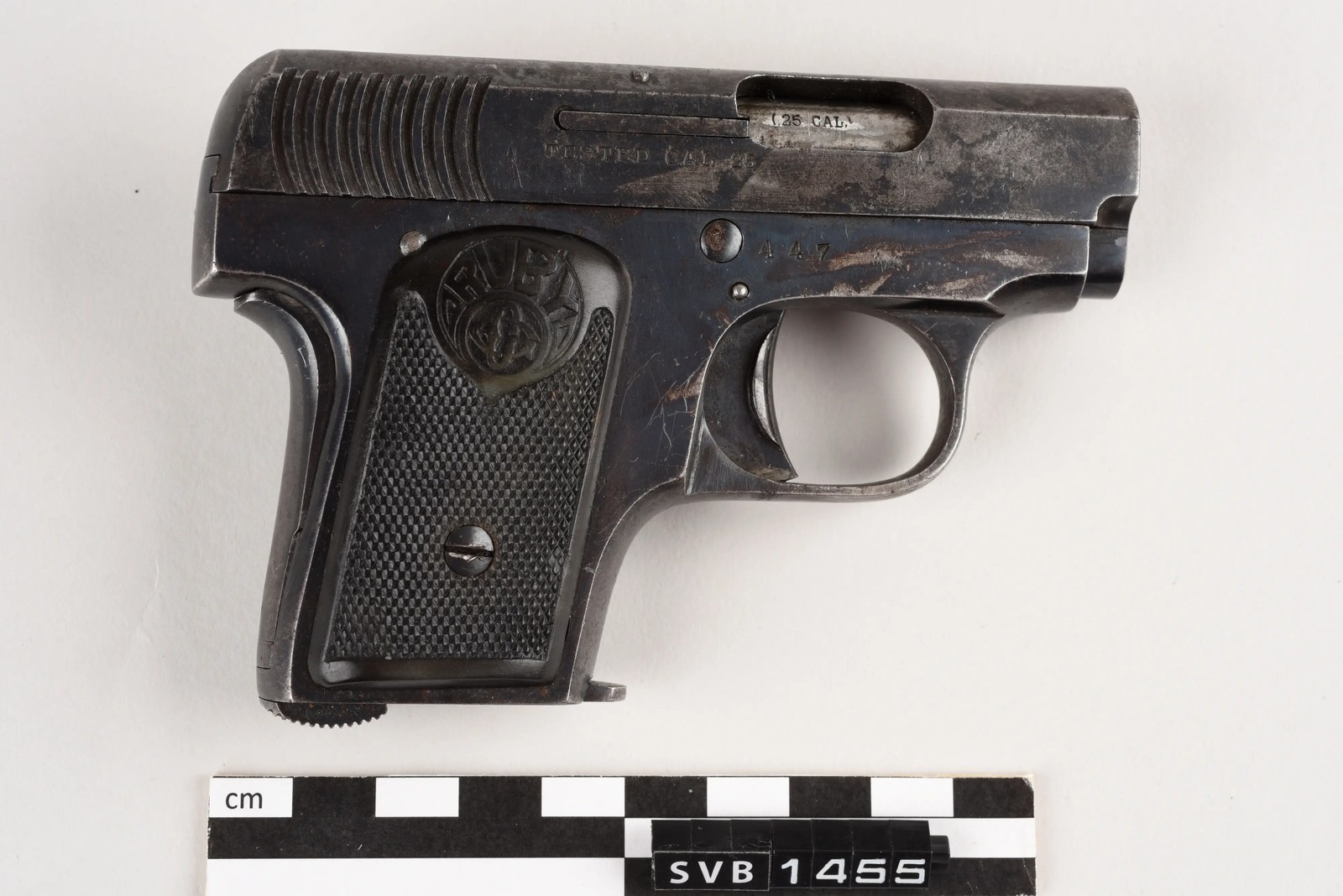
The cabin door stood open. Williams was at his desk in the heavy coat, with the coat unbuttoned and a drawer pulled out. From the drawer he took a small pistol in a brown leather holster with pale stitching, put it inside the coat on the left side, and did up the buttons over it. He shut the drawer and turned to the doorway.
“Well, Mr Clark?”
“The boats are alongside, sir.”
“Thank you.”
Clark kept his eyes on the captain’s face. Williams took his cap from the hook, put out the lamp and went past him to the ladder.
They went over the side in the order he gave. The radio officer, the second engineer, the boatswain with the gunner from the galley, Hardy. Fenn to his own boat. Clark went down into the motor boat and found a place on a bench between Pounder and Alexander. Williams came last, one rung at a time, and Colvin took him by the belt and sat him in the stern.
It was four o’clock.
“Shove off,” Williams said. “Oars only. We keep the motor.”
Colvin sat beside the motor with one hand flat on its cover.
“How long will she run, chief?”
“Not in hours, sir. I’d not burn a cupful of it sitting still.”
“Nor shall we.”
The oars took them out from the ship’s side, and at once the boat began to pitch. Williams switched on the torch. The beam went out ahead through the snow and showed black water, and then, at the end of its reach, a line of white that ran from one side of the dark to the other. He turned it to the left. The white went with it. He turned it to the right, and it was there too, further off, bending round behind them toward the ship. The sound of it came from every side at once.
“Hold her where she is.”
From the dark a voice came across the water. It was Fenn’s.
“Breakers on this side too, sir! All along!”
Williams kept the light moving a little longer, slowly, the way he had searched for the two men. He switched it off.
“We are inside a horseshoe,” he said. “There is a way out of it, since the sea comes in. I cannot find it with a torch. Back to the ship. All boats will lie alongside her until daybreak.”
They pulled back under her. Hardy stood up in the bow and got a rope round the foot of the ladder, and the other two boats came in behind and made fast to them, and the three lay in a string, rising and falling beside the plates. Each swell lifted them and laid them against her, and the men on that side fended off with the oars and their boots, and did it again at the next.
After that there was the cold. It rose through the bottom boards into the feet, and off the water into the face, and the men drew in against each other and sat still. Alexander had sweated through his clothes in the boiler room. The wet had gone cold on him now, and he shook without stopping, and Clark felt it through both their coats.
“They said there’d be heating in the boats,” somebody said, further forward. “At Iceland. They said London had seen to it.”
Nobody answered him. Clark had heard the mate on that subject in the chartroom at Hvalfjord, and he kept it to himself.
The snow stopped for a time and began again. Somebody was praying, or counting. Above them the ship stood black, without a light in her anywhere, and now and then she made a small noise in her plates as the swell worked her.
“Sir.” It was Pounder, very low. “How long is it now, to the grey?”
The boy had stood enough watches to know the answer. Clark gave it to him all the same.
“Nearer four hours than three. It will come in the south-east, the same as yesterday.”
“And then we’ll see the way out.”
“Then we shall see.”
The boy said no more. In the stern the captain sat with the torch on his knee and his face turned to the south-east. Clark had seen him wait like that for a star.
IV
The grey came so slowly that Clark could not have said when it began. He found that he could see the rope leading up to the ladder, and then the rivets in the plates beside him, and then the faces in the boat, one after another, each with frost in the eyebrows. Alexander had stopped shaking. He sat with his chin on his chest and his eyes open.
Williams was standing in the stern, steadying himself on Colvin’s shoulder, looking at the sea.
It was as he had said. The reef lay round them in a ring, a long curve of rock with the swell bursting white along the whole of it, and the ship sat at the centre of the curve with her bow down. But on the far side there was a place where no white showed. The swell went through it whole and came on toward them, grey and smooth.
“There,” Williams said. “Mr Fenn! Do you see it?”
“I see it, sir.”
“I shall go first. Follow close behind me, one boat at a time, and take short strokes.”
Hardy let go the rope. Clark watched it fall back against the ship’s side and hang there. They would find the way out and mark it, and when the swell went down there would be the ship to come back to.
The firemen pulled, Alexander with them, and Hardy stood in the bow and called to them over his shoulder, left, and left again, and now together. The sound of the reef came closer on both hands until a man had to shout to be heard through it. Then the boat lifted to a long swell that had nothing under it but deep water, and went down the back of it, and the noise was behind them.
The second boat came through, and the third.
“Rest your oars,” Williams said. He was looking back at the gap. “Hardy, get the mast up.”
Hardy had the mast half up when Whiteside got to his feet.
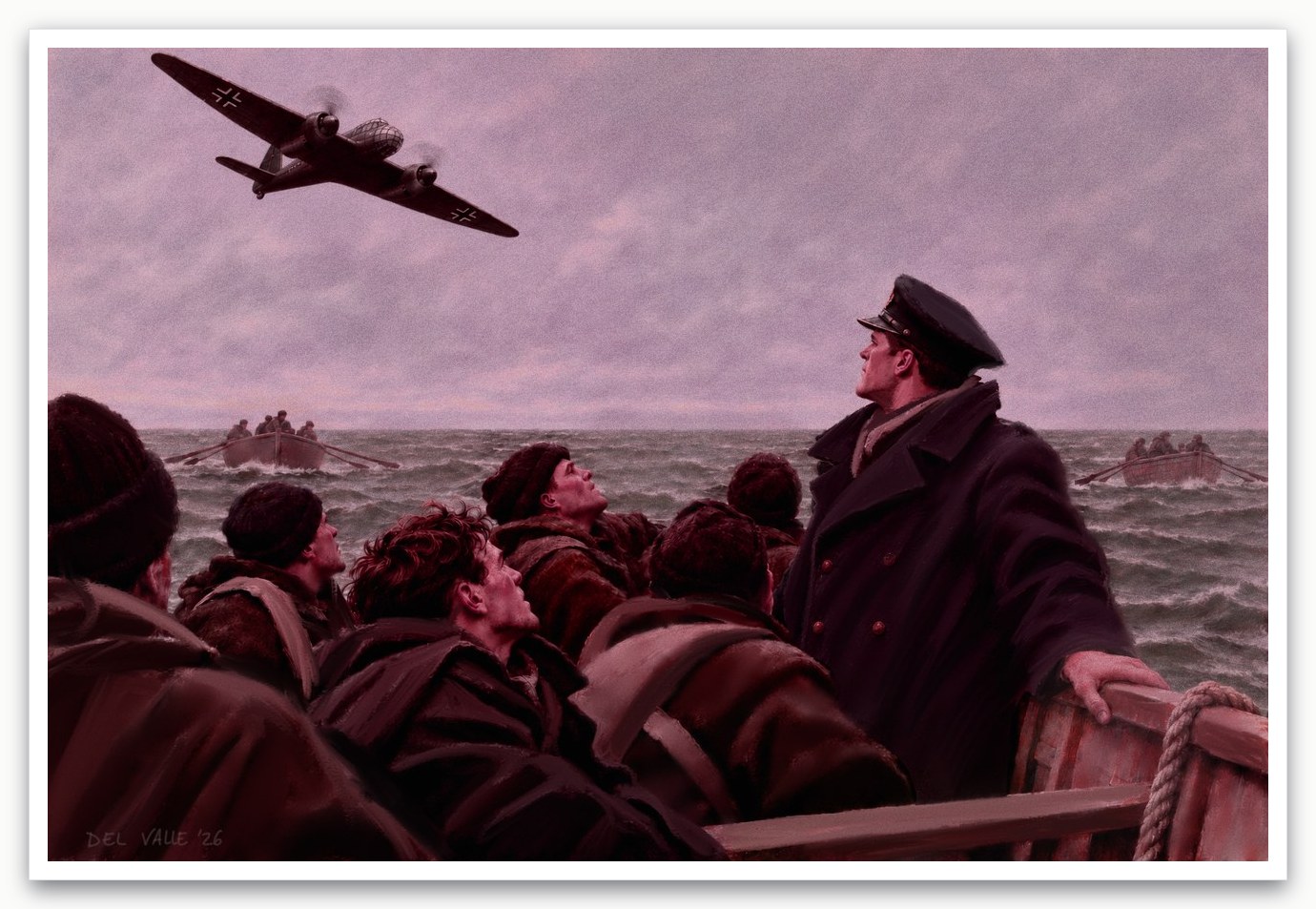
“Aircraft, sir.” He pointed with his whole arm, low, to the south. “Five. Junkers.”
They came up the coast under the cloud in a loose line, and the sound of them arrived after Clark had already counted. A man near him slid off the bench into the bottom of the boat and put his arms over his head. Another began to climb over him toward the side.
“Sit up,” Williams said. “Sit still, all of you. If they want us, they will have us sitting or lying.”
He went on standing himself. The man in the bottom of the boat got back onto the bench.
The first aircraft tilted over on one wing and began to go round them, and the other four followed it, one behind another, until the three boats lay in the middle of a wide ring of aircraft. They were low enough for Clark to see the black crosses, and the oil streaked back along the grey under each engine, and the glass at the front, and behind the glass a head turning, always toward the boats.
Nothing came from them but the noise. It went round with them. When they were ahead it was in front of him, and when they passed behind the boat it was on the back of his neck, and for that part of the ring he could only hear them. He kept his eyes on the captain then. Williams was turning slowly where he stood, following the first aircraft the whole way round, and Clark knew where it was by the way the captain was facing.
Each man had hold of something, the edge of the bench or the man beside him. One of the firemen leaned forward and was quietly sick between his boots, and sat up again. Somewhere forward a man had begun the Lord’s Prayer and got it wrong, and went back to the beginning. He was on his third start when another voice spoke, quite low.
“Get on with it, then. Get on with it.”
The man was looking up when he said it. The captain let him say it.
Pounder had made no sound at all. Clark looked at him because the boy’s shoulder was against his own and had begun to jump. His head was back like the rest, as he had been ordered, and he was wet from the eyes to the chin, and he did nothing about it.
Clark found that he was counting again, the aircraft this time, one to five and one to five, and that it was no help, for he lost the count each time the first one went behind him. He saw the boats as they must look from up there: three specks on the grey, with oars sticking out. A man could hardly miss them. He kept his face up, having been told to sit still.
They had been round once. The first one came out of its turn with its nose swinging across the boats, and for the length of a breath Clark looked straight into the glass at the front of it.
Then it had gone over their heads, and it was flying at the ship.
It went down until it was no higher than her masts, and something fell away from under it, and the sea beside her stood up in a white column taller than the funnel. The second followed it down, and the third. Most of what they dropped went into the water. Two did not. Clark saw the flashes on her, one close behind the other, and felt them a moment later through the wood he sat on. A thin black smoke came up from her and leaned over to the north.
The log was in her, open, with his own hand in it, and the sergeant’s name.
He went on looking.
The last of them turned over the wreck and came back along the line of boats, low, so low that the men ducked under the noise. As it passed, a hand lifted behind the glass and moved from side to side, twice.
Whiteside was on his feet before it had gone by. He had no gun to follow it with this time. He put up two fingers at it, knuckles outward, the oldest insult he had, and kept them there at the full stretch of his arm until the aircraft was a speck.
The sound went away to the south, and after a time there was only the swell again, and the smoke.
“Well, he’s waved us goodbye,” Hardy said.
Williams sat down. He looked at the ship for as long as a man takes to read a short letter, and turned his back on her.
“Now hear me. There is a settlement called Barentsburg, in Ice Fjord, up this coast. It is a hundred and fifty miles. We go north, and we keep the land in sight the whole way, and no boat loses the others.”
Nobody in the boat repeated the figure.
Williams felt inside his coat, and for a moment his hand stayed there. It came out with the torch. “Mr Clark, this is yours to keep dry. I may want both hands.”
“Yes, sir.”
Clark put it inside his own coat. It was as cold as the cap had looked on the water.
“The motor will not take us half that distance, sir,” Colvin said.
“Then we keep it for the day we need it. Get the sail on her.”
Hardy got the mast up and the sail on it. It filled on the wind from the south. On the right hand the land was coming out of the grey, white down to the edge of the sea, with no mark on it of any kind, and the three boats turned and followed it north. Before the wreck was out of sight, the smallest of them had begun to fall behind.
To be continuedPart three, “The motor”, on Saturday 28 November.
Illustrated by the author
Published