 Svalbard
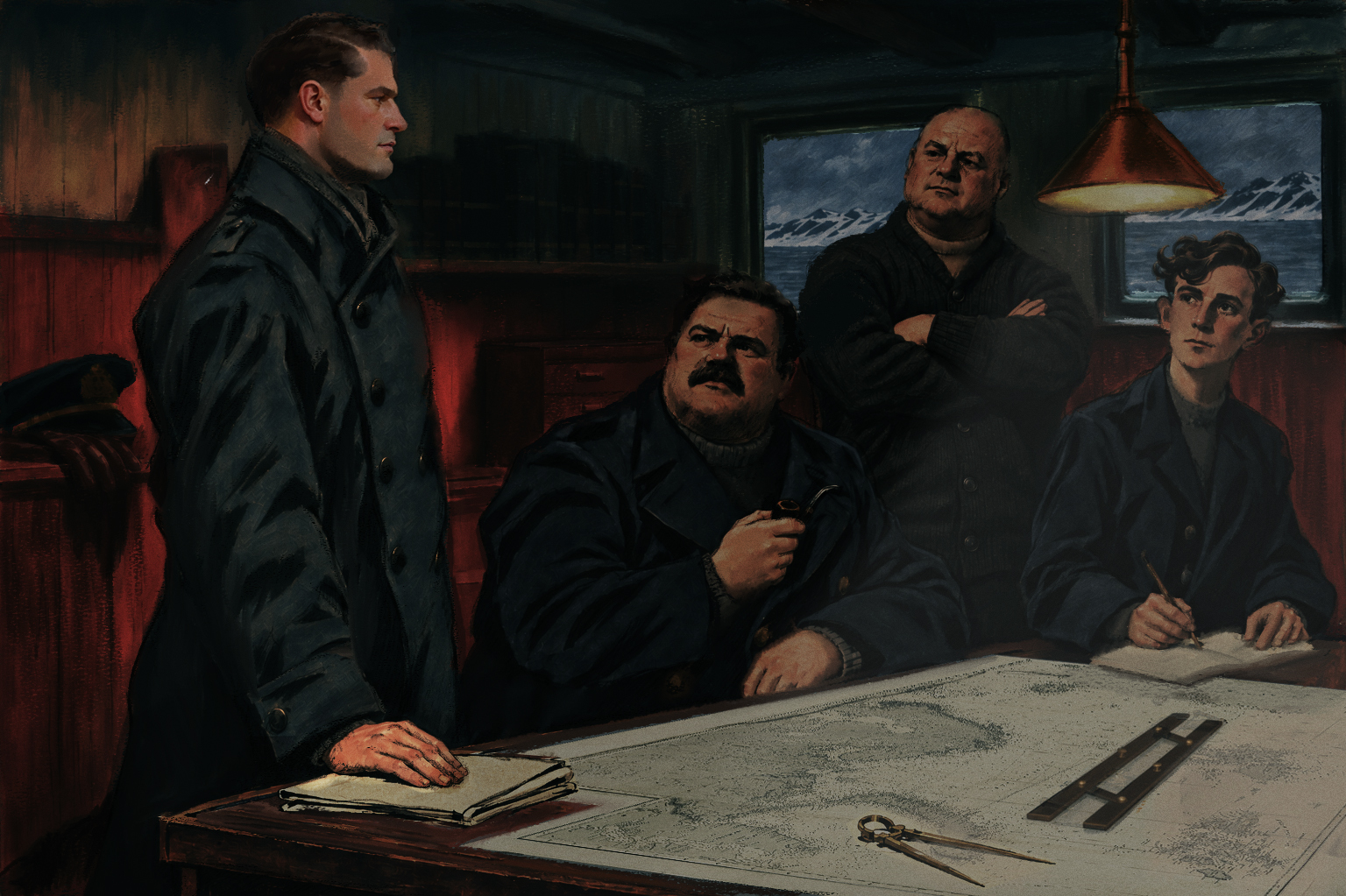

The motor boat bringing the captain back to the ship came down Hvalfjord a little after noon. From the top of the gangway, the third mate could see him sitting at the back of it with his cap on his knee, looking at nothing.
David Clark had been at the top of that gangway for two hours, in the wind off the bare Icelandic hills, because nobody else wanted it. He was twenty. When he looked down the ship’s side he could see the dents in her steel, toward the stern, where the ice of the Archangel River had squeezed her the winter before. All round her lay the anchorage, full of merchant ships, every one loaded as deep as she could float, all of them waiting for a convoy.
The Chulmleigh was a tramp steamer four years old. She had five thousand tons of government stores under her hatches and more guns bolted to her than she had been built to carry.
Captain Williams came up the ladder. Clark straightened and stood clear of the rail. Williams nodded to him without stopping. He was thirty-five. He had been mate of this ship from the day she left the builder’s yard, and her master for less than a year.
“Mr Clark.”
“Sir.”
“Find Mr Fenn, Mr Starkey and the chief. Chartroom. You come too. You’ll be keeping a watch on this, you had better hear it.”
On his way forward he stopped at the compass, as he always did, and looked into it the way a man looks at a clock he has caught out once before.
In the chartroom he did not sit. He put a folded sheet on the table and kept two fingers on it.
“There’s no convoy,” he said. “There won’t be one before January.”
Fenn, the mate, took his pipe out of his mouth. He was forty-five, ten years older than his captain. “Then we lie here.”
“No. We sail. One ship at a time, twelve hours apart. By the time the next one leaves, the one ahead is two hundred miles gone.”
“Alone.”
“Alone.”
“And the escort?”
“There is no escort. There are trawlers strung out along the track, and submarines on patrol north of Bear Island.”
“Trawlers,” Fenn said. “Fishing boats with a gun bolted on. How many?”
“Seven.”
“On how long a track?” It was Starkey who asked, the second mate, who kept the ship’s charts.
Williams opened the sheet and laid a pencil along the chart. North of Jan Mayen. East, to pass thirty miles south of Spitsbergen. Then down to the White Sea.
“Two thousand five hundred miles,” he said.
Nobody in the chartroom did the sum aloud. Clark followed the pencil and tried to picture the sea up there at noon in November. He could not give it any colour.
“And if a ship is hit?” Fenn said.
“London has thought of that. The men are to have Arctic clothing. The boats are to have heating.”
“I went round the boats this morning,” Fenn said. “Biscuit. Water. A compass. One of them has a motor. I didn’t find a stove.”
“No,” Williams said. “I don’t expect you did.”
The chief engineer was a man of forty-seven named Colvin, who spoke as though words were coal. “They’ll want speed,” he said.
“They want all she has. The ice is making in the Gourlo already.”
“She has ten knots. On a port boiler with a seam I watched them rivet in July.”
“Then I’ll have ten.”
Fenn was still looking at the chart. “What did the Navy say, sir? When they told you.”
Williams looked at him for a moment. “They said they were sorry.”
Nobody spoke. Williams folded the sheet along its creases and put it in his pocket.
“One thing more. Whoever has the watch, the first star he sees, he takes it. I want that compass checked.” He looked at Clark when he said it.
“That’s all, gentlemen. We sail today. Mr Clark, back to your gangway.”
Clark went down. One of the deck hands was at the gangway, a Shetlander named Hardy, smoking inside his hand.
“Is it true about the money, sir?” Hardy said. “A hundred pounds an officer, fifty a man. For going.”
“It’s true,” Clark said.
“Cash,” said Hardy. “Before we sail.”
“So I’m told.”
Hardy thought about that, looking at the end of his cigarette. “Nobody pays a man fifty pounds for an easy passage,” he said. “And nobody pays it first, unless he thinks there’ll be no one to pay after.”
Clark said nothing.
“Is it the owners paying it?” Hardy asked.
“Not ours,” Clark said. “A shipowner called Bilmeir has put it up, for any crew that goes.”
“What is it to him?”
“I don’t know,” Clark said.
Hardy pinched out his cigarette and put what was left of it in his pocket. They were still standing there when the order came to bring the gangway in.
The Chulmleigh raised her anchor that day, Saturday the thirty-first of October.
II
By the third of November the days were a few hours long and getting shorter, and what light there was came grey through cloud. Nobody aboard had seen the sun or a star since Iceland.
The ship was being steered on a pencil line. Each watch Starkey, the second mate, drew it a little further across the chart: so many hours, at such a speed, on such a course by the compass. By that line she had passed the island of Jan Mayen a little after midnight and turned for Spitsbergen. No one had seen the island. They had turned because the clock said it was time.
Clark had the watch that night, and with him the apprentice Pounder, who was sixteen and on his first voyage. Snow came and went. They were out on the open wing of the bridge when the cloud tore apart above the foremast, and in the gap there was a star. One star, low and steady.
“Take the time!” Clark shouted, and went up the ladder to the big compass on the roof of the wheelhouse. He pulled off a glove to work it, and the brass burned his fingers. He sighted the star across it and called down the direction. Pounder wrote it on his cuff with the time beside it.
In the chartroom Clark opened the tables. The pages were damp and would not come apart. The boy stood at his elbow.
“Will that tell us where we are, sir?”
“No. One star won’t do that.” Clark ran his finger down a column. “It tells you whether your compass is honest. The book says where that star has to be. The compass says where it is.”
“And is it? Honest?”
Clark did not answer. He worked the figures a second time.
“Call the captain,” he said.
Williams came up buttoning his coat. Starkey came behind him, because the charts were his. Williams read the figures through twice and passed the paper to the second mate.
“Eight degrees,” Starkey said. “In one day’s sailing that puts us thirty miles to one side of where I have us on the chart.”
“Since when?” Williams asked.
Nobody could tell him. It might have been eight degrees all the way from Iceland. It might have gone wrong that evening.
Starkey looked at his pencil line, three days long. “They all go soft up here, sir. The further north, the less a compass can be trusted.”
“I know what they do, Mr Starkey.”
Williams went out to the wing of the bridge and looked up. The gap had closed. There was only the cloud, and the snow starting again.
The radio officer came up the ladder with a message pad in his hand.
“Distress calls, sir,” he said. “A merchant ship, saying she is under attack. Then a second one, after.”
“How far off?” Williams asked.
“I can’t tell, sir. Not near.”
“Did they give their names?”
“None that I could read.”
Nobody on the bridge needed the names. Ships had left the fjord ahead of them, one every twelve hours, down this same road.
“Do we answer them, sir?” the radio officer asked.
“We do not. Nothing goes out from this ship.”
The radio officer went below. Starkey went back to his chart. Williams stayed out on the wing with his face turned up to the cloud.
“What is he looking for, sir?” Pounder said, very low. “Aircraft?”
“No,” Clark said. “Another star.”
III
The signal came at midnight, as Wednesday the fourth of November turned into Thursday the fifth. The radio officer brought it up to the bridge himself. It was from the Admiralty in London.
Williams read it under the chart lamp, with Fenn, the mate, on one side of him and Starkey, the second mate, on the other. Clark had just come off his watch. He stayed where he was, by the door.
“They want us further north,” Williams said. “North to seventy-seven degrees before we turn east. So that we go round the South Cape of Spitsbergen in the dark.”
“That’s sense, sir,” Fenn said. “They have lost ships today.”
Williams did not give the order. He laid the signal down on the chart, across the end of the pencil line.
“Where are we, Mr Starkey?”
Starkey put his finger on the place. “Here, sir. By the reckoning.”
“By a compass that was eight degrees wrong two nights ago and may be anything tonight,” Williams said. “If I am to turn north from here, I must know where here is. There is land up there.”
“It is an order, sir,” Fenn said. He said it quietly. He was ten years older than his captain.
“It is an order, Mr Fenn. I shall carry it out when I know where I am carrying it out from.” Williams took his cap off the hook. “Hold her as she goes. Call me the moment there is a break in the sky. One star will do.”
He did not wait to be called. He went out into the snow on the wing of the bridge, and the Chulmleigh held her old course against an order from London. Clark should have gone to his bunk. He put his coat back on and went out after him.
Williams did not turn round. “This is not your watch, Mr Clark.”
“No, sir.”
“You found the last star,” Williams said. “You may as well look for the next.”
Clark stayed.
There was nothing to do out there but wait. Williams stood at the forward corner with his hands behind him and his face turned up. The snow lay on his cap and his shoulders and he did not brush it off. After the first hour Clark could not feel his feet. After the second he stopped thinking about them.
Some time after three a part of the cloud went thin, high up on the right-hand side, and behind it there was a darker patch that might have been open sky. Williams had already taken a step toward the ladder to the compass. Then the snow came across it. It had been nothing, a hole in one layer of cloud with another layer behind.
Williams stood a little longer with one hand on the ladder. Then he went back to his corner. Neither of them said anything.
At four Fenn came up to take the watch. He looked at the compass, and at the captain through the glass, and said nothing.
No star came.
At five Williams came in off the wing.
“Bring her round to north, Mr Fenn,” he said. He did not look at anyone when he said it.
At eleven that morning Clark had the watch again. There was no sun now. This far north it would not rise again before the spring. But for a few hours in the middle of the day there was a grey half-light, enough to see by, and then the night again.
The cloud broke. It broke ahead of the ship and to the right, a long tear with pale sky behind it. For the space of a breath every man on the bridge looked into it for what the captain had been looking for since Jan Mayen.
What came out of it was an aircraft.
It was a flying boat with three engines, low and slow, and every gunner aboard knew the shape of it. German. Clark hit the alarm, and the bells rang through the ship. On the gun platform a small soldier named Whiteside, who stood four feet eleven, swung one of the light guns round to follow it.
It did not attack. It flew one slow circle round the ship, well out of reach, in no hurry. Then it climbed back into the cloud, and the cloud closed behind it. On the gun platform somebody laughed.
“He has counted our guns,” Fenn said.
“He has done more than that,” Williams said. “He has told the Germans where we are. Which is more than I could tell them.”
At noon Starkey came out of the chartroom.
“Seventy-seven degrees, sir,” he said. “By the reckoning.”
That was the place where London had told them to turn. Whether the ship herself was there, nobody on the bridge could say.
“Then that is where we are,” Williams said. “Bring her round to south-east. We run down past the cape.”
By the middle of the afternoon it was full night and snowing hard. The wind went round to the south and began to rise. Under the ship there was a long slow lift that had not been there in the morning.
“Swell,” Fenn said. “There is weather coming behind that.”
Williams did not answer him. He was out on the wing of the bridge again, on the left-hand side. This time Clark could see that he was not looking up. He was looking out into the dark, to the north, where the land was.
IV
A little before eleven that night Captain Williams stood over the chart for a long time. Clark had the watch, the last hour of it, and he had learned in five days that when the captain stood like that the watch was no longer his. Fenn was up too, though it was not his time.
“By this line the South Cape is behind us, Mr Fenn,” Williams said at last. “Thirty miles off, and behind us.”
“Aye, sir,” Fenn said.
Clark looked at the line too. He had put part of it there himself, watch after watch, from the only things they had to give it: the course steered, the speed, the hours run. He marked the eleven o’clock position on it with a small neat cross and wrote the time beside it. On the paper there was a thumb’s width of clean white between the cross and the land.
Williams looked at the chart a little longer, as if it might still say something else. He straightened up.
“Then we have our room. Bring her round to east.”
“Round to east, sir,” said Hardy at the wheel. He turned it and the compass swung under its small lamp until it showed east, and he held her there. “Steady on east, sir.”
Clark wrote the time and the new course in the log. East was the White Sea, and the way out. Since the night of the star he had wanted the captain to be sure of something. Behind him the captain sat down on the stool by the chart table. It was the first time Clark had seen him sit since Iceland. Fenn took out his pipe and filled it, taking his time over it, and Hardy eased his shoulders at the wheel. If the captain could sit, the cape was behind them.
He went out on the wing to look, because looking was what a watch was for. There was nothing to look at. The snow was so thick that the lookout, a yard from him, could not see the front of his own ship. The lookout was a seaman named Nicolson. The cold got in at Clark’s cuffs and his collar and stayed there.
She was making seven knots. He could not see the sea, only feel it. There was a swell running, long low hills of water that came up under her from the right without breaking, lifted her, set her down and went on into the dark. He had the rhythm of it in his legs by now. Up, and down, and the wait.
At half past eleven she did not come down.
She hit something. It came up through the deck into his knees first, a blow from underneath. Then the noise came, a long tearing groan of steel, the whole length of her, and it went on and on. The ship climbed in the middle and stopped. Clark did not stop. The rail caught him under the ribs. Snow and ice came down off the rigging onto the wing in lumps. Behind him in the wheelhouse everything loose went on travelling too, the pencils, the mate’s mug, and he heard all of it arrive.
Torpedo. He held on to the rail and waited for the bang and the fire, the way he had waited for them every night since they sailed. Neither came. The engine was still turning and the ship was not moving, and he had no name for that.
My watch, he thought then. It is still my watch.
“Stop engine!” Williams had the handle of the engine-room signal over before the words were out.
Nobody moved. Clark got himself in through the door. The next swell arrived and broke against her side, like a wave against a pier.
“That’s not ice,” Fenn said.
“No,” Williams said.
“By the chart we’re thirty miles clear of the land.”
“By the chart,” Williams said.
Clark looked at the chart table. The line was still there, good and straight, with his small neat cross at the end of it and the thumb’s width of white beyond.
“Full astern.” Williams rang it down himself. Below, the engine started again, turning the other way, to drag her backwards off whatever she was sitting on. The whole ship shook with it. She did not move.
Nicolson came in from the wing.
“White water all round us, sir,” he said. “Ahead, and both sides.”
“Mr Clark.”
“Sir.”
“The time, in the log. And get me the carpenter.”
Clark wrote it. 2330. Struck. He looked at the word.
The crew slept at the stern, and the stern was now the highest part of the ship. They were coming already. He heard boots on the bridge ladder, and then there were faces in the wheelhouse door, men half dressed, each with a hand on something, braced against the slope of the deck. The two apprentices were with them, Pounder and Marritt, both sixteen. Clark sent Pounder for the carpenter.
For half an hour the engine pulled. There was nothing for the officer of the watch to do, and Clark did it standing beside Hardy, who was still at the wheel. Nobody had told him to leave it. It turned loosely now and moved nothing. The compass in front of the two of them still said east. It had not shifted by a hair.
Owens, the carpenter, came up from below wet to the thighs. He was fifty-six.
“She’s open at the front, sir,” Owens said. “The two front holds are filling. The deck up there is as near under as makes no difference.”
“And the stern?” Williams asked.
“Dry, sir. It’s out of the sea. She’s sitting on the rock by her middle.”
Williams looked at Fenn. “Held by the middle with both ends hanging,” he said. “If this swell gets up she’ll break her back.”
From somewhere under their feet came a sound none of them had heard a ship make, one deep crack, and nothing after it. Clark felt it in his teeth. The bow went down a little further and stayed there.
Williams rang the engine to stop. He did not say anything. In the quiet they could hear the swell breaking all round them.
He wrote two lines on the message pad and held it out to the radio officer.
“Send that. Keep sending it.”
AGROUND OFF SOUTH CAPE, SPITSBERGEN. TAKING IN MUCH WATER.
It was the first word the ship had sent to anyone since she sailed. Clark looked at the clock. It was past midnight. His watch had ended some time ago, and nobody had thought to say so.
Fifty-eight men, and four boats.
To be continuedPart two, “The boats”, on Saturday 21 November.
Illustrated by the author