Ukraine deposits seeds in Svalbard vault for first time since war
Svalbard WirePublished 14 OctoberThe Government's announcement in full, reported in the third person.
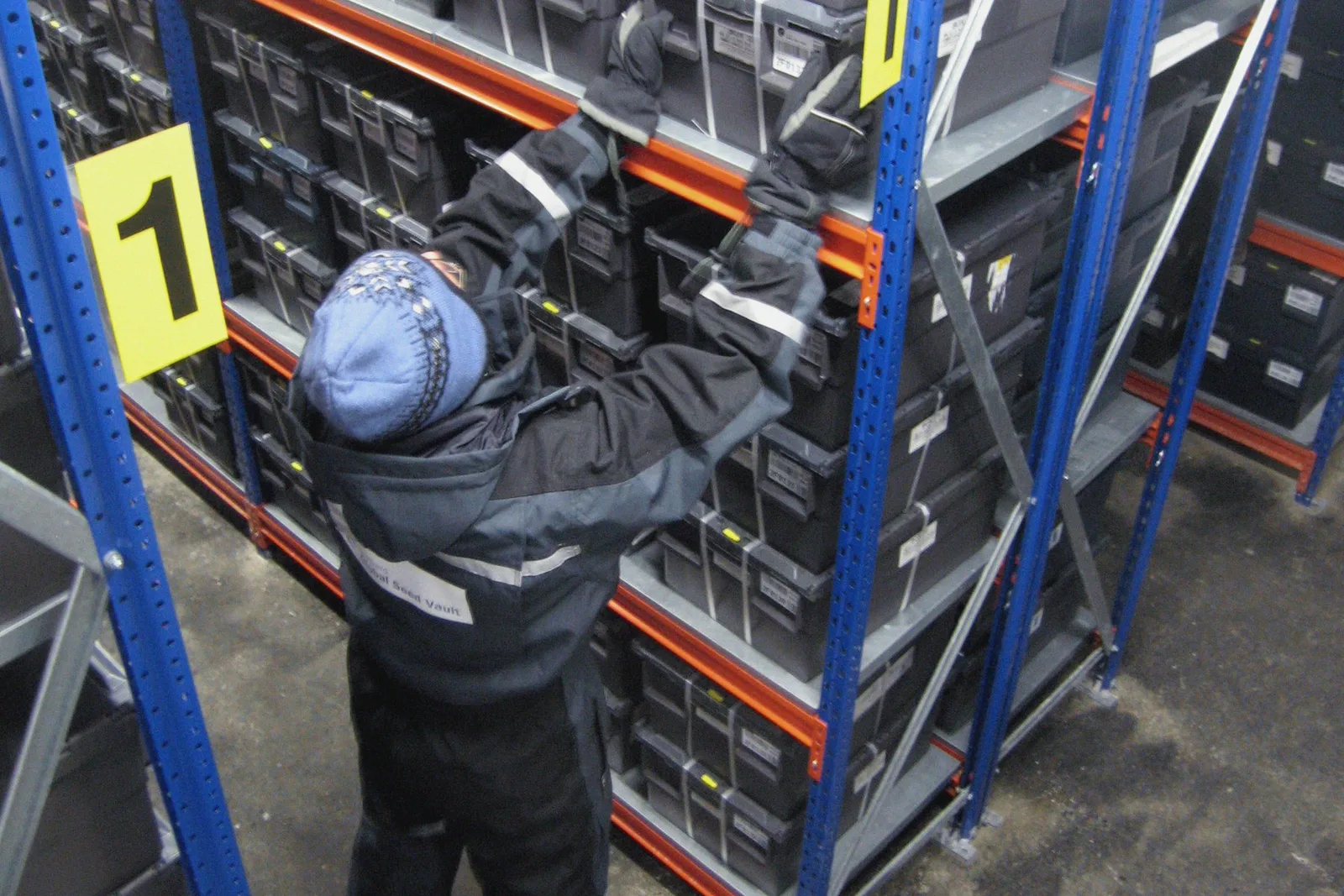
Shelves with boxes of seed samples inside the Svalbard Global Seed Vault. File picture, February 2008. Photo: Dag Endresen, public domain, Wikimedia Commons.
Thousands of seed samples of important agricultural crops were recently secured in Svalbard as 21 genebanks from across the world participated in a seed deposit.
Ukraine is a major agricultural nation and is often referred to as the breadbasket of Europe. The country also maintains a highly significant and extensive genebank collection which, according to FAO, contains more than 150,000 seed samples. Following Russia's full-scale invasion of Ukraine in 2022, the national genebank in Kharkiv faced a critical situation as bombing damaged buildings and infrastructure. In cooperation with FAO and the Crop Trust, and with financial support from the Novo Nordisk Foundation, NordGen took part in an emergency effort during the spring of that year to support the Ukrainian genebank. At a later stage, the collection was also relocated to a site in western Ukraine, far from the front line.
"When Norway established the Svalbard Global Seed Vault, the vision was to create a secure safeguard for the world's crop diversity and a shared resource for humanity. Today's deposit demonstrates that this vision is more relevant than ever. Countries and institutions continue to come together to protect the genetic resources that future generations will depend on for food security and resilience. We are proud to partner with the Crop Trust and NordGen in this unique global effort," said Nils Kristen Sandtrøen, Norway's Minister of Agriculture and Food.
In addition to Ukraine, 20 other genebanks from four continents sent a combined total of more than 16,000 seed samples to the Seed Vault. The boxes contained seed samples sent from countries in Asia, South America, Europe and Africa.
The Svalbard Global Seed Vault functions as a safety deposit box where the world's genebanks can store backup copies of their unique seed collections free of charge. These collections are vital for safeguarding future global food security. Today, the Seed Vault holds more than 1.4 million seed samples belonging to over 130 genebanks. This makes the Svalbard Global Seed Vault the world's largest secure repository for the diversity of cultivated crops.
The vault outside Longyearbyen keeps 1.4 million seed samples from 135 genebanks in 84 countries and the international centres.
Each square is one genebank. Its area is the number of seed samples it keeps in the vault; the smallest are drawn at the smallest size that can be seen.
The vault has opened for deposits on 73 days since 26 February 2008; the largest day, 26 February 2008, brought 237,106 samples, and the latest, 13 October 2026, 16,514.
Each mark is one day the vault opened; its area is the samples that came in. The smallest days are drawn at the smallest size that can be seen. An outlined mark is a day the portal lists with no samples under it.
Government of Norway, Government, 14 October 2026, 13:09. Ukraine safeguards seeds at Svalbard Global Seed Vault for the first time since the outbreak of the war. https://www.regjeringen.no/en/whats-new/ukraina-lagrar-fro-i-svalbard-globale-frokvelv-for-forste-gong-sidan-krigsutbrotet/id3177597/?utm_source=regjeringen.no&utm_medium=rss
 Svalbard