Svalbard WireSpecial · Wednesday 28 October 2026
A Svalbard Wire special

Russia on Svalbard

In 1985 the Soviet towns of Barentsburg and Pyramiden had 2,228 residents. In the latest count, 419. The towns have shrunk. Have Moscow's ambitions shrunk with them? A new book argues they have not: Russia's plans for Svalbard, it says, now have more money, political backing and momentum behind them than before. This is the record in maps and numbers.

Scroll to fly in. Drag the globe to turn it. Skip the map

Svalbard lies between mainland Norway and the North Pole. Longyearbyen is from Tromsø and from the Pole.

Straight-line distances, computed from the places' coordinates.

Russia is close too. Barentsburg is from Murmansk and from Moscow.

Norway has held sovereignty over the archipelago since the Svalbard Treaty came into force in 1925. The same treaty gives the citizens of every state that has joined it "equal liberty of access and entry", and the right to carry on mining and business "on a footing of absolute equality".

Svalbard Treaty, Paris, 9 February 1920, Articles 1 and 3.
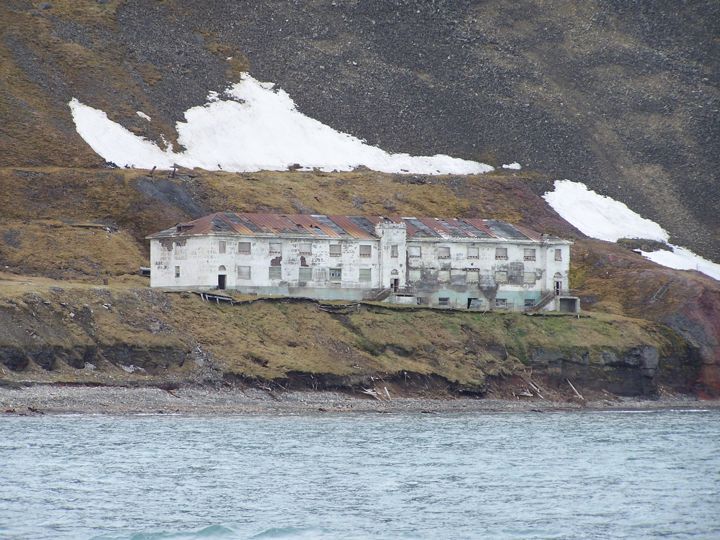
The white ruin of a large building on a green slope above the fjord at Grumantbyen.
Grumantbyen, abandoned since 1961, in 2008. Photo: Elgaard, CC BY-SA 3.0, via Wikimedia Commons

Two states run towns on one fjord. Longyearbyen is Norwegian. Barentsburg, to the west, belongs to Trust Arktikugol, the Russian state's coal company. Pyramiden stopped mining in 1998 and now lives on tourism. Grumant was abandoned in 1961.

Closures: Store norske leksikon (Norway's national encyclopaedia), "Trust Arktikugol".

Each dot is ten residents in Statistics Norway's latest count, for the second half of 2026. people lived in Longyearbyen and Ny-Ålesund, in Barentsburg and Pyramiden.

Statistics Norway, table 07430. The Russian settlement figure comes from Trust Arktikugol's report to the Governor of Svalbard.
1 · People

The Soviet towns were once the bigger half of Svalbard

The Russian presence on Svalbard is a coal story. Trust Arktikugol was set up in 1931 and began mining in Barentsburg the year after. In 1985 the Soviet settlements held about twice as many people as the Norwegian ones.

Residents of the Russian and the Norwegian settlements

Barentsburg and PyramidenLongyearbyen and Ny-Ålesund, registered on the mainlandfrom abroad (counted from 2009)estimate
Line chart. The Russian settlements had about 1,230 residents in 1937 (estimate), about 2,900 in 1958 (estimate), 2,228 in 1985 and 2,407 in 1990, then fell to 419 by July 2026. The Norwegian settlements grew from 1,129 in 1985 to 2,504 in 2026.

In 1937 about 1,230 Soviet citizens lived on Svalbard, by figures a Russian historian published. By 1958 there were about 2,900.

Portsel (2019), cited in Middleton, Polar Record (2023). Not official counts.

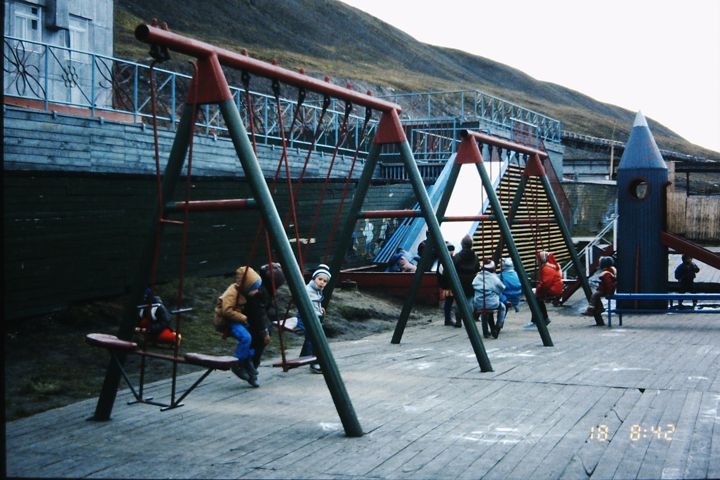
Children on swings in a wooden playground in Barentsburg, with a rocket-shaped slide.
Barentsburg's kindergarten, summer 1989. Photo: Lorenz.King at geogr.uni-giessen.de, CC BY-SA 4.0, via Wikimedia Commons

The first official count by town is from 1985: 1,220 in Barentsburg and 1,008 in Pyramiden, against 1,118 in Longyearbyen and 11 in Ny-Ålesund.

St.meld. nr. 9 (1999–2000), the government's white paper on Svalbard.

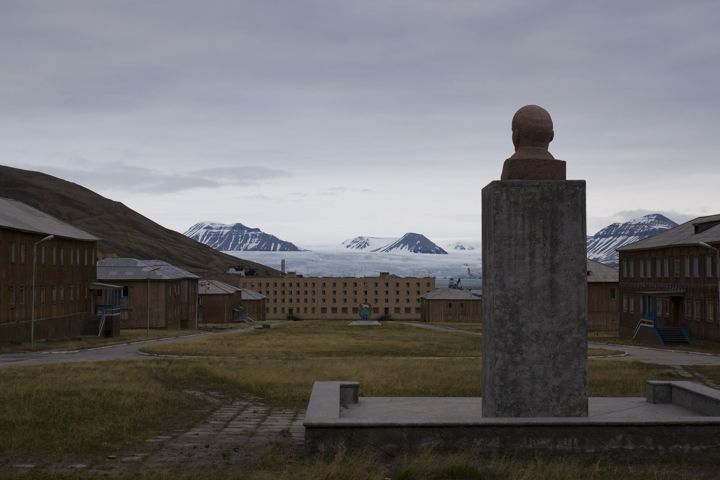
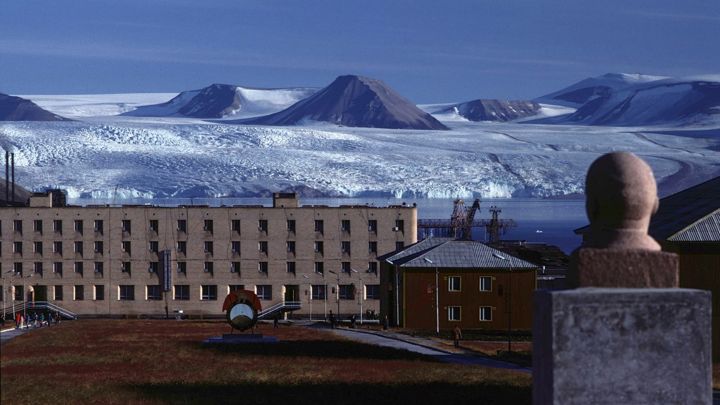
Pyramiden in 1990: the Lenin bust, apartment blocks and the Nordenskiöld glacier behind.1990
The same square in Pyramiden in 2011: the Lenin bust, empty grass, the glacier behind.2011
Pyramiden's Lenin bust in 1990, while the mine still worked, and in 2011. Not the same viewpoint: two photographers, 21 years apart. Photo: Mozzihh, CC BY-SA 4.0, via Wikimedia Commons; Photo: Hylgeriak / Wikipedia, CC BY-SA 3.0, via Wikimedia Commons

Then the Soviet Union fell. In 1998 mining stopped in Pyramiden and the town emptied. That year the Norwegian towns overtook the Russian ones for the first time in these figures.

From 2009 Statistics Norway also counts Longyearbyen residents who came from abroad. Today they are of the .

Since 2022 the Russian settlements have swung between and residents. In the latest count there were .

Statistics Norway, table 07430, half-yearly.

"Russian" settlements is shorthand. On 1 September 2024 Barentsburg's management counted 340 residents by citizenship.

Barentsburg's residents by citizenship, 1 September 2024

Each square is one resident.

Figures given by the company's management, recorded in Store norske leksikon, "Barentsburg" (updated 28 September 2026).
2 · Coal

Norway mined its last coal on Svalbard in 2025

Coal built both towns. Store Norske, the Norwegian state's company, closed its last mine, Gruve 7 outside Longyearbyen, on 30 June 2025. Its big Svea mines had closed by 2020. Trust Arktikugol mines on in Barentsburg on a far smaller scale than Norway did at its peak.

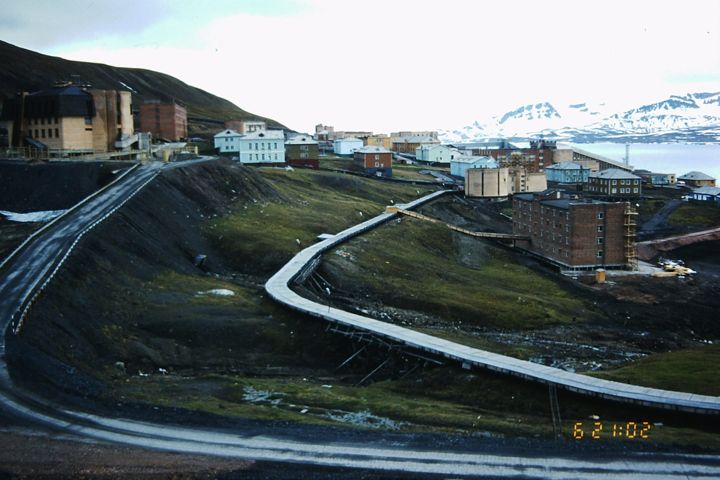
A coal conveyor winds down a dark hillside towards the apartment blocks of Barentsburg.
Barentsburg, August 1989: the coal conveyor. Photo: Lorenz.King.at.geogr.uni-giessen.de, CC BY-SA 4.0, via Wikimedia Commons
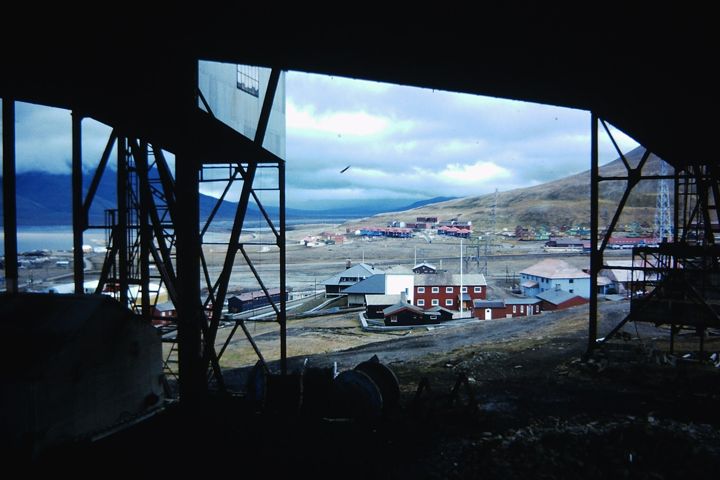
Longyearbyen's red and white houses seen through the dark frame of a coal installation.
Longyearbyen, August 1989, seen from a coal installation. Photo: Matti&Keti, CC BY-SA 4.0, via Wikimedia Commons

Coal shipped from Svalbard, tonnes a year

Each bar is one year's shipments. Same scale on both rows.

Bar charts, 1991 to 2019. Norwegian mines shipped between about 77,000 and 3.6 million tonnes a year, peaking in 2007. Russian mines shipped between nothing (2009 and 2010) and about 486,000 tonnes.
Source: Statistics Norway, Svalbard statistics, coal shipped 1991–2019. Closures: Store norske leksikon; Statistics Norway, 30 September 2026. Store norske leksikon (12 November 2025) records Trust Arktikugol in Barentsburg as the only coal miner still operating. Russian sources differ on its output today: about 80,000 tonnes a year (ambassador Korchunov, Izvestia, March 2026) or 120,000 (TASS, November 2025).
3 · The treaty

Who has signed up to the Svalbard Treaty, and when

The treaty gives Norway sovereignty and gives every state that joins it equal access to Svalbard's economic life. Nine states signed it in Paris in 1920. Most others joined in the 1920s. The Soviet Union joined in 1935. Since then the newcomers have been few: Ireland in 1976, Iceland in 1994, the Czech Republic in 2006, South Korea and Lithuania in 2012, North Korea and Latvia in 2016, Slovakia in 2017, Serbia in 2022, Türkiye in 2024 and the United Arab Emirates in 2026.

States party to the Svalbard Treaty, by year they joined

One dot per state, placed at the year it ratified or acceded. Hover or tap a dot for the name.

full BRICS memberBRICS status disputedother statesNorway
Dot plot from 1920 to 2026. Most states joined between 1923 and 1931. Recent joiners: South Korea and Lithuania 2012, North Korea and Latvia 2016, Slovakia 2017, Serbia 2022, Türkiye 2024, United Arab Emirates 2026.
Dates: Lovdata (deposit of ratification for the 1920 signatories), the Dutch government treaty database, and Austria's federal law gazette, BGBl. III 125/2024, for Serbia. BRICS membership as reported by Business Today and ANI from the 2025 Rio declaration; Arab News (13 September 2026) reports that Saudi Arabia has not formally accepted.

Why join now? The Emirates gave its own reason. Its accession is "enabling our scientists to contribute directly to global research initiatives at stations such as Ny-Ålesund," the assistant foreign minister Abdulla Balalaa told the Emirates News Agency, The Barents Observer reported.

Russia sees a wider circle. Dmitri Negrutsa of Arktikugol told The Barents Observer in October 2023 that a planned science centre in Pyramiden would be a base for cooperation between Russia and friendly countries.

4 · The book

One reading: Norway under pressure

Per Arne Totland, a former newspaper and Norwegian Broadcasting reporter, presented "Russerne på Svalbard. Norge under Putins press" (The Russians on Svalbard: Norway under Putin's pressure) at Svalbard Museum on 27 October.

Cappelen Damm, 2026. His earlier Svalbard book is "Kaldfront" (Cold front), 2016. The Wire's report of the talk.

Totland reads a Russian strategy for Svalbard in Russia's Arctic strategy, the work of its government commission on Svalbard and its maritime doctrine. In his reading it means pressure on Norway just below the threshold of war, a stronger presence in Barentsburg and Pyramiden, money from Russian oligarchs and BRICS state funds, and a turn from keeping China at a distance to inviting "friendly" states in.

Russia's ambassador in Oslo, Nikolai Korchunov, told Izvestia on 1 March 2026 that Oslo is trying to push Russia out of the archipelago, and that Russia seeks its presence on equal terms with Norway and the other treaty states.

Research is where Totland expects the next conflict. Article 5 of the treaty foresaw a later agreement on scientific work. None was ever made, he said. Norway applies its own rules; Russia holds that the treaty's equal treatment covers science too. He names three points.

Three points of dispute over research

Norway's position in its own words, from the white paper Meld. St. 26 (2023–2024). Russia's plans as Totland describes them, and Russia's own statements where they exist.

Norway
The point
Russia
No new stations outside planning areasWhite paper, chapter 5
Norway's words
Research "shall primarily be conducted from established local communities and research stations"; permits for new research stations "outside the planning areas" cannot be expected.
Wherea new centre
A science centre in PyramidenTotland; Arktikugol
Russia's position
The planned centre would be a base for cooperation between Russia and friendly countries, Dmitri Negrutsa of Arktikugol told The Barents Observer, 30 October 2023.
Natural sciences firstWhite paper, chapter 5
Norway's words
The strategies give "clearer prioritisation of the natural sciences".
Whatwhich sciences
History, politics, archaeology tooTotland
Russia's position
Ambassador Nikolai Korchunov told Izvestia on 1 March 2026 that Norway's permit procedure for scientific work restricts Russian activity.
UNIS alone teachesWhite paper, chapter 5
Norway's words
"UNIS shall be the sole provider of higher education in Svalbard." UNIS is the University Centre in Svalbard, in Longyearbyen.
Who teachesuniversity level
University teaching in the new centreTotland
Totland's three points are from his talk at Svalbard Museum, 27 October 2026, as the Wire reported it. The white paper does not name Pyramiden.
5 · The harbour

Barentsburg's harbour trade, and the ship that cannot leave

Totland links a business in Barentsburg to sanctions. Since Norway closed most of its ports to Russian fishing vessels, he said, they go to Barentsburg for supplies and repairs.

Since October 2022, Russian fishing vessels over 500 gross tonnage may call at only three Norwegian ports: Tromsø, Båtsfjord and Kirkenes.

Norwegian government, October 2022.

Barentsburg's port earned more than 70 million roubles in 2024 from serving and supplying Russian fishing vessels, Arktikugol's director Ildar Neverov told the Murmansk edition of Komsomolskaya Pravda.

The Barents Observer, June 2025.

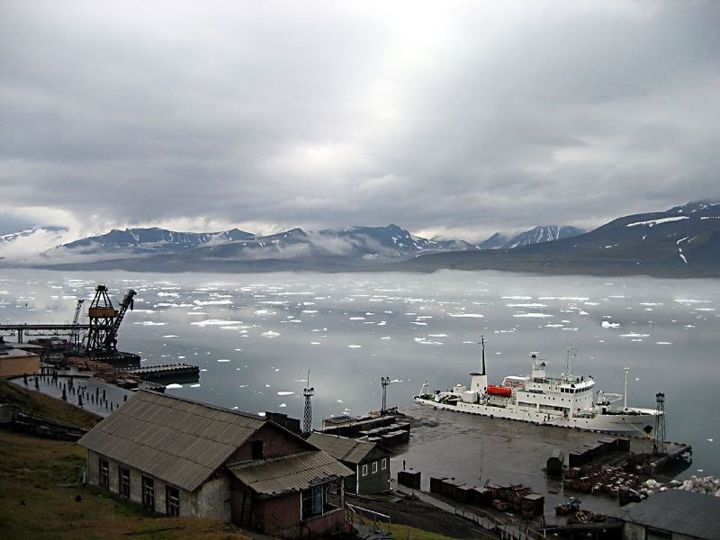
A white ship moored at the Barentsburg quay, with drift ice on the fjord and mountains behind.
The Professor Molchanov at the Barentsburg quay, July 2004. Photo: Alastair Rae, CC BY-SA 2.0, via Wikimedia Commons

The Professor Molchanov, the Russian state ship that links Murmansk and Barentsburg, has been held at Barentsburg since 2 September under a court order won by Ukraine's Naftogaz.

Arktikugol says the arrest hurts Barentsburg and Pyramiden. Naftogaz says the ship is in commercial use. Russia's embassy called it a politically motivated violation of international law. On 28 October the district court rejected Arktikugol's request to lift the arrest.

Sysselmesteren (the Governor of Svalbard); TASS, 3 September; NRK, 28 October; the Wire's reports.

In depth: Why the Professor Molchanov remains held in Barentsburg →

Russia's government commission on Svalbard has set a target of 50,000 tourists a year in its settlements by 2040.

The company's own past counts for Barentsburg: about 27,000 visitors in 2016, and 37,000 in 2019 with cruise passengers included.

TASS, 17 November 2025; Arktikugol's heads to The Barents Observer (2017) and High North News (2020).

6 · Plans

"Taken with a pinch of salt"

Russian plans for Svalbard must be "taken with a pinch of salt" (translated), Totland said. He said similar plans were announced as early as 1998, when Pyramiden was emptied. What has changed, in his account, is the money, the political backing and the momentum. How it ends is not yet known, he said.

Pyramiden's second life

Mining stopped in Pyramiden in 1998, but the town did not stay empty. Its hotel reopened for overnight guests in March 2013 and is now open from March to October. The abandoned town has become a major tourist attraction, visited by several tour operators, Store norske leksikon records. Trust Arktikugol has upgraded the place for tourism, the Norwegian government notes in its white paper.

It is also where Russia wants its new science centre. In December 2023 Arktikugol's director Ildar Neverov described it to TASS as an international scientific and educational centre for the BRICS countries and the Shanghai Cooperation Organisation.

Symbols have followed. In 2023 a seven-metre Russian Orthodox cross went up above the town without a permit from Sysselmesteren. It had to be removed, but permission was given to put it up elsewhere in the town. In 2024 a large Soviet flag was raised on top of the mountain Pyramiden. The Russian authorities in Barentsburg said it marked the Russian history tied to Pyramiden, Store norske leksikon records.

Russia's draft budget for Svalbard halves after 2025

Federal money for Russian organisations on the archipelago, million roubles a year, as drafted in September 2024.

TASS, 30 September 2024: the budget line for the financing of Russian organisations on the Spitsbergen archipelago, all of them, not Arktikugol alone. High North News reported that the money was likely to go to Arktikugol and its subsidiary Grumant. Draft figures; the final budget may differ. On their own they do not show rising state spending: the money falls after 2025.
7 · Where it stands

Russia on Svalbard, October 2026

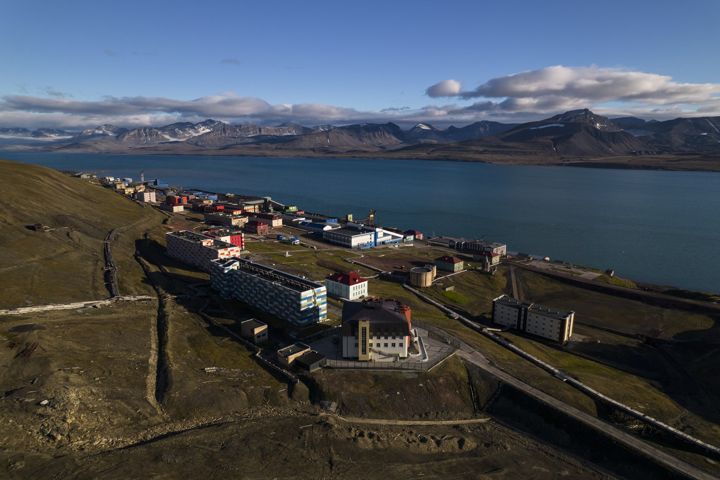
Barentsburg from above: apartment blocks on a slope beside Grønfjorden, mountains across the water.
Barentsburg, July 2022. Photo: Dmitrii Rusanov, CC BY-SA 4.0, via Wikimedia Commons

From the Wire's topic page, checked 27 October 2026.

Every Wire report on Russia on Svalbard

How this was made

  1. Population: Statistics Norway table 07430 (half-yearly, 1990 to 2026), Barentsburg and Pyramiden as reported by Trust Arktikugol to the Governor of Svalbard. 1985: St.meld. nr. 9 (1999–2000). 1937 and 1958: figures from Portsel (2019), cited in Middleton, Polar Record (2023), not official counts, drawn hollow. Before 2009 the Norwegian figure counts only residents registered on the mainland.
  2. Coal: Statistics Norway, Svalbard statistics, coal shipped from Norwegian and Russian mines, 1991 to 2019. Closures: Store norske leksikon and Statistics Norway.
  3. Treaty: deposit dates for the 1920 signatories from Lovdata; other dates from the Dutch government's treaty database; Serbia from Austria's federal law gazette (BGBl. III 125/2024). The Barents Observer reported the UAE's accession on 7 April 2026. Successor states (Czech Republic, Slovakia, Serbia, Russia) are placed at their own dates; the Russian Federation at the Soviet Union's 1935 date.
  4. Maps: coastline and glaciers from the Norwegian Polar Institute, S100 and S250 map data (CC BY 4.0), simplified; the world from Natural Earth. Distances are great-circle distances between town coordinates.
  5. Totland's arguments are his, as he gave them at Svalbard Museum on 27 October 2026. Russia's and Norway's positions are in their own documents and statements, named where they appear.

Map data © Norwegian Polar Institute (CC BY 4.0). Corrections: editor@svalbardwire.com.