Svalbard's polar bears: fifty years of the treaty
Signed in Oslo in November 1973, in force since 26 May 1976: how the hunt ended on Svalbard, and what the bears face now.
Polar bears hunt from the sea ice. Around Svalbard their main prey is the ringed seal. In autumn pregnant females cross the ice to the islands where they den, and when the ice comes late they make few dens.
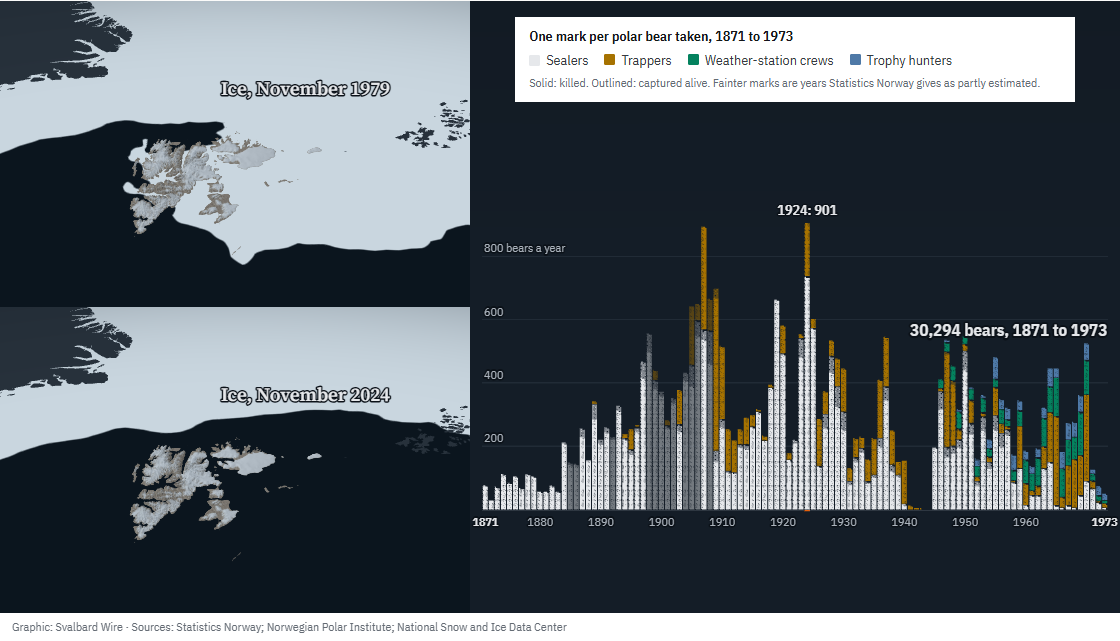
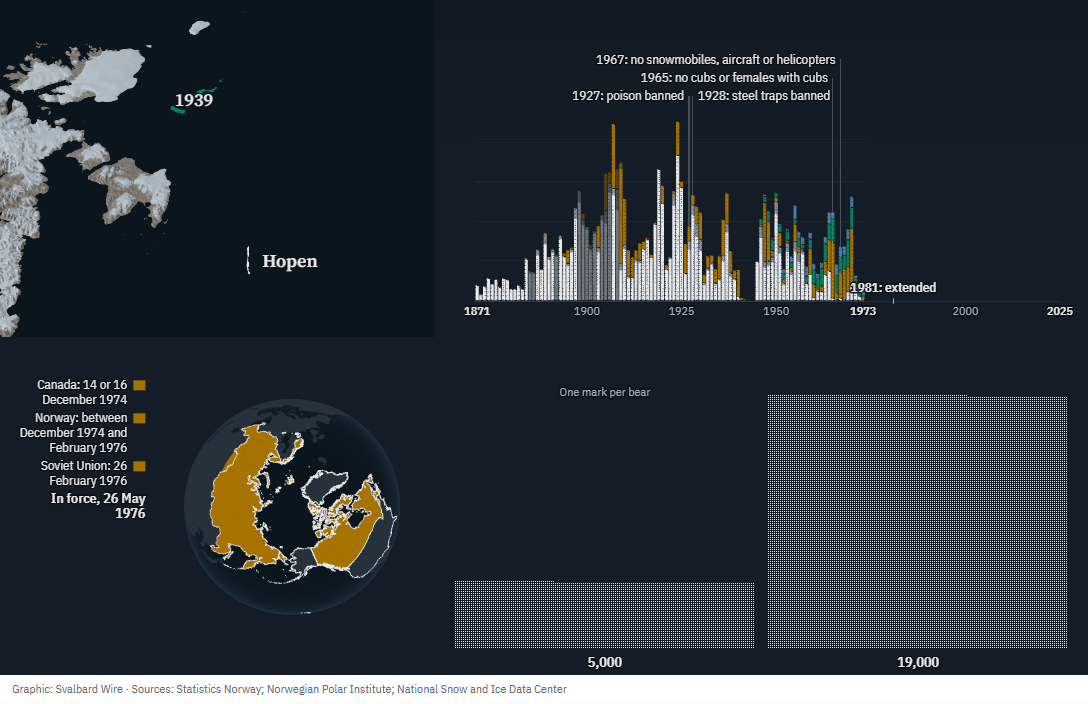
Norway cut the hunt back in steps. Poison bait was banned in 1927 and steel traps in 1928. From 1965 cubs and females with cubs could not be hunted, and from 1967 the hunt could not use snowmobiles, aircraft or helicopters. In 1970 hunters took 515 bears. In 1973 they took 41.
On Kong Karls Land, the island group in the east where the bears den, they were protected in 1939, and in the waters around the islands from 1955. In 1973 the islands became part of the Nordaust-Svalbard nature reserve.
In the autumn of 1973 the environment ministry refused the crew of the radio station on Hopen an exemption from the new protection. A bear could be shot only in an emergency. The state took the animal or its value, and each case went at once to the Governor of Svalbard.
The first scientific meeting on the polar bear met in Fairbanks, Alaska, in September 1965. Its 46 delegates came from the United States, Canada, Denmark, Norway, the Soviet Union and Switzerland. They discussed protecting females with cubs and bears in international waters.
When the polar bear specialists of the International Union for Conservation of Nature first met, in January 1968, the literature put the world population at 5,000 to 19,000 bears. A Norwegian polar bear researcher later called the estimates mostly speculation.
The Soviet Union had banned all polar bear hunting in 1956 and argued that the others should follow. States where the hunt was part of the culture and of the livelihood of indigenous people refused.
Environment minister Tor Halvorsen opened the conference in Oslo on 13 November 1973. On 15 November Norway, Denmark, Canada and the United States signed the agreement. The Soviet delegate, Ivan Maksimow, could not sign that day for formal reasons. The Soviet Union signed later.
Article I of the agreement bans hunting, killing and capturing polar bears. Article III makes exceptions for research, for conservation and for local people hunting by traditional methods under traditional rights. Norwegians living on Svalbard argued for years that they counted as local people. The Norwegian government rejected this.
The agreement entered into force on 26 May 1976, 90 days after the third ratification: the Soviet Union's, on 26 February. Canada had ratified in December 1974 and Norway before February 1976. The sources differ on the United States: 1 November 1976 or December 1977. Denmark followed in December 1977.
The first term was five years. Meeting in Oslo in January 1981, the five states extended the agreement for an indefinite period. In Tromsø in 2009 they agreed to meet at least every second year.
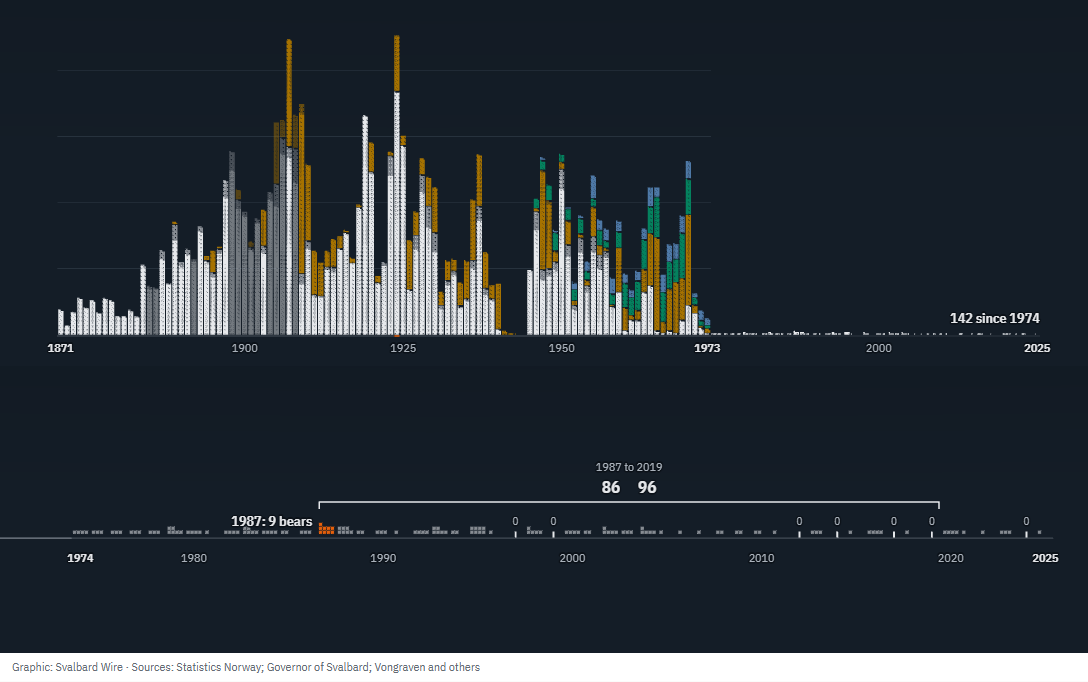
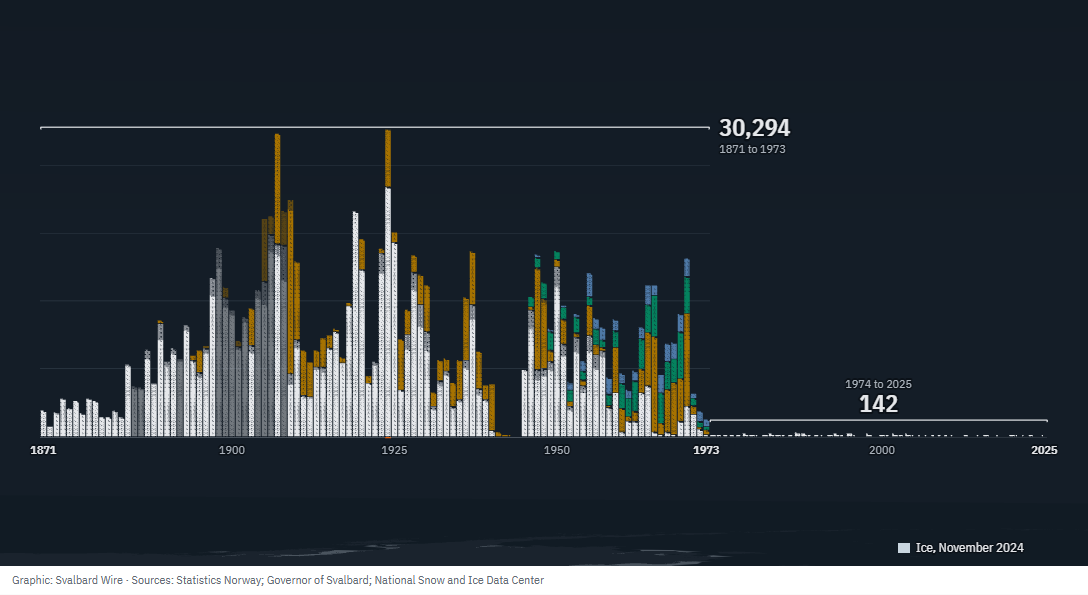
Since 1974 a polar bear on Svalbard may be killed only in self-defence, to protect life or property, or to end its suffering, and every case is a police matter. From 1974 to 2025, 142 bears were killed: 2.7 a year.
The most in one year was nine, in 1987. Since 2005 it has been four or fewer every year. In seven years since 1974, no bear was killed.
The counts differ. For 1987 to 2019 one count gives 86 bears killed, another 96.
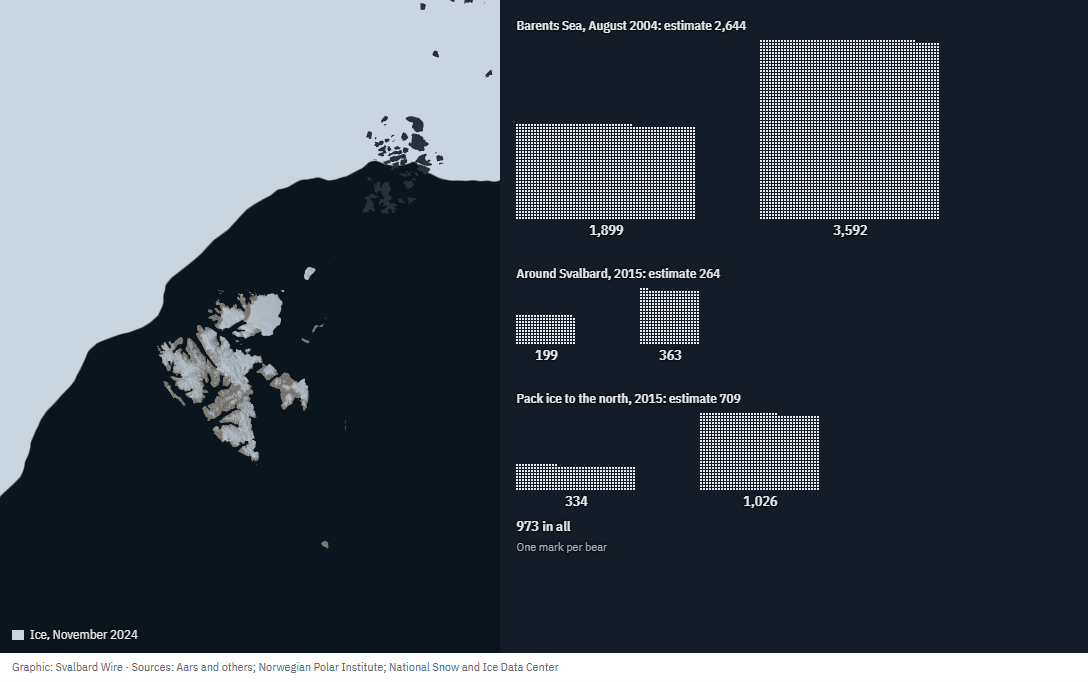
There is no count of good quality from the hunting years. In August 2004 a survey by helicopter over Norwegian and Russian waters estimated 2,644 bears in the Barents Sea population. Its 95% interval runs from 1,899 to 3,592.
In 2015 Russia did not give permission, and the count covered only the Norwegian side: 264 bears around Svalbard and 709 in the pack ice to the north, 973 in all.
The researchers found no sign that the loss of sea ice had yet reduced the number of bears, and wrote that the recovery from the hunt may still be going on.
In the Barents Sea the ice season shrank by about four days a year from 1979 to 2014. That is more than twice as fast as in any other polar bear area.
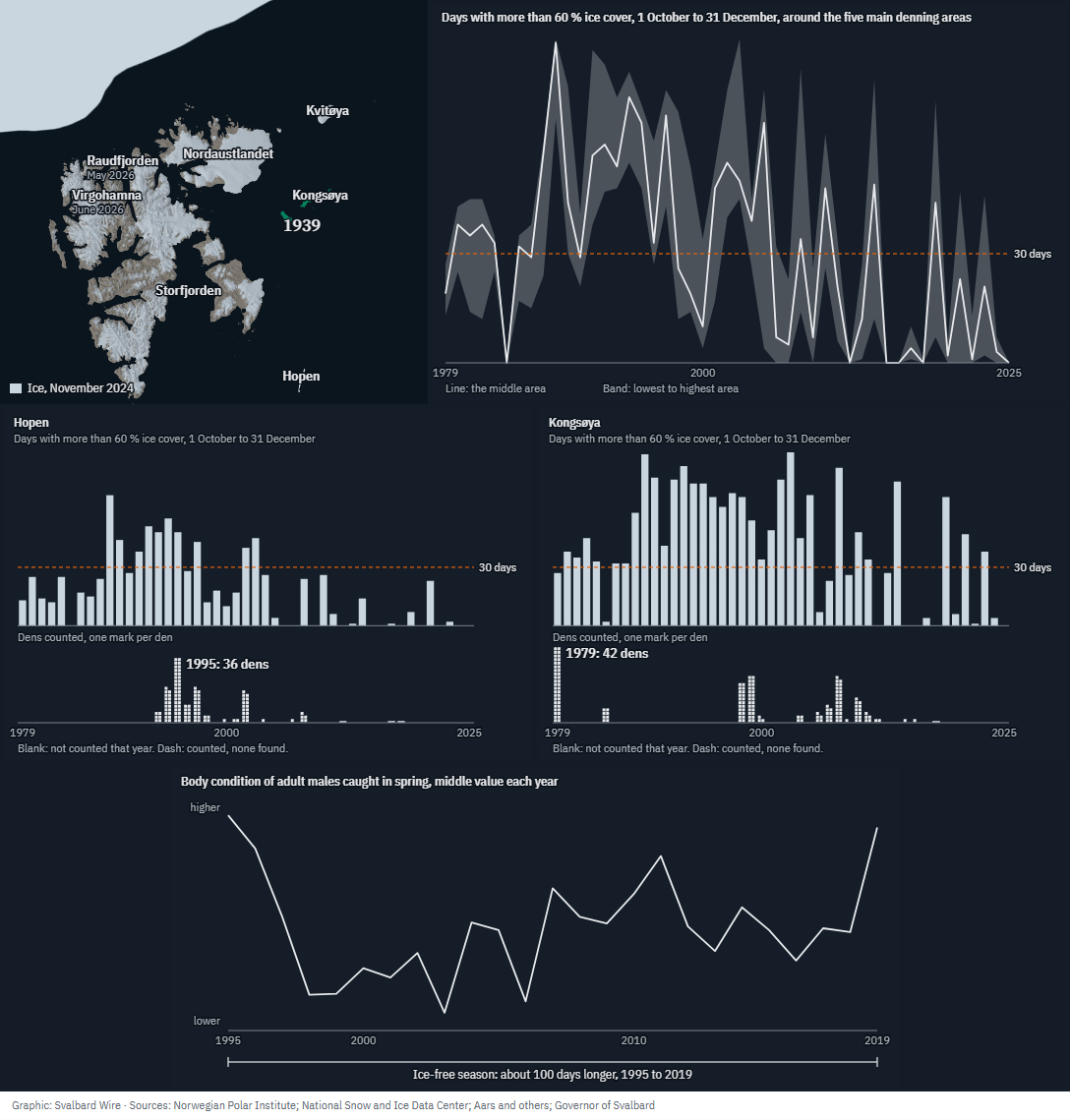
Around the five main denning areas, the days with more than 60% ice cover from October to December have fallen since 1979. Below 30 days, pregnant females struggle to reach the islands.
On Hopen 36 dens were counted in 1995. In 2012, 2017 and 2018 none was found. Since 2016 the island has had at most 23 days of ice in autumn.
On Kongsøya, in Kong Karls Land, 42 dens were counted in 1979. In 2015 and 2016 there was one each year, and in 2018 none.
In 770 adult bears caught in spring from 1995 to 2019, body condition fell until about 2000 and then rose, while the ice-free season grew by about 100 days. The researchers suggest more reindeer, walrus and harbour seals may partly make up for it, and warn that further ice loss could harm the population.
In May 2026 bird flu was confirmed in a dead young polar bear in Raudfjorden, the first case in polar bears in Europe. A second young bear, found dead near Virgohamna, was sampled in June.
Outside the settlements everyone must carry a means of scaring off polar bears, and the Governor recommends a firearm. Inside Longyearbyen a loaded firearm may not be carried.
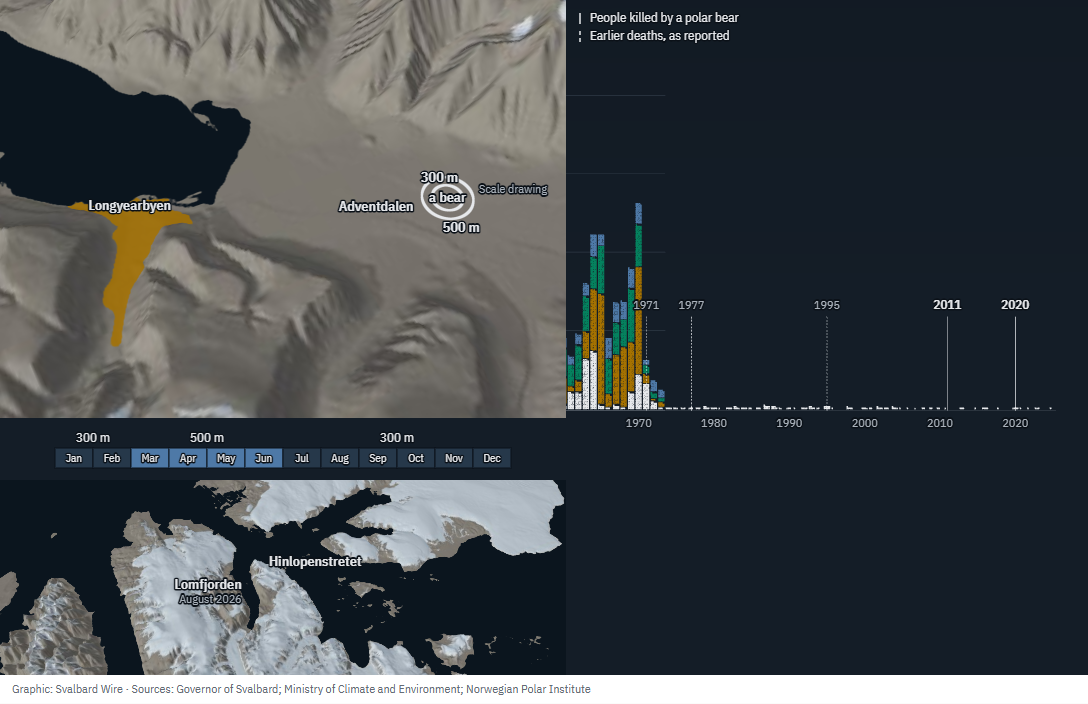
Since 1 January 2025 everyone must keep at least 300 m from a polar bear, and 500 m from 1 March to 30 June. Whoever comes closer without knowing must withdraw. The rule does not apply in settlements or to people in cabins, tents or research stations.
In August 2026 the Governor issued a fine of NOK 50,000 after a ship's horn in Lomfjorden woke a bear sleeping on land and made it move.
Bears have killed people on Svalbard in 2011 and in 2020. Earlier deaths are reported for 1971, 1977 and 1995, and the sources disagree on the total. In 2025 there were three dangerous close encounters between bears and people, none with injuries.
From 1871 to 1973, 30,294 bears were taken. From 1974 to 2025, 142 were killed.
Fifty years after the agreement came into force, Norway's polar bear strategy of 2026 names climate change as the main threat.