 Svalbard
The last boat of 1945 turns back off Isfjorden
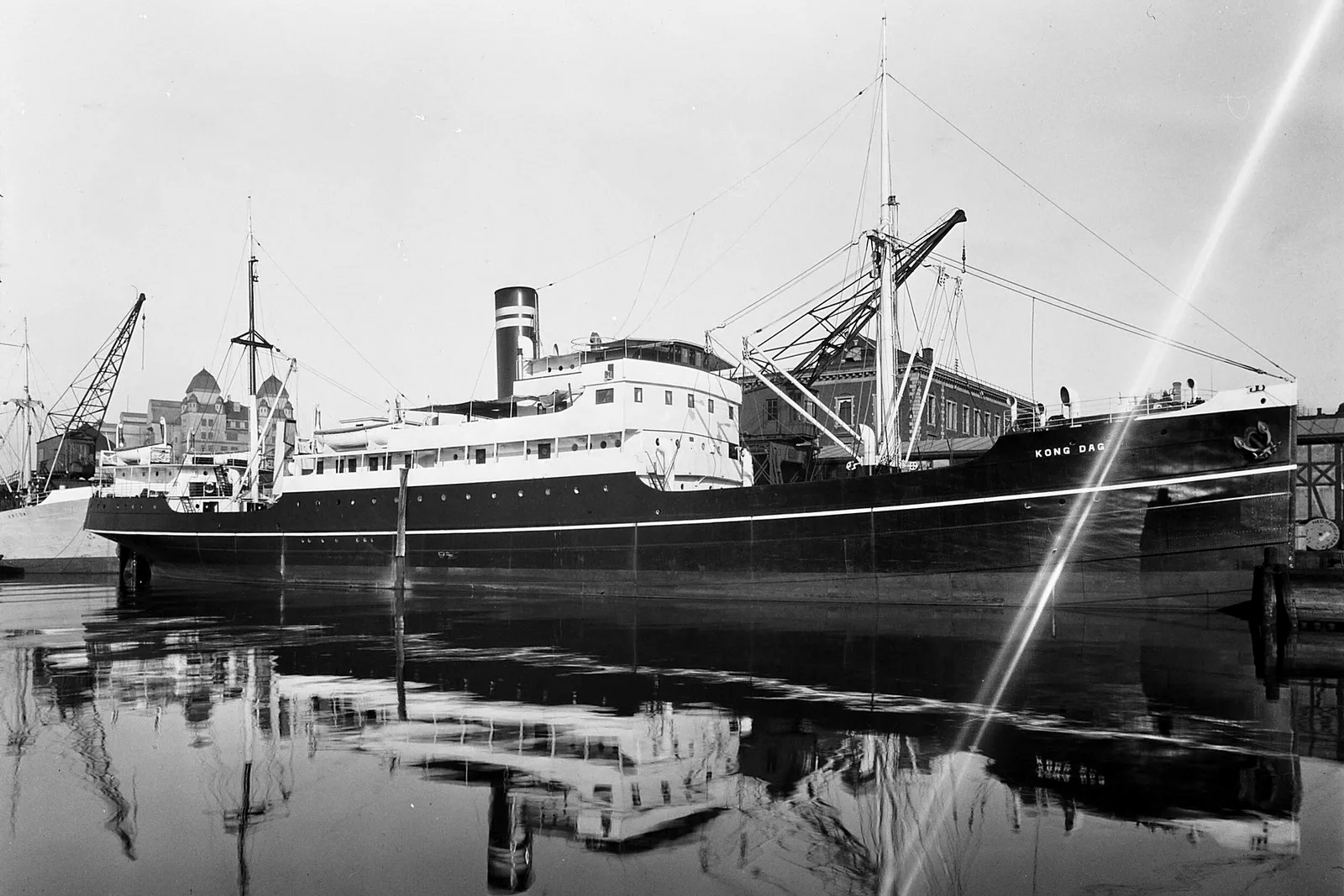
Late in November 1945 a lead went down into black water off the west coast of Spitsbergen and came up at 5 m. That was about what the ship above it drew.
She was the Kong Dag, a passenger steamer built for the route between Oslo and Hamburg, and she had sailed the full distance to the mouth of Isfjorden. Her officers could not find it. The sun had been gone for almost a month. Snow drove across the deck and sea smoke lay on the water. No light showed anywhere on the land.
The captain, Henrik Homlung, had moved on to the bridge and kept going on coffee and cigarettes, the Governor said afterwards. The radio operator sat at the telegraph day and night, and his arm had swollen from it.
Below them were 109 passengers. Among them were the new Governor of Svalbard (sysselmann), Håkon Balstad, a doctor, nurses, and the workers and officials who were to rebuild the coal mines. Their machinery and the food for the winter lay in the holds. The Kong Dag was the last boat of the year, and Longyearbyen lay inside the fjord she could not find.
What went on board
She had come north by way of Trondheim, where the Governor boarded. A reporter from Nationen had reached him in Oslo while he was still packing. Balstad said he would winter on Svalbard, act for the state in whatever came up and plan the rebuilding of its administration. He also expected trouble from the sledge dogs that had been let loose when the Russians left in the war. They had bred and gone wild, and they were a danger to the reindeer and the musk oxen.
The Norwegian settlements had been evacuated in 1941. A German naval force destroyed most of Longyearbyen in September 1943, and Sveagruva, the company's other mine, was burned in 1944. Both belonged to Store Norske Spitsbergen Kulkompani. The company sent its first boat north on 27 June 1945, Adolf Hoel writes in his history of Svalbard. By late October the power station in Longyearbyen was running again, and Mine 1 gave coal for the station and the houses.
The Kong Dag was to bring the men and machines for a first winter of production. She was 22 years old, a steamer of 1,922 gross tons with a certificate for 60 passengers in first class, 20 in second and 12 in third. The Germans had taken her in October 1944, and her owners got her back in Harstad the following May. Store Norske chartered her after an earlier boat, the Dronningen, had turned back at the start of November. Some of the women on board had been on the Dronningen too.
The company's own history, printed for its centenary in 1954, tells what she had done since the liberation. She was requisitioned to carry troops and prisoners, docked for repair in Oslo in July, and then brought Norwegian refugees home from Leith to Stavanger and Tromsø.
Her captain was Henrik Fredmann Homlung, born in Hvaler in 1892. He had gone to sea in 1907 and had sailed for the company since 1919, as a master since 1923. He gave his own account of the war in a register of Norwegian shipmasters published in 1954. In September 1944 he commanded the Kong Bjørn when British aircraft attacked her and set her on fire. The pilot and the second mate were killed. He got the ship ashore and the fire put out, and when she was pumped dry and patched he took her to Oslo under her own steam.
In Harstad the mine workers came on board. Folkeviljen, a newspaper of the town, listed the cargo: four large crates of machinery, 20 cables, about 60 tons of clothes and provisions, two jeeps. The Governor brought guns and ammunition for the dogs.
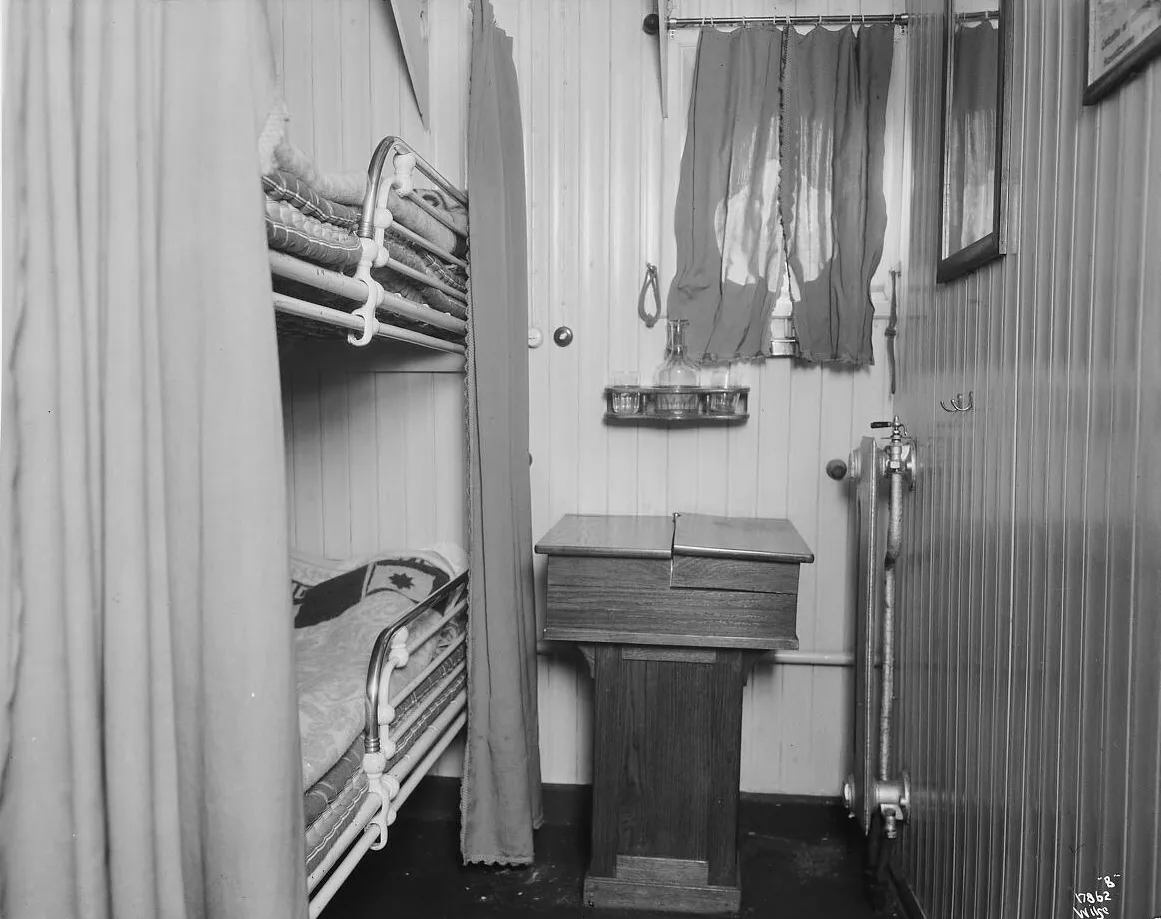
One of the workers was Kåre Olav Kristensen, a fisherman from Harstad, who told his story in the book Store Norske published for its 75th year. The boat was fine, he said. There were cabins for everyone but 35 men, and for those bunks had been rigged in the hold. He was one of the 35.
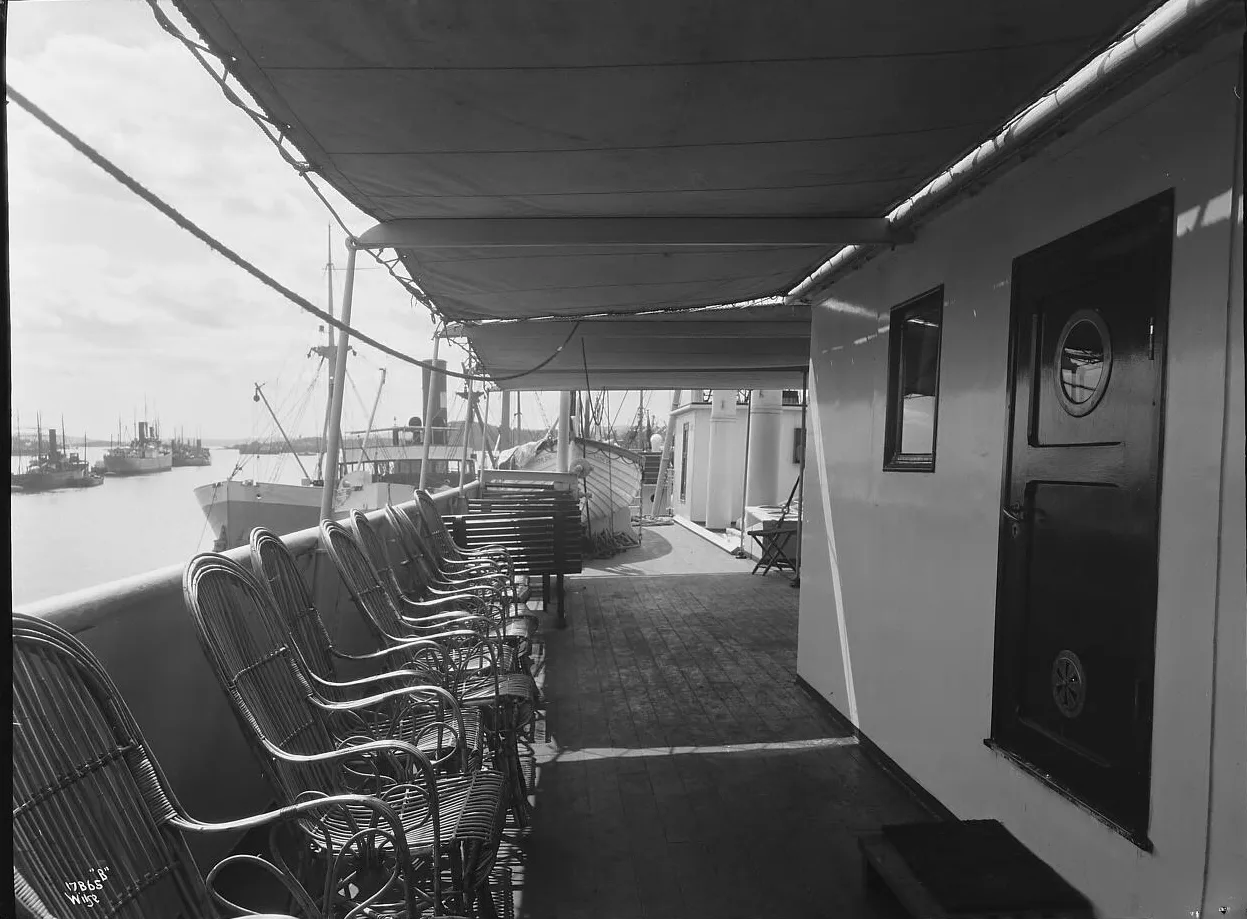
On deck was the company's meat for the winter: pigs, shut in the German latrines. The man who tended them was going north to winter and had his wife with him, a couple from Gudbrandsdalen. They were given separate cabins, Liv Balstad writes in her memoir, because nobody on board could establish from the employer's papers that the two were lawfully married.
Bjørnøya
The Kong Dag left Harstad on the evening of Monday 12 November, Folkeviljen wrote; the Tromsø papers give Tuesday. At about nine on Wednesday evening the naval command in Tromsø had a message from her. The steering engine was damaged, and she was heading back for the coast at seven knots in a rising gale from the south-west. Nordlys, the Tromsø newspaper, printed it the next morning: the Kong Dag was in distress at sea.
She had been close to Bjørnøya when a part of the steering engine broke. The crew rigged an emergency rudder. The naval trawler Honningsvåg went out at two in the morning, met her off the coast and followed her in to Tromsø, where she went to the shipyard. The passengers were not allowed ashore, Kristensen said.
The repair was finished on Saturday evening. She took on coal and left Tromsø on the morning of Sunday 18 November. The forecast Nordlys printed the next morning was a full storm at sea from the west and north-west.
An unlit coast
In the Governor's telling, which his wife set down in 1955, the ship lay at the edge of the open sea until the weather eased and then drove north for two days into a gale. On 21 November it cleared. The officers expected to reach the mouth of Isfjorden late that night.
Nothing on that coast would show them where it was. Every light along the shores of Svalbard and in the fjords to the mines had been destroyed in the war. The storm had put the ship's direction finder out of use, and she had no echo sounder. That left the log, the compass and the lead.
Leif Bryde was making for the same coast that week as captain of the Åsenfjord, an icebreaker and salvage vessel of 600 tons. He had hunted whales there for many years. "There are no lanterns up here," he told Sandefjords Blad a month later, "so one has to go by the little one sees of the land, the glaciers that glitter in the dark and the black mountains."
At eleven that evening the officers of the Kong Dag worked out their position. By the reckoning she lay off the fjord mouth. Around her was the polar night and no sight of land.
Rockets
Day came, and at that time of year it was little lighter than the night. The ship moved north and back at slow speed, and the lead went down again and again.
She had radio contact with Longyearbyen. Another ship of the Svalbard traffic, the Hedvig I, had arrived and was unloading. The Hedvig broke off her work, went out to the fjord mouth and began to send up rockets. Nobody on the Kong Dag saw one. They asked over the radio whether snow might be hiding them. The answer came back that at Isfjorden the stars were out.
The naval command in Tromsø had sent the trawler Molde north with a full set of instruments for Arctic waters. She reached Longyearbyen without having seen the Kong Dag pass. On the evening of 23 November she went out again to lead the steamer in, and took radio bearings on her. They put the Kong Dag far up on Forlandet, the long island north of the fjord mouth. Nobody on board believed them.
Later that night the Molde reported that she had seen nothing and was going back to Longyearbyen. The Governor wrote a telegram to the naval command in Tromsø, asking it to order the Molde to keep searching. The trawler came out again. Her next message ended with a request that the Kong Dag move into shallower water.
"We tore our hair," Balstad said. "We were lying at five fathoms."
On Saturday 24 November the Åsenfjord made land at Bellsund, the next fjord to the south. Bryde knew where he was as soon as he saw the shore, he told Sandefjords Blad. He telegraphed to the Kong Dag that his ship lay in Bellsund with her masthead lantern lit, so that the steamer would have something to steer by.
Then the Molde sent word that she had gone in to Longyearbyen to have her instruments corrected. On the Kong Dag, by the Governor's account, everyone knew that a ship's instruments could not be corrected in Longyearbyen.
The hold
Most of the passengers were seasick, Kristensen said, and so was he at first, fisherman though he was. It was cold. When the ship lay hove to, the crew had to knock ice off her.
The days went by and the men in the hold were told nothing. The ship would go for a while and then stop, and that was what wore on the nerves. "There were many rumours," he said. "Some said he could not find Svalbard, and some said we were going to Iceland."
Food ran short. On the last two days there was one slice of bread at each meal. Someone in the hold got hold of a crowbar and broke into the stores, and the men lay in their bunks eating raw carrots and cabbage.
The Governor and the office manager of Store Norske, Bing, and a number of engineers were on board, Kristensen said, and they knew no more than the men did.
The saloon
Water was rationed, Liv Balstad's memoir goes on, and the crew fished up a block of ice and melted it. The passengers talked the position over among themselves, all of them. Workers who had made the crossing before said the ship should try for land while the weather held. If that failed she must go south. She could not risk a hundred and fifty lives, the ship and the cargo more than she already had.
At ten in the evening the weather service forecast a storm. The ship had come into drift ice, and the lead still showed the same depth. She turned south in the night to Sunday 25 November.
The passengers were ordered up into the saloon and the hatches were battened down. Some wept, some prayed, some sang hymns. Then the piano tore loose and struck the bulkhead. "We sat and stood and lay across one another," the Governor told his wife, "more than a hundred people on a few square metres."
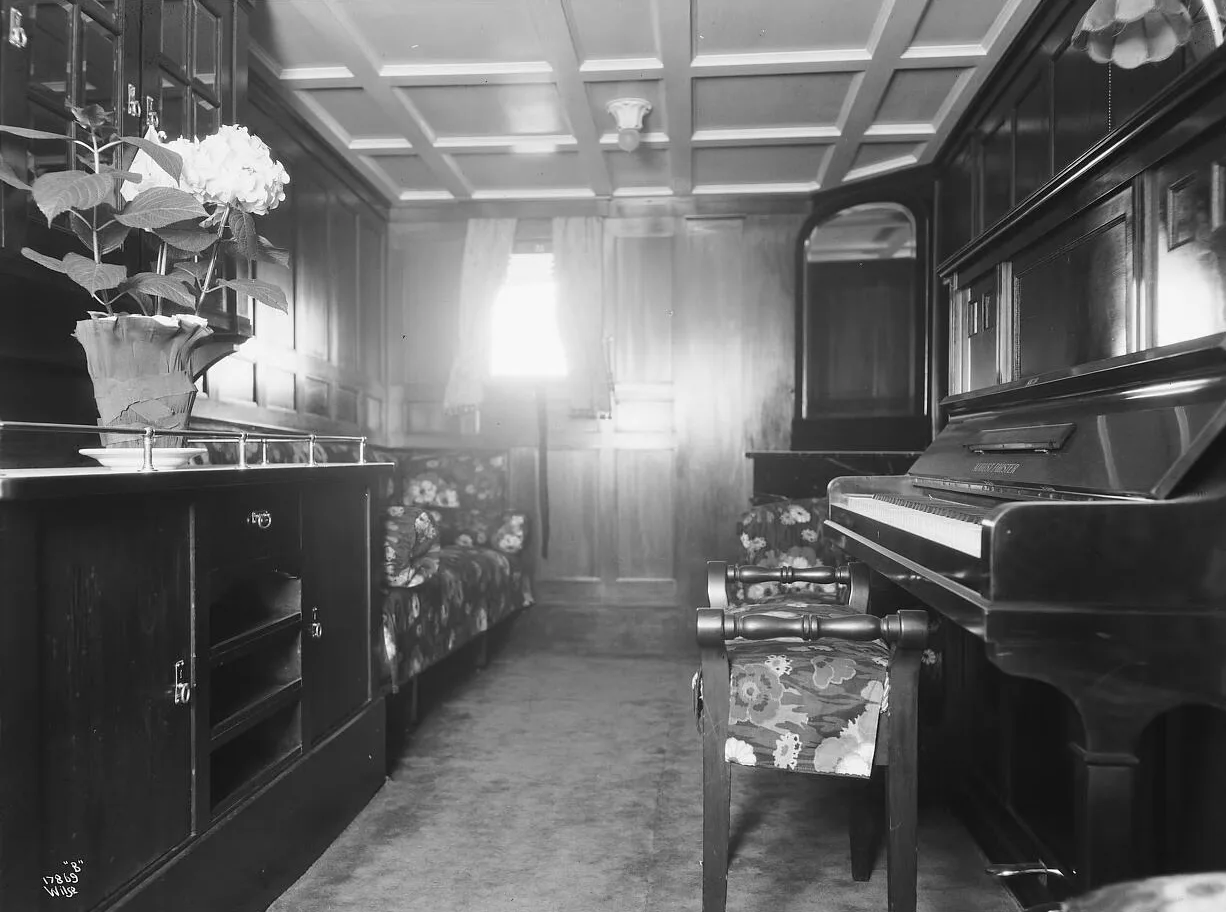
Bing was thinking of the pigs. He was afraid they would drown in the latrines when the seas broke over the deck, and he had said so to the Governor. Nobody could reach them while the storm lasted.
Harstad
Late in the evening of 27 November the Kong Dag had the Norwegian coast ahead, north of Harstad. Rockets went up from the land. On board they were taken for a signal to stop, and the ship lay and waited. Nothing happened. Over the radio the officers learned that a gang of boys had found a German store of rockets and were letting them off.
That evening Bing and the Governor went forward to the pigs. Many had drowned.
The ship came in to Harstad on the morning of Wednesday 28 November. A reporter from Folkeviljen asked Homlung why he had not reached Svalbard. "We had sailed out the distance and did what was humanly possible to get in," the captain said, "but because of drifting snow and sea smoke we did not get a glimpse of land." They had searched for three days. He had found it indefensible to drift longer in the dark with about 150 people on board. A grounding would have been a catastrophe.
A meeting was called in the saloon, Kristensen said, and the passengers were told that this had been the last boat of the year. The company paid their fares home. He went to its office in the town for his money. While he sat there the captain walked in. The manager, Sigurd Westby, was irritated, and Kristensen remembered his face as he saw who it was. What the two said to each other, he supposed, nobody would ever know.
The hearing
On Saturday 1 December evidence was taken at the district judge's office in Harstad. The captain, the ice pilot and the radio operator were heard, and of the passengers Balstad and Bing.
Folkeviljen reported what came out. The ship's position could not be fixed while she felt her way in darkness, sea smoke and drifting snow. Cross-bearings from the Hedvig I and the Molde had been tried, and conditions for them were impossible. One bearing placed the ship on the shore while she had several metres of water under her keel. Her water tanks, which served as ballast, had been emptying, so that icing was feared, and a storm centre was coming from the east. With 109 passengers, a crew of 36 and a costly cargo of machinery, going on was found too great a risk.
The paper's main impression of the evidence was that, as matters stood, turning back to Norway had been the right thing to do. Nordlys wrote the same.
Two captains
The Åsenfjord got in. From Bellsund she went to Sveagruva and then to Longyearbyen with flour, goods and post, and on to Ny-Ålesund to free a ship with a wire round her propeller. She was back in Harstad on about 10 December, and Bryde was home in Sandefjord on 23 December.
Sandefjords Blad printed his story on 28 December. It opened with his disappointment: the Kong Dag, which his ship was to assist, had turned for home before she met the ice. In Bryde's own words, further down, she had more than 100 passengers on board, 40 of them women, dared take no chances and went back when she met the first ice. The Hedvig, he said, was a little boat that had steered by his lantern, landed half her cargo and left, frightened by the ice and the storm.
The Hedvig's captain, Alf Brubakk, answered on 11 January 1946. Bryde's statements were "misleading and full of untruths and boasting", he wrote. The Hedvig I was a ship of 2,000 tons deadweight, the size of the Kong Dag and more than three times that of the Åsenfjord. She had reached Svalbard five days before Bryde did. While the Åsenfjord was making land at Bellsund, the Hedvig lay off Isfjorden sending up rockets for the Kong Dag. Sandefjords Blad added a note that Bryde did not dispute Brubakk's statements.
The winter
Another boat was talked of and given up, and so was a plan to drop the most needed supplies by parachute. The Governor was back in Oslo on 23 December.
The production planned for Mine 1 and for Sveagruva could not be carried out, Hoel writes. That winter 344 men wintered: 276 in Longyearbyen and Sverdrupbyen and 68 at Sveagruva. Sixty of them could be spared for Mine 1 and 20 for the mine at Sveagruva. The rest built. By 30 June 1946 Mine 1 had produced 18,908 tons of coal.
The Kong Dag did not go north again. The navy used her to carry war material from northern Norway to Bergen, Horten and Oslo, her owners' history records. She was found less suited to the changed trade, and in January 1946 she was sold to France.
Kapp Linné
At the end of April 1946 Nordlandsposten wrote that Balstad was expected to go north with one of the first boats of the season. Liv Balstad followed that summer on a naval vessel, and at the mouth of Isfjorden the ship stopped off the radio station at Kapp Linné to ask for the Governor's boat. Two men rowed out from the station. Before anyone could hail them they shouted that Lyngaas was in Longyearbyen.
Nobody on the ship knew who Lyngaas was. He led the expedition that was putting up lights and markers along the coasts of Svalbard that summer.
An account of the rebuilding in Polarboken 1949 lists what the state's Svalbard expeditions had done in the four years since the war. They had set up radio beacons and lanterns on the way in to every mining settlement.
Written by the Wire's software from the works listed below and checked against them before publication. The editor sets the rules and answers for every story. How the Wire is made.
Sources
Nord for det øde hav, Liv Balstad (1955)
pp. 23-29
Store norske 75 år, Store Norske Spitsbergen Kulkompani (ed. Thor B. Arlov) (1991)
pp. 141-143
Svalbard. Svalbards historie 1596-1965, Adolf Hoel (1966)
pp. 939-941
Polarboken 1949, Norsk Polarklubb (1949)
pp. 39-50
Rutefart i 100 år: Det Søndenfjelds-Norske Dampskibsselskab 1854-1954, Eivind Thon (1954)
pp. 99, 106, 116
Norges skibsførere 1935-1953 (1954)
pp. 208-209
skipshistorie.net: Kong Dag (1923), Steinar Norheim (2021)
Nationen (1945)
10 November 1945, p. 6
Folkeviljen (1945)
14 November 1945, p. 1; 1 December 1945, p. 1; 5 December 1945, p. 1
Nordlys (1945)
15 November 1945, p. 4; 16 November 1945, p. 5; 19 November 1945, p. 2; 3 December 1945, p. 2
Tromsø (1945)
16 November 1945, p. 4
Harstad Tidende (1945)
12 December 1945, p. 2
Sandefjords Blad (1945)
27 November 1945, p. 2; 28 December 1945, p. 2; 11 January 1946, p. 2
Nordlandsposten (1946)
30 April 1946, p. 2
Norges Handels og Sjøfartstidende (1945)
22 November 1945, p. 7; 29 November 1945, p. 8