 Svalbard
The local council begins
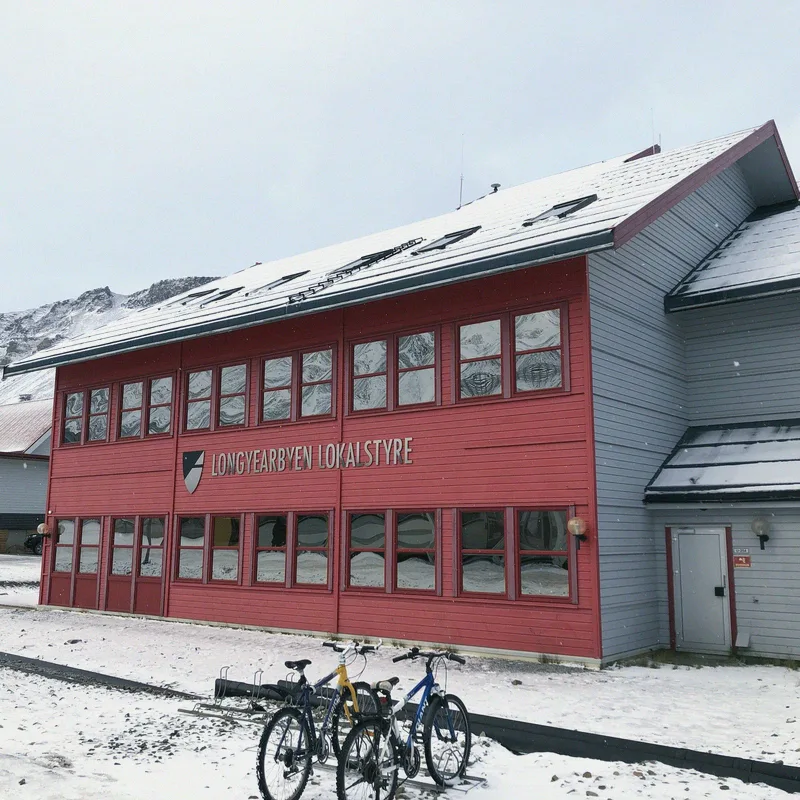
Svalbard lies between 10 and 35 degrees east and 74 and 81 degrees north, and Longyearbyen is its largest settlement. Longyearbyen lokalstyre (the local council) was established there on 1 January 2002. The council's own website says that its creation brought local democracy to Longyearbyen, and the elected body has 15 members. Store norske leksikon records that the first lokalstyre of Svalbard was elected in 2001, and the council's annual report for 2002 says the election was held in autumn 2001.
The lexicon, in the text by Susan Barr, places the cause in a slow change. From the end of the 1980s the arrangement in which Longyearbyen was a company town was gradually given up, as many community tasks that the coal company Store Norske Spitsbergen Kulkompani (the state-owned mining company) had handled passed to other bodies. The lexicon adds that in 1989 the typical community services were split off into separate companies. The Store Norske jubilee history of 1991 lists Svalbard Samfunnsdrift A/S as taking over infrastructure and community running in Longyearbyen from 1 January 1989.
The government's Prop. 43 L of 2018 to 2019 gives the reasoning. The arguments for municipal self-government on the mainland were applied, so residents could influence decisions as close to those affected as possible. Special conditions, among them foreign policy, state control of the archipelago and environmental goals, gave a different framework, and the local council works within Norwegian Svalbard policy. The document states that Longyearbyen was the last place in Norway to get local democracy, and that the model is close to the mainland one without making the lokalstyre a municipality.
On the day itself, the lexicon says, Svalbardrådet was replaced by the lokalstyre, as part of a development toward more local democracy for the residents of Svalbard. A parliamentary committee report of 2000 to 2001 says the lokalstyre took over ownership of Svalbard Samfunnsdrift AS and that some powers moved from Sysselmesteren (the Governor of Svalbard). The annual report for 2002 adds that the shares of the company moved to the lokalstyre on 1 January 2002.
The annual report records that principles were adopted on 8 January, a folkefest was held on 12 January 2002, the first term was two years and a new organisation began on 1 October 2002. The lexicon says members and leader are chosen in direct elections every four years, and that the lokalstyre is responsible for public services and for technical services such as electricity, district heating, roads, water, sewage and waste. The council's website says its responsibilities resemble those of a mainland municipality, including primary and secondary schools, kindergartens, libraries, sports, culture and infrastructure, within a planning area of about 260 km2.