 Svalbard
Barentsz finds Spitsbergen
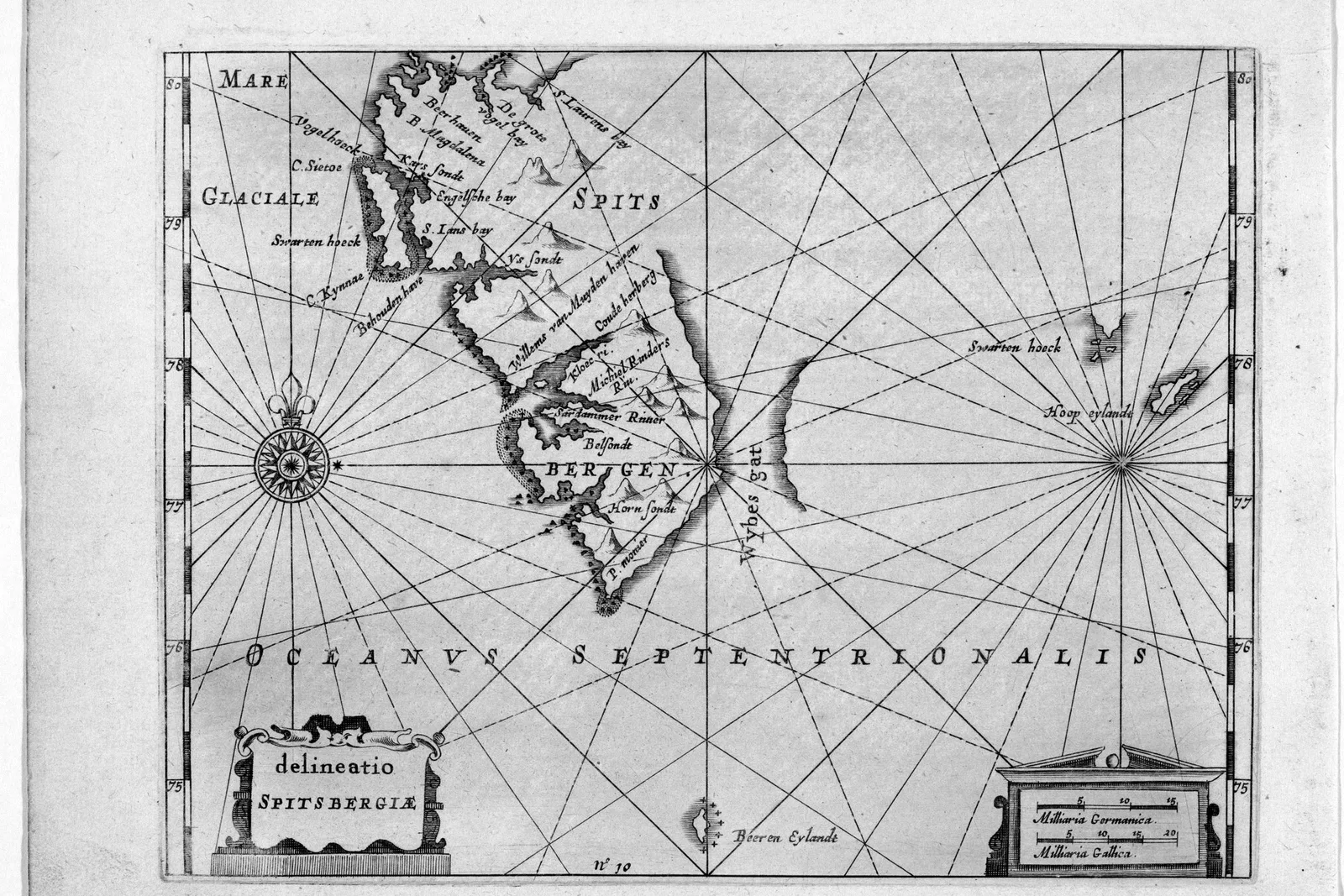
In 1596 the Dutch navigator Willem Barentsz found Bjørnøya and the island of Spitsbergen, says Store norske leksikon. On 17 June 1596 two ships under Barentsz and Jan Cornelisz Rijp sighted high land covered with snow at 80°10' north, on the north coast of the island of Spitsbergen. The lexicon says Barentsz named the land Spitsbergen after the sharp, jagged peaks he saw. Dole wrote in 1922 that Barentsz's log describes a land of "mountains and pointed hills", and that Rijp explained the name before the magistrates of Delft: it came from the great and high points on the land.
The name Svalbard is older. The lexicon says Icelandic annals record for 1194 that Svalbard was found, and that Landnámabók gives the voyage from Iceland as four days' sail. It adds that it is uncertain whether this meant the present Svalbard, and that nothing suggests Barentsz knew of those islands. Helge Ingstad writes that Barentsz rediscovered the group in 1596.
The ships were looking for another route. The lexicon says Barentsz took part in three expeditions from the Netherlands between 1594 and 1597 to find a northeastern passage to East Asia. Conway records that the fleet of seven vessels sent in 1595 was stopped by ice in the Kara Sea, and that merchants paid for one more attempt in 1596. The jubilee history of 1991 from Store Norske (the state-owned mining company) calls the discovery a result of faulty navigation, since the Dutch were bound for China. The lexicon adds that Rijp wanted a more westerly course than Barentsz, and says it can therefore be argued that Rijp counted for more in the discovery than Barentsz did.
Conway writes that the two ships left Vlieland on 18 May 1596, with Barentsz as chief pilot on one under Captain Jacob Heemskerck and Rijp as captain of the other. Conway dates the arrival at Bear Island to 9 June, and Thoralv Lund gives the same day. Lund says the island was named after a polar bear the crews killed there. The lexicon gives 8 June for Bjørnøya, and 17 June for the island of Spitsbergen. Conway writes that the ships met the ice pack on 16 June and sailed along its edge eastward. He adds that De Veer put the sighting of land on 19 June. Ingstad writes that the ships then went south along the west coast of the island of Spitsbergen and that Barentsz took possession of the land for the Netherlands. Dole adds that on 25 June the crews found walrus tusks at a bay they called Tusk Bay, and left a box there with a record of their discovery. Ingstad writes that Barentsz took the land to be part of Greenland.
The ships parted near Bear Island. Dole writes that Rijp tried to go north around the island of Spitsbergen and was held back, while Barentsz sailed for Novaja Zemlja, where ice crushed his ship and the crew wintered. Conway gives 20 June 1597 as the day Barentsz died in an open boat on the voyage home, ill with scurvy. The twelve survivors met Rijp at Kola and reached Amsterdam on 1 November 1597. Store Norske's history says Barentsz's chart was published in 1598, after his death, with the island of Spitsbergen marked as Het nieuwe land, and the lexicon calls it the first known map of Svalbard. Ingstad writes that the discovery drew little notice at first, and that Hudson's voyage in 1607 brought the islands attention after he saw whales along the coasts. Lund records that whaling in the fjords of the island of Spitsbergen began after 1610.
Conway identifies the first land seen as the north coast of the island of Spitsbergen, from Hakluyt's Headland to Liefde Bay. He writes that the ships anchored at Fair Haven on 21 June, where Barentsz put up a post bearing Dutch arms, and Dole says the English carried it off in 1612.
Svalbard Wire on Facebook, The week by email every Sunday