 Svalbard
The company town ends
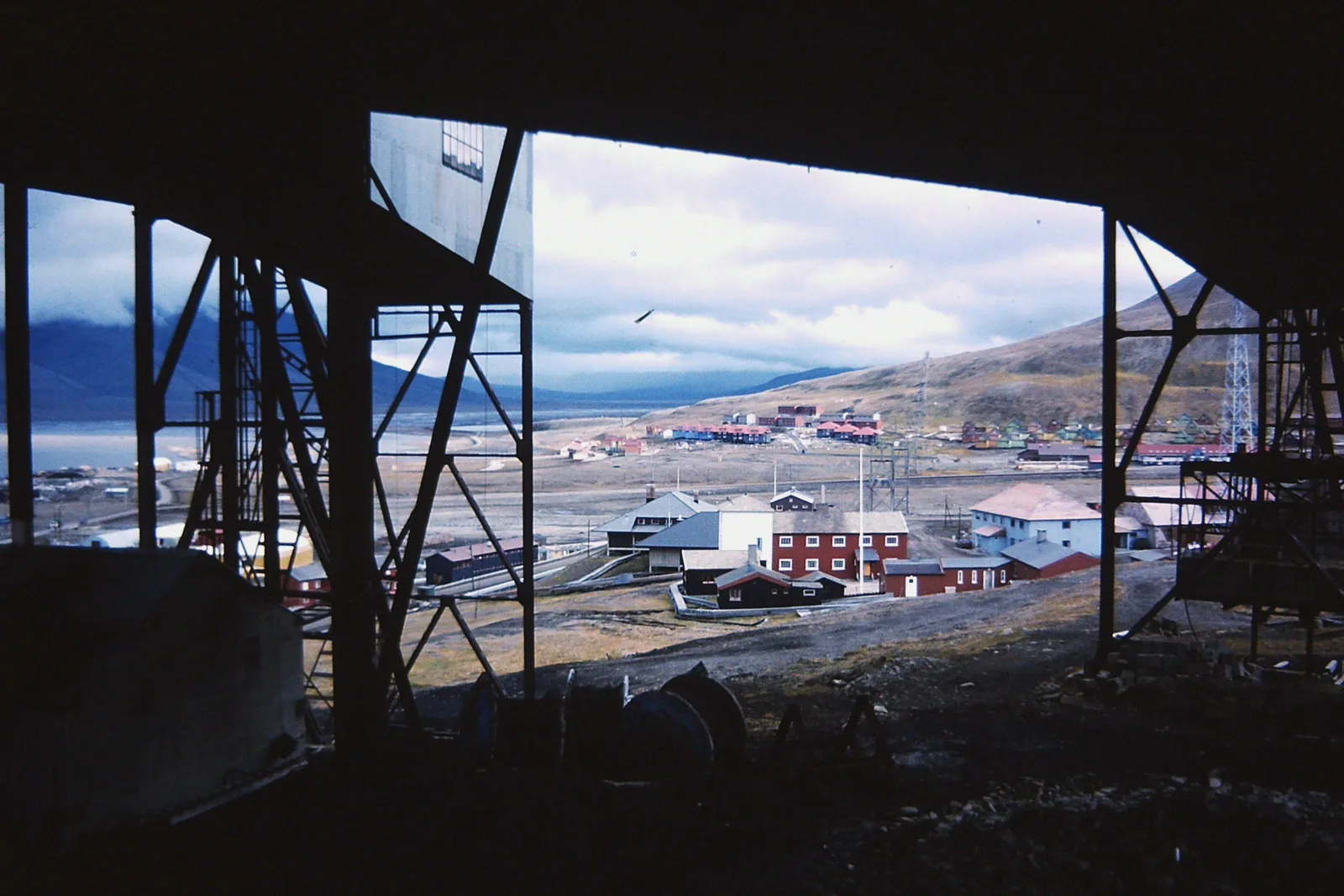
In 1989 the typical community services in Longyearbyen were split off into their own companies, ending the period in which the mining company Store Norske Spitsbergen Kulkompani (the mining company), known as SNSK, ran most of the town. Store norske leksikon, in its article on Longyearbyen by Susan Barr, says the settlement had long been a company town, where SNSK was responsible for most of the activity and the infrastructure.
The lexicon's article on the company adds that SNSK developed and operated all infrastructure and community services in both Longyearbyen and Sveagruva. Store Norske 75 år, the company's jubilee book of 1991, describes Longyearbyen as a verkssamfunn, a company community, with a social hierarchy that showed in the layout of the town. The worker barracks lay to the south, farthest up the valley and nearest the mine. The mess, shop and church stood in the middle, staff housing and the administration building lay to the north, and the state offices, including the residence of the Sysselmann, stood at the edge toward the sea. Store Norske 75 år says that a strong normalisation of the community took place in the 1970s, driven by a political wish to strengthen the Norwegian presence on Svalbard, with housing as the main change. It lists the state taking over the school and the hospital, and SNSK ceasing to print its own banknotes.
According to the lexicon's article on SNSK, most community areas in Longyearbyen were separated out as companies of their own in 1989, and SNSK then remained a pure coal mining company. Svalbard Samfunnsdrift was given responsibility for running the community, while Svalbard Næringsutvikling was to prepare the ground for new business.
The jubilee book gives the scope of the first of these in its report for 1990. Svalbard Samfunnsdrift had operating and investment responsibility for roads, water and sewage, housing and common buildings, quays, energy supply, building services, the bakery and dairy, the kindergarten, refuse collection, land-use planning and the cinema. At the turn of the year it had 128 employees, who carried out 123 person-years of work. The book counts 539 employees in the group at that point, 376 of them in the coal company, 123 in Svalbard Samfunnsdrift, 37 in Spitsbergen Travel and three in Svalbard Næringsutvikling. The company's own foreword in Store Norske 75 år gives about 550 employees in the group and 370 in the mine. The foreword says that half of the population of Longyearbyen was tied to the coal mining through those employees and their families.
The jubilee book also sets out the ownership. SNSK was the parent company, with the Norwegian state holding 99.9% of its shares. Svalbard Samfunnsdrift and Svalbard Næringsutvikling were wholly owned by SNSK, and Spitsbergen Travel was owned 51% by Svalbard Næringsutvikling and 49% by SNSK. The lexicon records that SNSK was involved in Spitsbergen Travel from 1988 to 1997, and that the state took over both Svalbard Samfunnsdrift and Svalbard Næringsutvikling in 1993.
In its history of Svalbard, also written by Barr, the lexicon places the change in a longer process: from the end of the 1980s the company town arrangement was gradually abandoned, as many of the tasks SNSK had earlier handled passed to other bodies. The lexicon notes that Longyearbyen lokalstyre (the local council) was established on 1 January 2002. The lexicon's Longyearbyen article says that mining was later scaled back sharply, as it became less profitable and environmental concerns weighed more, and that the share of residents tied to the mining company fell. It gives 101 people working on coal mining and related construction in 2018, says coal mining in Gruve 7 in Adventdalen ended in 2025, and says the town's energy production changed from coal to diesel from mid-October 2023. The lexicon's Longyearbyen article adds that a growing number of residents now work in tourism and research.