 Svalbard
Explosion in the Ny-Ålesund mine
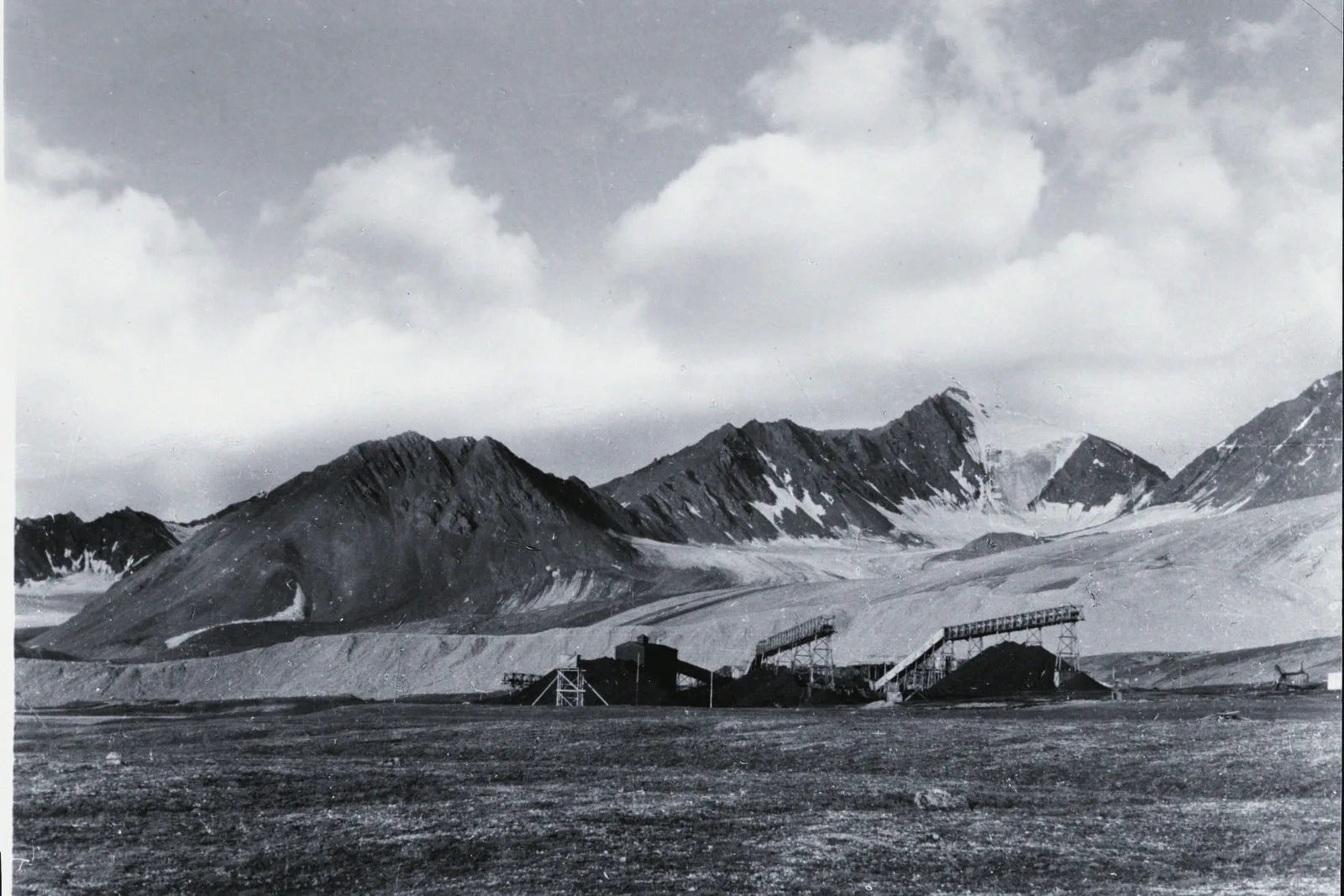
On the evening of Monday 5 November 1962, at about 22:45, the lights blinked across the whole camp at Ny-Ålesund, the mining settlement on the south side of Kongsfjorden on Spitsbergen. The mine went dark. Deep in the Ester mine, in the coal field called Østre Senterfelt, the conveyor belt stopped and the telephone line went dead. At the shaft opening the belt watchman saw smoke coming up.
Twenty-one men of the night shift were dead: twenty miners and their stiger, the shift foreman. Ten were carried out before morning. The other eleven were never found, and the mine became their grave. Within ten months the Storting, the Norwegian parliament, had decided to end coal mining at Ny-Ålesund, and had brought down the government of Einar Gerhardsen.
The night shift
The shift came on at 22:00. Twenty-five men reported for work, and 21 went underground. The electrician, the mechanic, the belt watchman and the lift man stayed on the surface.
The stiger that night was Fredrik Wavold, from Løkken in Orkdal. Before he went down he talked about gas with Johan Rasch, the stiger of the afternoon shift. That afternoon Rasch had measured 6% methane at one of the coal faces, the fourth. Fans had been set up in Beltesjakt Vest, the western belt shaft and the lowest working of the mine, to bring the methane down. Wavold telephoned the rest room underground and told the men bound for the fourth face to wait there for him. Then he went down with a methane meter.
Wavold and eight men walked on from the rest room towards Beltesjakt Vest, about 1,000 metres from the entrance and about 150 metres below sea level. Eight men were still in the rest room, and two were working close by. At about 22:45 the explosion came.
Into the smoke
The belt watchman rang the overstiger, the head foreman Hedgar Stien, who told him to see whether smoke was coming out. It was. Stien and the operations manager, Einar Grimsmo, the one trained mining engineer at the mine, went down in oxygen masks, followed by two men of the rescue patrol. They met falls of rock. The rest room was destroyed. Its north wall, a pillar of coal about 3 metres thick, was gone.
Eight men lay dead in the rest room and two in the gallery beside it. By about 04:30 on 6 November all ten were above ground.
The search for the other eleven went on for four days. Rolf Hanoa's history of the company, published in 1993, sets out its course. Patrols tried twice more on 6 November and failed. On 7 November there was no longer any doubt that the mine was on fire. At 15:30 on 9 November an open flame was seen about 50 metres from the rest room.
Two of the eleven, Sverre Sæter and Arne Arntsen, had been working a few hundred metres below the mouth of shaft I, in the belt gallery called beltefeltort 18. Monica Kristensen's 2012 book on the case tells how their families had been told early on that the two might be alive, and how the mine's safety committee asked Grimsmo for one last attempt. On 9 November a test at the mouth of the shaft gave more than 3% methane, and rising. The management, Skjerdal, the Labour Inspectorate and the safety committee met that evening, from 21:30 to about 23:30. They agreed that nobody should go down while the danger of fire and explosion lasted. On 10 November the whole of Østre Senterfelt was cut off from power, the ventilation was stopped and the shafts were closed.
The news goes south
The news reached Oslo on the morning of 6 November. The same day the ministry of industry, under Kjell Holler, appointed a preliminary commission of inquiry, chaired by the Governor of Svalbard, Finn Backer Midbøe. That evening Holler spoke on the radio. The country had once more received a message of grief, he said, and this time it came from the far north, not from the sea.
In Longyearbyen the flags went to half-mast on Tuesday morning, Nordlys reported. In Barentsburg the Soviet consul, Barulin, sent his condolences through the Governor, and the Russian mining town called off its celebration of the revolution on 7 November.
An Air Force Albatros flew the commission, the mining inspector Harald Welde and the chairman of the company board, Karl Skjerdal, from Bodø to Longyearbyen on 7 November. The Governor's boat Nordsyssel, carrying them on to Ny-Ålesund, was caught in the ice in the mouth of Isfjorden. They reached Ny-Ålesund at about 18:00 on 9 November. By then the mine was burning, and nobody could go down.
The men
The dead came from all over Norway, and one from Sweden. Two were from Alta and one from Karasjok in Finnmark, two from Rossfjordstraumen in Troms, and others from Sortland, Sørreisa, Surnadal, Selbu, Oppdal, Øyer, Spydeberg and Hauge i Dalane. Kai Henriksson came from Lund. The youngest were born in 1941 and 1942. Wavold, the oldest, was 52.
Wavold had spent 12 or 13 seasons on Svalbard, Arbeiderbladet wrote on 7 November, and his wife had lived at Kings Bay with him for a long time. They were building a house at Løkken and meant to settle there. She had been home to fit out the new house and had travelled back north on Sunday 4 November, the day before the explosion. Wavold never saw the finished house. Martin Polden of Surnadal had married a woman he met on Svalbard, Tidens Krav wrote. She was widowed for the second time: her first husband had also died in a mine accident.
Pensions went to nine widows, 23 children under 18 and two parents. A national collection raised NOK 182,560 for the wives and children. The Oslo city council voted NOK 100,000 on 8 November.
Harstad
The bodies went south on the Jacob Kjøde, the last coal boat of the season, which left Ny-Ålesund on 16 November. It reached Harstad at about 23:00 on Monday 19 November.
On Tuesday 20 November flags in Harstad flew at half-mast. Soldiers from the brigade formed a lane from the quay where the ship lay to Harstad church. Bishop Monrad Norderval led the service and the Harstad ladies' choir sang. The Armed Forces district band played Chopin's funeral march as the coffins were set in the chancel. Many of the relatives of the dead had come to Harstad. On Wednesday the coffins were sent on to the home places.
Gas and coal dust
The mine had killed men before. On 4 December 1948 an explosion at Ny-Ålesund killed 15 men. On 7 January 1952 an explosion killed nine, on the same day that six men died in a Store Norske mine at Longyearbyen. On 19 March 1953 an explosion killed 19. With the 21 of 1962, explosions had killed 64 men at Ny-Ålesund in 14 years. Counting roof falls and other accidents, 76 people died in the Kings Bay coal workings in 17 years.
Each explosion had its commission. The British mines inspector George Hoyle sat on the commissions of 1948 and 1952 and again in 1963. In 1952 he found the coal dust at Ny-Ålesund more dangerous than in any English mine, and the commission said the mine had to be counted as gassy.
On 20 March 1956 the Storting voted unanimously to rebuild Kings Bay as a modern mine, at a cost of NOK 20 million. It set conditions. Everything that could be done to prevent accidents like the earlier ones was to be done, and "the safety rules of the State Labour Inspectorate and the mining inspector on Svalbard are followed in full", the committee wrote. The new power station, ventilation shafts, conveyor belt, messes and homes were mostly finished by the end of 1959.
The inquiries of 1963 set out what had happened at the mine. The safety rules required charges to be fired electrically, but the company went on lighting them with fuses; in 1962 it bought no electric detonators at all. Welde, the mining inspector, had seen fuses in use from 1957 to 1959 and raised it only orally. From November 1961 Grimsmo was the one mining engineer at the mine; the commissions of 1952 and 1953 had suggested at least three. By 1 June 1962 the inspector had received none of the safety reports the company had to send him.
Skjerdal, the chairman of the board, was also the most senior civil servant in the ministry of industry. On 14 August 1962 the Directorate of Labour Inspection wrote to him: "In view of the earlier accidents in the Kings Bay mines and the company's character as a state company, the directorate wishes to express its astonishment that the company thus ignores the provisions of the safety rules." That was twelve weeks before the explosion. The Tønseth commission was told the letter never reached Skjerdal; the board said he received it and passed it to the director, Finn Boger.
Coal mining at Ny-Ålesund killed 76 men in 17 years, 64 of them in four explosions
What the men said
The Midbøe commission spent eight days at Ny-Ålesund. Between 10 and 15 November it heard 25 witnesses: the manager, the overstiger, the stigers, miners of the other shifts, belt watchmen and electricians. Each statement was read back to the man and signed. Its report found that methane had been present in explosive amounts and that a methane explosion had taken place; it could not say how the gas was set alight.
The statements, printed with the report, show what was known underground on 5 November. Rasch, the afternoon stiger, took the 6% reading on his first round, between 14:35 and 15:15, two metres inside a new drift at the fourth face. "About two metres from the face he found 6% gas, and he then did not dare take any more measurements further in," the record says. At his last control, at about 19:00 to 19:30, his sheet gave the same result everywhere but one point. The mine's gas book carries the figure for that day.
Rasch passed the reading to Wavold at the stiger office before the night shift went down, with an order: nobody was to work at the fourth face unless the ventilation worked as it should. Grimsmo and Stien had been heard on 10 November, four days before Rasch, and asked about reports of danger in the week before the accident. Grimsmo said none had come in. Kristensen writes that Rasch did not tell Grimsmo of the reading.
The men's own readings went into no book. Miners at the fourth and sixth faces gave Rasch figures of 2% and 3% at the change of shift. "Such reports from the men working in the mine are usually not entered in the diary or the gas protocol," Rasch told the commission.
Stone dust, the inert powder spread to stop coal dust from exploding, had run out the week before. Rasch said he had reported this to Wavold, and that on the afternoon of 5 November nobody had been given the job of spreading it. The miners read gas by eye, from the height of the flame in a safety lamp. One of them said he was partly colour-blind and had a mate check his readings.
About a week before the explosion, two miners came up from the mine frightened, Rasch said. The cable that ran past the ramp at the fourth face to the pump below was so worn, they told him, that they could see the bare copper wire. Other witnesses called it a high-voltage cable that the belt had been wearing through. Rasch dug part of it out and hung it up. From what two other men told him, he later concluded that the bare wire was the earth wire, and he did nothing more about it. Four witnesses described the cable, with dates that do not agree.
The Tønseth commission
On 4 January 1963 the government appointed a full commission of inquiry under Per Tønseth, a district judge from Hokksund, with Hoyle, two engineers, a union secretary and an overstiger from Sulitjelma. It was at Ny-Ålesund from 15 to 25 May 1963. It could not go into the mine, which had been left to fill with water.
Blood tests on four of the ten dead had shown carbon monoxide levels of 57% to 67%. The Occupational Hygiene Institute wrote that these alone explained the deaths, and that the men could not have died at once. The police laboratory found coked particles of coal dust on the belongings of the dead, the sign of a dust explosion.
The Tønseth report, dated 27 May 1963, found the ventilation too poor and gas present in explosive concentrations. It found that coal dust had taken a considerable part in the explosion. "The coal dust was whirled up somewhere in Beltesjakt Vest as a result of a gas explosion that was not particularly large." How the gas was lit, it could not establish; it counted a damaged cable among the ways it could have happened, and found nothing that gave sure ground for it. "The commission has a strong feeling that the necessary precautions were not taken as it became clear that the gas situation was developing unfavourably," it wrote.
The rules on spreading stone dust and testing the coal dust had not been followed, the report found, and one mining engineer was too few. It criticised the board, the management in Oslo and at the mine, the mining inspector and the Labour Inspectorate. It called it unfortunate that Welde served under the ministry whose top civil servant chaired the company. The constitutional responsibility of the minister, it said, was outside its task.
The board answered on 4 July. It disputed that coal dust had exploded, called parts of the conclusions untenable and asked for an inquiry by a court. It said the dust samples had not been taken, and called this a serious error.
Four days in the Storting
The election of 1961 had given the Labour Party 74 of the 150 seats in the Storting. The four non-socialist parties together also had 74, and SF had two, Dag Karmly writes in his 1975 history of the case. On 18 June 1963 the government survived a vote over the state coke works at Mo i Rana by 75 votes to 73.
The report of the Tønseth commission, the inquiry into the explosion, reached the ministry of local government and labour on 13 June, and the government heard a first account of it that day. On 19 June the Storting voted money for the western field at Kings Bay without being told of the report. The next day Holler asked to resign, and the report was published on 21 June. On 15 July the government proposed that coal mining at Ny-Ålesund stop.
The two Storting committees that handled the case split eleven to eleven. The Labour Party members found that the ministers had acted in line with the Storting's decision of 20 March 1956. That was the vote to rebuild the mine on condition that the safety rules were followed in full. The members from the Conservative Party, the Liberal Party, the Centre Party and the Christian People's Party proposed a single sentence: "The Government does not have the confidence of the Storting."
The government, they wrote, had not kept itself informed. It had not made sure the mine had trained staff or the Labour Inspectorate mining knowledge, and it had not finished the safety rules in time. It had put the mining inspector under Skjerdal against good administrative practice.
The debate opened on Tuesday 20 August and ran for four days, broadcast live on radio and television. Remseth, a Labour member from Rogaland, spoke for the majority. "The cause of the accident is unknown, so nobody can be held responsible," he said. Gerhardsen told the Storting that when he visited the mine in 1955 the miners had things to complain about, but none complained about safety. On one point he agreed with the critics: the government had not mentioned the Tønseth report when the Storting voted the Kings Bay money on 19 June. "The way this case has developed, it is now easy to see that this should have been done," he said.
The Socialist People's Party (SF) held the balance with its two members, Finn Gustavsen and Asbjørn Holm. Late on the first evening Gustavsen answered the charge that the opposition was using the dead. "I have the feeling that they hold the victims in front of them as a shield and say: If you attack us, you attack the poor dead," he said. SF would vote for the motion.
On 22 August a telegram from Longyearbyen was read in the Storting. Workers on all three shifts had voted, about 300 in all, and all but seven had backed a protest against the use of the accident to bring down the government. The same day Erling Engan of the Centre Party, a member from Nordland, read out his own words from the budget debate of 11 December 1962. He was left with the feeling, he had said then, that the state had been playing with human lives at Kings Bay.
On the last day Gerhardsen summed up for the government: "We do not accept a political morality that allows a work accident to be used as a means in the struggle for the power of government." John Lyng followed for the opposition. "We protest against the idea that any attempt has been made here to exploit a tragic accident politically," he said. The motion, he said, rested on the Storting's duty to hold the government to account.
The Storting voted by roll call on the evening of Friday 23 August. The motion of no confidence was carried by 76 votes to 74. The four parties and SF's two members voted for it; the Labour Party's 74 voted against. The same evening the Storting agreed, without a vote against, to end the mining at Ny-Ålesund.
Twenty-eight days
Lyng's government of the four parties took over on 28 August. The votes on its programme in September showed that it had no majority behind it, and on 25 September Gerhardsen formed his fourth government. The Storting's own history of the case says it came to matter a great deal: it showed that there was a clear non-socialist alternative to a Labour government.
On 31 October 1963 Skjerdal, the board member Ludvig Larssen, Grimsmo and Welde were charged. On 29 April 1964 the Director of Public Prosecutions dropped the charges against Skjerdal, Larssen and Welde for lack of evidence. Grimsmo was given a waiver of prosecution. In June 1964 lawyers for two of the widows asked the King to overturn the decision.
After the coal
Mining in the western field stopped on 5 November 1963, a year to the day after the explosion. In the winter that followed, 23 employees, nine wives and 25 children lived at Ny-Ålesund. In 1964 the state signed an agreement with the European Space Research Organization (ESRO) for a satellite telemetry station at Ny-Ålesund. The station ran from 1967 to 1974, and the settlement turned to research.
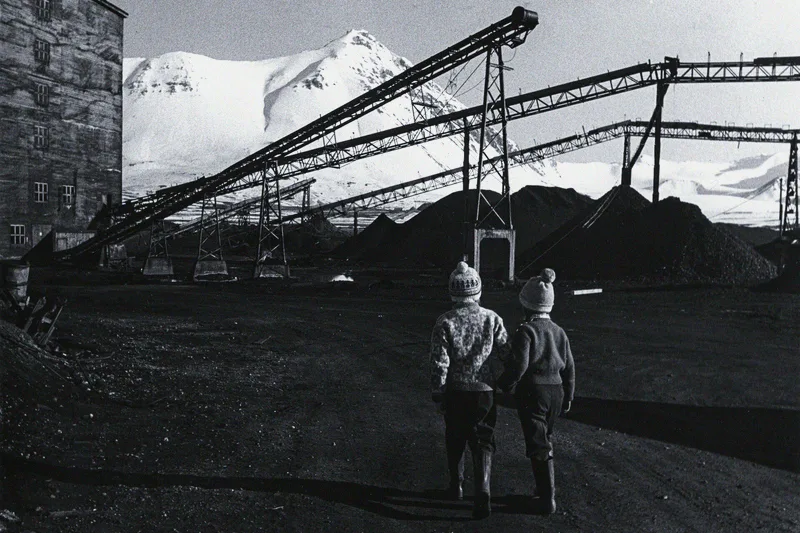
Head office in Oslo refused permission to pump the mine dry to bring up the eleven, and they are still inside. On 13 July 1963 a memorial stone was raised at Ny-Ålesund to all who had died in the Kings Bay mines from 1917 to 1963. The workers' association raised it with the company and the women's society Polarklokken. On 5 November 2002, the fortieth anniversary, a stone with the names of the eleven who were never found was put up. In 2012 a plaque with the names of the dead was added to the first memorial.
The 21
Ten were brought up from the mine:
Eivind Berge (born 1928), Skaun.
Helge Olav Erntzen (1941), Kåfjord.
Arvid Hansen (1923), Tennfjord.
Håkon Hauan (1942), Trondheim.
Kai Henriksson (1940), Lund, Sweden.
Ingebrigt Kosberg (1927), Oppdal.
Norgren Nilsen (1935), Rossfjordstraumen.
Arne Olsen (1935), Spydeberg.
Martin Polden (1923), Surnadal.
Leif Thuv (1929), Grønning in Vesterålen.
Eleven were never found:
Ronald Andreassen (1938), Rossfjordstraumen.
Arne Arntsen (1934), Trondheim.
Olav Berge (1929), Hauge i Dalane.
Hans Kemi (1941), Karasjok.
Håkon Lien (1925), Øyer.
Rudolf Olaussen (1921), Alta.
Ole Stensvik (1915), Sørreisa.
Sverre Sæter (1920), Selbu.
Thomas Thomassen (1931), Alta.
Albert Vråberg (1922), Sortland.
Fredrik Wavold (1910), Løkken.
Updated 5 November 2026: expanded with research in the inquiry reports, the Storting record, the witness statements of November 1962, newspapers of 1962 and 1963 and books held by the National Library.
Svalbard Wire on Facebook, The week by email every Sunday