 Svalbard
In depth
Who pays for a rescue on Svalbard
The bill for a rescue on Svalbard depends on who the traveller is and where the trip goes.
The film in words
- Opening
Who must insure against the cost of a rescue depends on who the traveller is and where the trip goes. Svalbard has three insurance zones, A, B and C. The travel area lies inside zone A. The cap is the most that can be claimed for each search, rescue or medical transport.
- The travel area
Cap NOK 120,000. Must insure: organised trips. No duty to insure: visitors on their own, research and education bodies, residents.
- Zone A
Cap NOK 120,000. Must insure: organised trips, visitors on their own, research and education bodies. No duty to insure: residents.
- Zone B
Cap NOK 350,000. Must insure: organised trips, visitors on their own, research and education bodies. No duty to insure: residents.
- Zone C
Cap NOK 650,000. Must insure: organised trips, visitors on their own, research and education bodies. No duty to insure: residents.
- Who pays
A resident can be made to pay only after acting with intent or gross negligence. The Governor must claim the cost from everyone required to insure, the justice minister told the Storting on 9 November.
Graphic: Svalbard Wire · Sources: Field safety regulations, the Governor of Svalbard · Terrain and place names: Norwegian Polar Institute
How this was made
The terrain is the Norwegian Polar Institute's elevation model of Svalbard, at true height. The land is coloured by area: the travel area from the points named on the map in the regulations' first annex, the zones as the second annex shows them. The light is the sun's position over Longyearbyen on 25 March at 15:00. The place names and their positions are from the Norwegian Polar Institute's place-name register.
Key points
- The Governor of Svalbard (Sysselmesteren) must claim the cost of a search, a rescue or a medical transport from everyone who is required to insure against it. Justice and Public Security Minister Astri Aas-Hansen wrote so in an answer to the Storting (the Norwegian parliament) on Monday 9 November.
- Who must insure depends on two things: what kind of traveller a person is, and where on the archipelago the trip goes. The rules are in the field safety regulations, which took effect on 1 January 2026.
- The claim for one mission is capped. Zone A, the middle of the island of Spitsbergen, Longyearbyen included: NOK 120,000. Zone B, the national parks Nordvest-Spitsbergen, Forlandet and Sør-Spitsbergen: NOK 350,000. Zone C, the nature reserves Nordaust-Svalbard and Søraust-Svalbard, Hopen and Bjørnøya: NOK 650,000.
- Longyearbyen and the rest of the travel area lie inside zone A. Inside the travel area the organiser of a trip must insure, and a visitor on their own or a research or education body has no duty to insure.
- The tourism industry has told the Governor that the insurance requirement could lead guides to choose not to report a mishap, the ministries recorded in their consultation paper of August 2021.
The Governor of Svalbard (Sysselmesteren) must claim the cost of a search, a rescue or a medical transport from everyone who is required to insure against it. Justice and Public Security Minister Astri Aas-Hansen wrote so in an answer to the Storting (the Norwegian parliament) on Monday 9 November.
Who must insure depends on two things: what kind of traveller a person is, and where on the archipelago the trip goes. The rules are in the field safety regulations, which took effect on 1 January 2026.
The regulations draw two maps. One marks a travel area around Longyearbyen, Barentsburg, Pyramiden and Ny-Ålesund. The other divides all of Svalbard into three insurance zones, A, B and C.
Three insurance zones, and a travel area inside zone A where a visitor on their own needs no cover
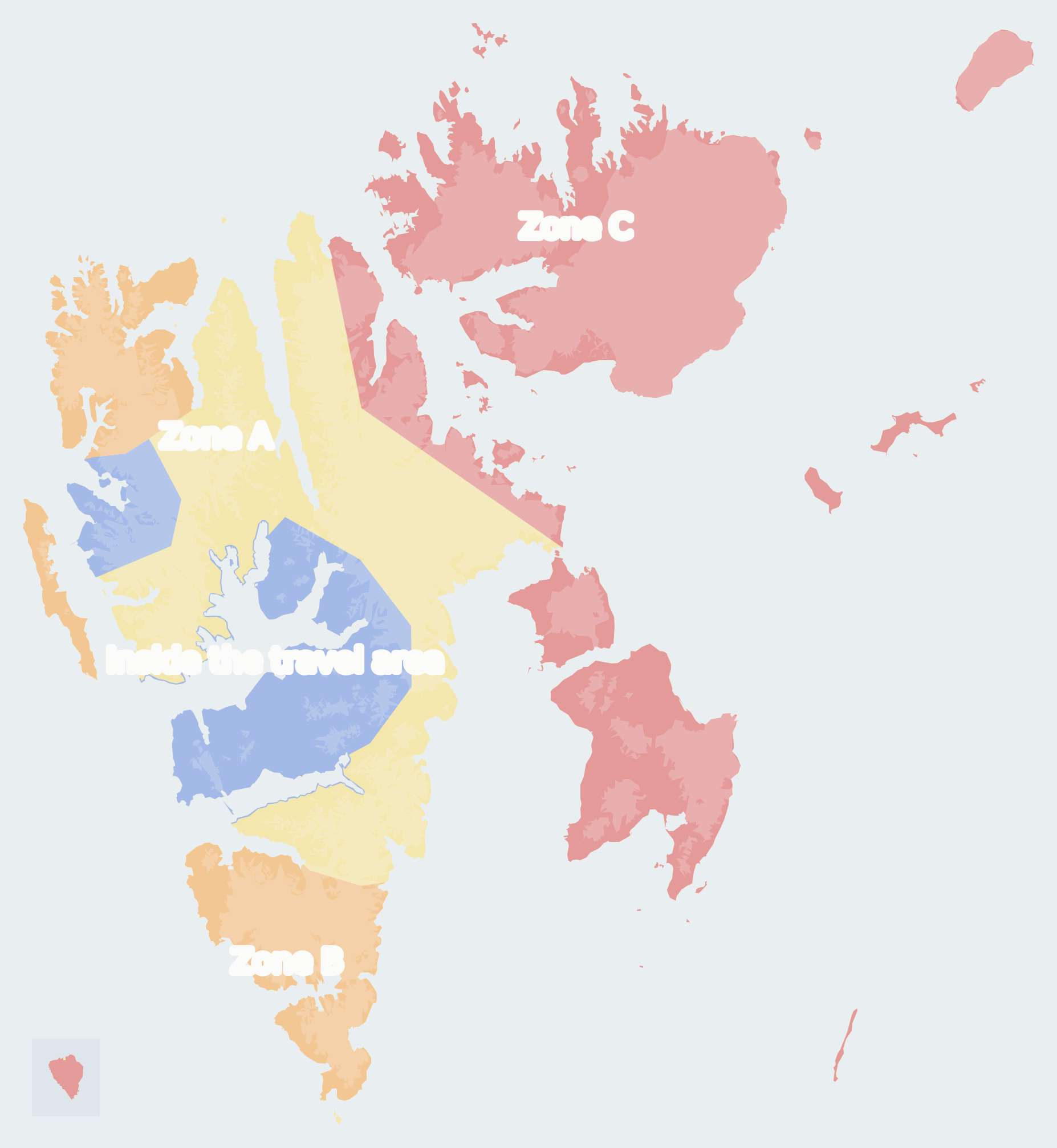
- The travel area, inside zone A
- Zone A NOK 120,000
- Zone B NOK 350,000
- Zone C NOK 650,000
A cap is the upper limit of a claim for each search, rescue or medical transport.
Graphic: Svalbard Wire · Sources: Field safety regulations and Motor Traffic Regulations, the Governor of Svalbard; sellers' descriptions of the trip · Map data: Norwegian Polar Institute
How this was made
The land and the protected areas are from the Norwegian Polar Institute's map data of Svalbard. The travel area is drawn from the points named on the map in the regulations' first annex. The zones are coloured on land as the second annex shows them. The orange line follows the snowmobile day trip to the east coast through the places its sellers name: Adventdalen, Sassendalen, Nordmannsfonna, Usherbreen and Mohnbukta (Arctic Adventures' description of the trip and Arctic Footsteps' listing at Visit Svalbard). Between those places the line takes the gentlest way on the elevation model, inside the areas where the Motor Traffic Regulations let visitors ride. It is not a recorded track; one seller writes that the route depends on the weather and driving conditions.
Four kinds of traveller
Tour operators and other paid organisers of trips must hold insurance or a guarantee everywhere on Svalbard. It must cover costs of any kind that a search, a rescue or a medical transport caused by their activity puts on public authorities or others. It applies whether or not the company, its staff or its guests were negligent. A guest on an organised trip does not count as a visitor under the regulations. The duty lies with the organiser.
Visitors travelling on their own must hold the same cover when they go outside the travel area. They must also notify the Governor at least four weeks before the trip and wait for the Governor's answer before they start. They must carry equipment for raising the alarm and for two-way communication.
Research and education bodies must hold the cover outside the travel area and need the Governor's permission for activity there. The application is due eight weeks before the start.
Permanent residents, the people entered in the population register for Svalbard, have no duty to insure. A resident can be made to pay the costs only after acting with intent or gross negligence. Residents must notify the Governor before trips into the three national parks on the west and south of Spitsbergen and the nature reserves in the east, on Hopen and on Bjørnøya.
The travel area and three zones
The travel area is drawn on a map in the first annex to the regulations. It covers Nordenskiöld Land with Longyearbyen and Barentsburg, Isfjorden, Van Mijenfjorden and the land around Pyramiden, and a second area around Ny-Ålesund. It was formerly known as Management Area 10.
The second annex divides Svalbard into three insurance zones. For each zone the regulations set a cap, the most the Governor can claim for one search, rescue or medical transport:
- Zone A, the middle of the island of Spitsbergen, Longyearbyen included: NOK 120,000.
- Zone B, the national parks Nordvest-Spitsbergen, Forlandet and Sør-Spitsbergen: NOK 350,000.
- Zone C, the nature reserves Nordaust-Svalbard and Søraust-Svalbard, Hopen and Bjørnøya: NOK 650,000.
Longyearbyen and the rest of the travel area lie inside zone A. Inside the travel area the organiser of a trip must insure, and a visitor on their own or a research or education body has no duty to insure. Outside it each of them must insure, up to the cap of the zone they are in.
The bill depends on who the traveller is and where the trip goes
| Traveller | Inside the travel area | Zone A, outside the travel area | Zone B | Zone C |
|---|---|---|---|---|
| Resident | No duty to insure | No duty to insure | No duty to insure | No duty to insure |
| On an organised trip | Organiser insures · cap NOK 120,000 | Organiser insures · cap NOK 120,000 | Organiser insures · cap NOK 350,000 | Organiser insures · cap NOK 650,000 |
| Visitor on your own | No duty to insure | Must insure · cap NOK 120,000 | Must insure · cap NOK 350,000 | Must insure · cap NOK 650,000 |
| Research or education body | No duty to insure | Must insure · cap NOK 120,000 | Must insure · cap NOK 350,000 | Must insure · cap NOK 650,000 |
Resident
- Inside the travel area
- No duty to insure
- Zone A, outside the travel area
- No duty to insure
- Zone B
- No duty to insure
- Zone C
- No duty to insure
On an organised trip
- Inside the travel area
- Organiser insures · cap NOK 120,000
- Zone A, outside the travel area
- Organiser insures · cap NOK 120,000
- Zone B
- Organiser insures · cap NOK 350,000
- Zone C
- Organiser insures · cap NOK 650,000
Visitor on your own
- Inside the travel area
- No duty to insure
- Zone A, outside the travel area
- Must insure · cap NOK 120,000
- Zone B
- Must insure · cap NOK 350,000
- Zone C
- Must insure · cap NOK 650,000
Research or education body
- Inside the travel area
- No duty to insure
- Zone A, outside the travel area
- Must insure · cap NOK 120,000
- Zone B
- Must insure · cap NOK 350,000
- Zone C
- Must insure · cap NOK 650,000
The Governor is to make the claim as soon as possible and at the latest six weeks after the mission ended. The caps and the deadline do not apply after intent or gross negligence. The Ministry of Justice and Public Security can change the three sums.
Shall, not may
Abid Raja, a member of the Storting for the Liberal Party, asked the minister on 3 November whether the rules oblige the Governor to demand reimbursement in every case or leave room for discretion.
In his question Raja gave the operators' case as follows. Local operators have seen the Governor change its practice from 2026. It now demands reimbursement after a mission whatever its cause, where it used discretion more often before. The tourism industry finds the change unnecessary and unreasonable.
The industry fears two effects, in Raja's account. The change can weaken the will to make voluntary resources available for local preparedness, or make guides reluctant to call for help early. Visit Svalbard (the destination company) had raised the matter with the Governor on behalf of local tourism businesses, and the industry reads the regulations as allowing discretion.
The duty to insure dates from 1991
Aas-Hansen traced the duty to a royal resolution of 18 October 1991. It required tour organisers to insure against search and rescue costs whether or not anyone had been negligent. In 1998 individual travellers on trips that had to be notified were given the same duty, and the Governor was allowed to grant exemptions.
The new regulations continue the duty, she wrote, and permanent residents are the one group exempt from it. The Governor may still grant an exemption from the duty to insure, and then no reimbursement is collected. The exemption power does not allow the Governor to waive a claim on insurance that is required and already bought. In her words, translated from Norwegian: "Under the rules, reimbursement shall therefore be collected from everyone who has the duty to insure." The claim goes to the insurance company.
The minister knew it may have varied over time whether the Governor collected, she wrote, and cited a letter from the Governor to Visit Svalbard in July. In the letter the Governor understands the provision to mean that reimbursement shall be collected when the conditions are met. It finds support for that reading in the six-week deadline and in the preparatory works, the documents written when the rules were drafted. The ministry reads the provision the same way.
The rescue service in figures
The three caps were raised on the way to the final text. The draft the ministries sent for consultation on 31 August 2021 had NOK 75,000 for zone A, NOK 200,000 for zone B and NOK 400,000 for zone C.
The state pays to keep the rescue service ready whether or not it is called out. The Governor's transport service, which runs two rescue helicopters, the service vessel Polarsyssel and vehicles, has a budget of NOK 282.7 million for 2026. The helicopters flew 678 hours in 2025 on all their tasks.
The Governor counted 51 rescue missions in 2025, 62 in 2024 and 86 in 2023. The count has moved between 24, in 2020, and 86 over the fifteen years from 2011. Almost half of the missions in 2021, 42.9%, were for people who mainly needed medical help, the Governor wrote in the report for that year.
The Governor counted 51 rescue missions in 2025
A system for reimbursing the cost of rescue operations is in place, the Governor wrote in the annual report for 2025. The Government proposed a new income line for it in the Svalbard budget for 2026, "reimbursement for search and rescue missions". The proposal gives authority to use the income for the transport service.
The tourism industry has argued that it gives the rescue readiness more than it takes from it. Two tourism leaders made the case in a debate article in High North News in January: Ronny Brunvoll, tourism director of Visit Svalbard, and Ronny Strømnes, chair of the Svalbard tourism council. In their account the industry adds more capacity, skill and resources than it draws on.
Their example is the guides, who spend much of their working day in the field and are trained in safe travel, first aid and handling demanding situations. Many are also volunteers in the Longyearbyen Red Cross rescue corps and bring snowmobiles, equipment and experience when an accident happens.
The two cited an analysis that Visit Svalbard commissioned from the consultancy Samfunnsøkonomisk Analyse in 2025. Its conclusion has two halves. More visitors raise the need for local preparedness. The number of search and rescue missions is nevertheless at about the level of 2008 to 2015, with substantially more tourists in the area.
The worry about the late call
Under the regulations, the Governor claims the cost of a search, a rescue or a medical transport from the organiser's insurance. The tourism industry has told the Governor that this requirement could lead guides to choose not to report a mishap. The ministries recorded the objection in their consultation paper of 31 August 2021, and the regulations were adopted on 6 June 2025.
The ministries answered in the same paper. In their answer, the expenses of a search or a rescue are exactly what the insurance is there to cover. The claim is also capped at the amount set for each zone.
Rescue bodies in North America have argued that the fear of a bill can delay the call for help. The search and rescue association of British Columbia does not charge "regardless of the reason". It wrote in 2021 that the belief that a person will be charged "could directly affect the decision as to whether or when a call for professional help will be made". The president of the Mountain Rescue Association, whose teams work across North America, said in 2009 that people will often delay calling for help when they fear a cost.
How other places settle the bill
Greenland requires search and rescue insurance of DKK 1,000,000 from each expedition inside its remote travel area. The Danish state is the sole beneficiary, according to the site manual of the Zackenberg research station.
In Switzerland the rescued person or the insurer pays as a rule, the air rescue service Rega wrote on its website. Rega puts a helicopter mission at about CHF 4,500. It may waive the cost for its patrons, the people who support it with contributions, when no insurer has to pay.
The Italian region of Veneto treats a rescue that is not medical as a service charged to the user, when the user asked for it or it can be attributed to them. Residents of the region get 20% off.
In Norway the Government has ordered a study. The order is in the allocation letter for 2026, the yearly instructions from the Ministry of Justice and Public Security to the Joint Rescue Coordination Centre, dated 22 December 2025. The centre is to examine whether compulsory payment from some outside users should cover more of the rescue service's costs. It is also to examine whether private persons or commercial companies should in future have to hold financial security for search and rescue in the Norwegian rescue region. The centre is to report in its annual report.
The Wire's coverage
- Minister answers Storting on Svalbard rescue costs (9 November)
- Raja asks if Governor must always seek rescue costs (3 November)
All sources
- Storting: Written question 15:471 (2026–2027) from Abid Raja to the Minister of Justice and Public Security, with the minister's answer (3 and 9 November 2026)
- Lovdata: Field safety regulations, FOR-2025-06-06-940: sections 3, 6, 7, 8, 16, 17 and 26 and the two annexes (6 June 2025)
- Government of Norway: New regulation on field safety in Svalbard – guides must be approved (6 June 2025)
- Governor of Svalbard: New regulation on field safety in Svalbard from 1 January (28 November 2025)
- Governor of Svalbard: Application and notification duty for trips on Svalbard
- Ministry of Justice and Public Security and Ministry of Trade, Industry and Fisheries: Consultation paper on a regulation on safety in the field on Svalbard (31 August 2021)
- Governor of Svalbard: Annual report 2020
- Governor of Svalbard: Annual report 2021
- Governor of Svalbard: Annual report 2022
- Governor of Svalbard: Annual report 2023
- Governor of Svalbard: Annual report 2024
- Governor of Svalbard: Annual report 2025
- Governor of Svalbard: Allocation letter 2026 to the Governor of Svalbard
- Government of Norway: Proposition 1 S (2025–2026), Svalbard budget
- Government of Norway: Proposition 96 S (2025–2026): supplementary appropriations and reprioritisations in the 2026 state budget
- High North News: The most important preparedness on Svalbard goes to work every morning (15 January 2026)
- Samfunnsøkonomisk Analyse, commissioned by Visit Svalbard: Social analysis of tourism on Svalbard, report 23-2025 (2025)
- Visit Svalbard: News (read 11 November 2026)
- BC Search and Rescue Association: No charge for search and rescue (April 2021)
- Mountain Rescue Association: Mountain Rescue Association reaffirms its position opposing charging subjects for the costs of their rescues (1 August 2009)
- Zackenberg Research Station: Site manual (2025)
- Rega: Questions and answers (read 11 November 2026)
- Veneto Region: Regional Law 11/2015, new rules on mountain rescue, article 5 (11 May 2015)
- Ministry of Justice and Public Security: Allocation letter 2026 to the Joint Rescue Coordination Centre (22 December 2025)