 Svalbard
In depth
Plastic from European cities reaches Zeppelin Observatory
Two samplers on a mountain above Ny-Ålesund collect microplastic from the air. In 2025 the observatory measured the lowest level of the three stations in Norway's national monitoring.
Key points
- In 2025 microplastic falling to the ground at Zeppelin averaged 18 micrograms per square metre per day, against 42 at Birkenes in Agder and 550 in Oslo
- NILU links episodes of high concentrations at Zeppelin to air masses from Central and Southern Europe; particles can travel many hundreds of miles in days
- The samplers contain no plastic: the filters are heated to 600 degrees without oxygen and analysed with a mass spectrometer
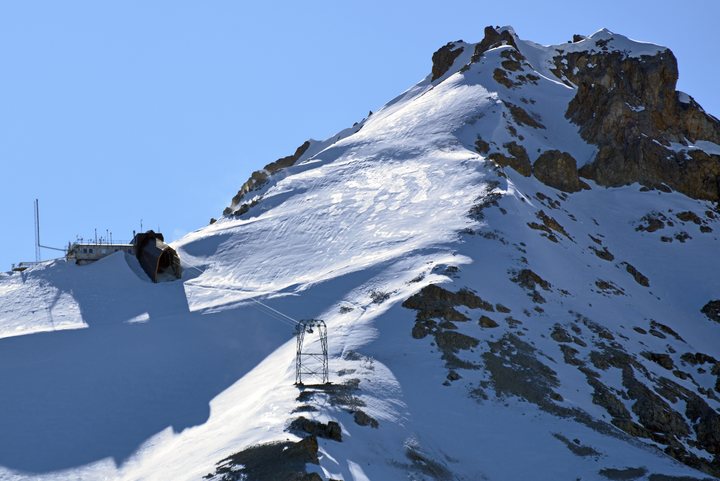
Every 14 days, a filter is changed in a sampler attached to the railing of the Zeppelin Observatory, 472 metres up Zeppelin Mountain above Ny-Ålesund. Beside it stands a large metal bucket that collects everything that falls from the sky, snow included. Both have been there since autumn 2021, and both are looking for plastic.
The national results for 2025 came out on 4 November. The Norwegian Environment Agency measures microplastic falling from the air at three stations: Zeppelin, Birkenes in Agder and Sofienbergparken in Oslo. The Oslo station measured about 30 times the Svalbard average and about 13 times the level at Birkenes.
The observatory
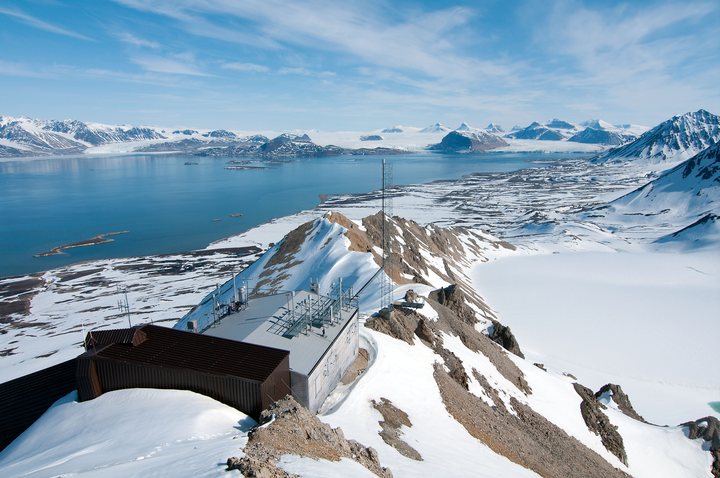
The observatory opened in September 1989 as part of the Ny-Ålesund research station. The first building had water leaks, poor insulation and heavier snow loads than expected, and the instruments needed more room. It was rebuilt in 1999 and inaugurated on 2 May 2000, according to a 2022 study by NILU researchers in the journal Atmospheric Chemistry and Physics.
The Climate and Environmental Research Institute NILU has the scientific responsibility for the observatory. The Norwegian Polar Institute handles its daily technical maintenance. NILU says the site lies "in an undisturbed arctic environment, far from major sources of pollution". Besides microplastic, the station measures greenhouse gases, ozone, aerosols, mercury and other pollutants, and its data go to international networks that track the atmosphere.
How plastic is caught without plastic
The two samplers do different jobs. The active sampler draws air through filters that collect all particles larger than 10 micrometres. It measures plastic floating in the air. The passive sampler, the bucket, measures how much falls to the ground, including in rain and snow.
How the Zeppelin Observatory catches plastic from the air
Plastic floating in the air
On the railing, a pump draws air through a filter that keeps every particle larger than 10 micrometres.
Plastic falling to the ground
Beside it, a large metal bucket collects everything that falls from the sky, snow and rain included.
A new filter every 14 days
Every 14 days the filter is changed. Its holder closes as soon as it is removed, so no other plastic gets in.
In the laboratory
Heated to 600 degrees without oxygen, the plastic breaks apart instead of burning (pyrolysis). A mass spectrometer identifies each kind of plastic.
No plastic parts: the samplers are made of metal.
Graphic: Svalbard Wire · Sources: Climate and Environmental Research Institute NILU (2023, 2026)
The equipment cannot itself contain plastic. "We can't take microplastic samples with plastic equipment," NILU senior scientist Dorte Herzke said in 2023. The samplers are adapted from an earlier NILU design, with all the plastic components replaced with metal. The filter holder closes as soon as it is removed, so the sample is not contaminated on its way to the laboratory.
In the laboratory, the filters are heated to 600 degrees without oxygen. The plastic does not burn: its polymer structure breaks apart, a process called pyrolysis. The fragments are then analysed with a mass spectrometer.
Monitoring began in 2021 as a pilot of six measurements over three months on Svalbard and at Birkenes. It now runs all year. In 2025 each station took 12 samples, each covering 14 days. The work is part of Mikronor, the national microplastic monitoring programme led by the Norwegian Institute for Water Research (NIVA) for the Environment Agency. "Norway is the only country in the world that has permanent monitoring of microplastics in the air," said Natascha Schmidt, a senior scientist at NILU.
What the numbers measure
The Mikronor 2025 report gives Zeppelin's own figures. Microplastic falling to the ground averaged 18 micrograms per square metre per day, against 42 at Birkenes and 550 at Sofienbergparken in Oslo. The highest sample at Zeppelin, 75, was taken in March; the lowest, 3, in January and late August. Half of all analyses at Zeppelin were below the detection limit.
Zeppelin samples in 2025: highest in March
Microplastic falling to the ground, in micrograms per square metre per day
Average for 2025 at the three stations
Microplastic falling to the ground, in micrograms per square metre per day
Graphic: Svalbard Wire · Source: Norwegian Environment Agency, Mikronor 2025 (NIVA, Climate and Environmental Research Institute NILU)
The figures measure plastic falling to the ground at one station, not the air people breathe in Longyearbyen or Ny-Ålesund.
Where the plastic comes from
In August, NILU reported that high concentrations at the observatory "originate from urban areas in Europe", and that dispersion models point to Central and Southern Europe as the main sources. The findings are published in the paper "Airborne microplastics on the move: Urban Europe as a source to remote regions".
The paper, by Dorte Herzke and seven colleagues, uses samples from 2022 and 2023. The air arriving at Zeppelin and Birkenes was traced 50 days back with the dispersion model FLEXPART. When the samples were high, the air had come from Central and Southern Europe and from the Atlantic west of the Iberian Peninsula. When they were low, it had come from Eastern Europe or from the open Atlantic between 35 and 40 degrees north, regions where far less plastic enters the air.
Road dust was the largest modelled source at both stations, followed by mineral dust blown up from soil and plastic lifted from the sea in spray. In the air at Zeppelin, polyvinyl chloride (PVC) and PET were the main plastics found, with polypropylene a minor part. Neither remote station showed a seasonal pattern; Oslo did, with the change to winter tyres.
"Everything that is transported by air is very fast," Herzke said. Particles are sometimes carried many hundreds of miles within days, according to NILU, and the transport is most efficient in autumn and winter. At Zeppelin, polypropylene and PET were the plastics found most often. Tyre wear particles were detected in 2 of the 12 samples, in March and November; in Oslo they made up about 75 per cent of the microplastic.
The report links the lowest sample, from late August, to air that came over open ocean, and the higher samples to air from larger or continental areas.
In January 2023 the Environment Agency reported that concentrations in southern Norway were four times those on Svalbard, probably because of more precipitation and continental air masses.
The Wire's coverage
All sources
- Norwegian Environment Agency: Bildekk er største kjelde til mikroplast i Osloluft (4 November 2026)
- NILU: Mikroplast fra bildekk preger luftprøvene fra Oslo (6 November 2026)
- Herzke et al., Environmental Pollution: Airborne microplastics on the move: Urban Europe as a source to remote regions, vol. 388, 127380 (online 14 November 2025; open copy in the Norwegian Research Information Repository, CC BY)
- NILU: Microplastics from European cities fly quickly up to the Arctic (4 August 2026)
- NILU: Aluminium buckets and 600-degrees help researchers find microplastics in air (28 March 2023)
- NILU: Zeppelin Observatory
- Platt et al., Atmospheric Chemistry and Physics: Atmospheric composition in the European Arctic and 30 years of the Zeppelin Observatory, Ny-Ålesund (2022)
- Norwegian Environment Agency: Mikroplast spredt i hele Norge (10 January 2023)
- Norwegian Environment Agency: Mikronor 2025: Monitoring of microplastics in the Norwegian environment, report M-3205, pages 40 and 66 (4 November 2026)