How the Svalbard seed vault could help protect Africa's food future
Svalbard WirePublished 26 OctoberSummary of the article by Africanews.
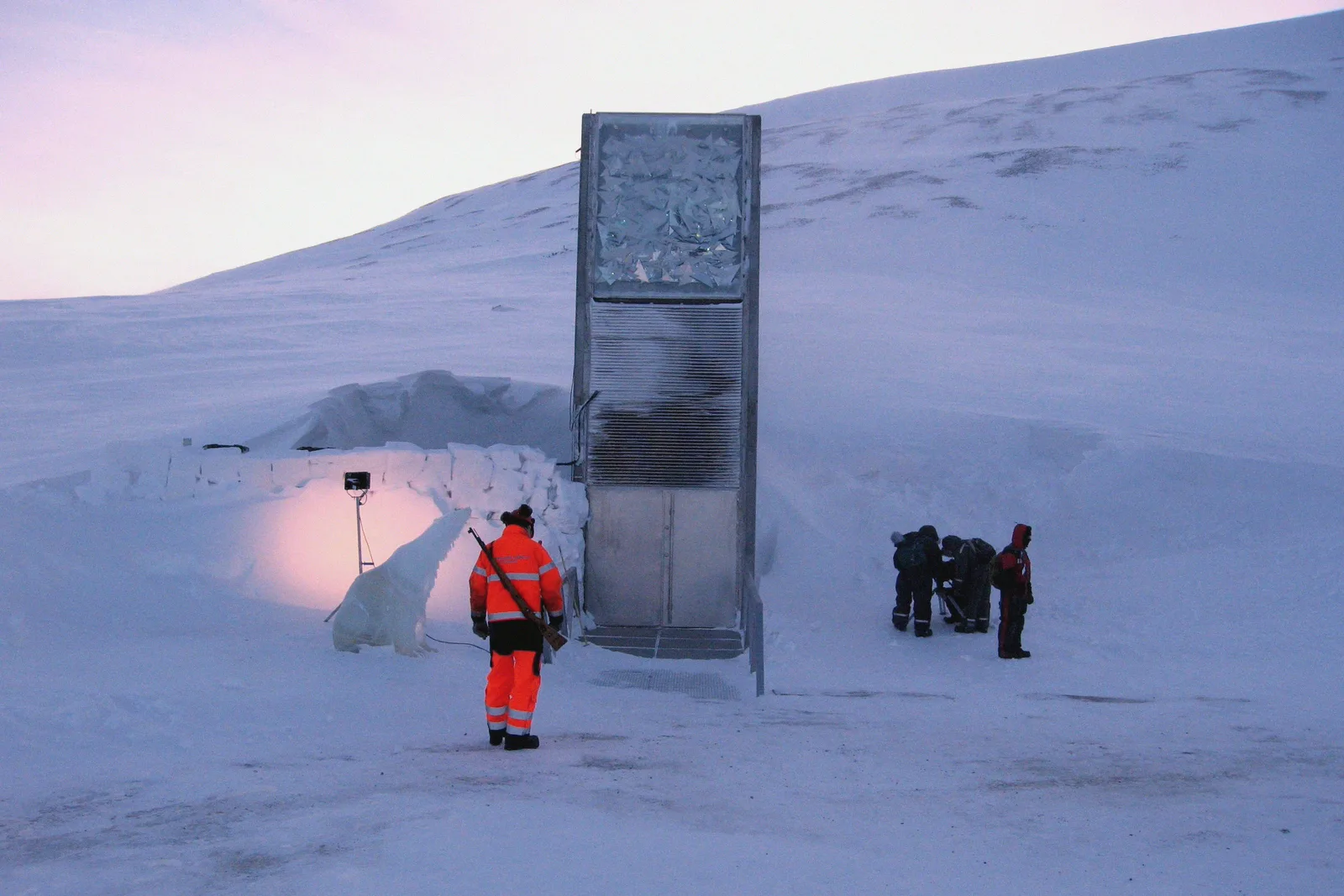
An armed guard stands at the entrance to the Svalbard Global Seed Vault in snow. File picture. Photo: Dag Endresen, CC BY 3.0, Wikimedia Commons.
The Svalbard Global Seed Vault, an Arctic backup store for the world's food supply holding over a million seeds, is this year's winner of the Princess of Asturias Award, given for international cooperation. Africanews reporter Ronald Kato interviewed Lene Krøl Andersen, executive director of NordGen. Topics were African staple crops, ties with national seed collections and the question of whether seeds can match a changing climate.
Andersen said climate change is one reason the vault was set up. Natural biodiversity is under pressure, so the genetic traits needed for future crops may not remain in the wild. Stored seeds keep that resilience. She said the diversity must be kept alive so it can be used, and that gene editing and modern breeding let crops be adapted to the climate. She compared the collection to a library whose books hold genetic information.
Asked about Norwegian law, which governs the vault and bars genetic modification, Andersen said technology will develop. For storage, the aim is to keep samples as close to the original as possible, because that widens diversity. What happens with the traits in those samples is up to researchers and breeders.
On Sudan and Ukraine, both at war and both depositors, she said the logistics vary with the situation. NordGen has worked closely with Ukraine and still does. There, seeds were moved from one side of the country to the other to keep them safe. Svalbard is the last layer of backup: a depositor turns first to its own gene banks, then to the vault. Seeds can be withdrawn at any time. She said the vault does not address geopolitics, and seeds from Russia, America and Ukraine are stored side by side.
For a farmer in Senegal or Uganda with a local okra or cowpea variety, Andersen said it means the farmer's own breeding work is kept as insurance for the next generation. Looking 50 years ahead, she hopes more information on diversity will be generated and shared. She said the global collection sits at Svalbard, but the work happens in individual gene banks.
The vault outside Longyearbyen keeps 1.4 million seed samples from 135 genebanks in 84 countries and the international centres.
Each square is one genebank. Its area is the number of seed samples it keeps in the vault; the smallest are drawn at the smallest size that can be seen.
The vault has opened for deposits on 73 days since 26 February 2008; the largest day, 26 February 2008, brought 237,106 samples, and the latest, 13 October 2026, 16,514.
Each mark is one day the vault opened; its area is the samples that came in. The smallest days are drawn at the smallest size that can be seen. An outlined mark is a day the portal lists with no samples under it.
Africanews, Press, 26 October 2026, 13:53. How the Svalbard seed vault could help protect Africa's food future. https://www.africanews.com/2026/10/27/how-the-svalbard-seed-vault-could-help-protect-africas-food-future/
 Svalbard