Thousands of Seed Samples Added to Svalbard Global Seed Vault
Svalbard WirePublished 19 OctoberSummary of the article by SeedWorld.
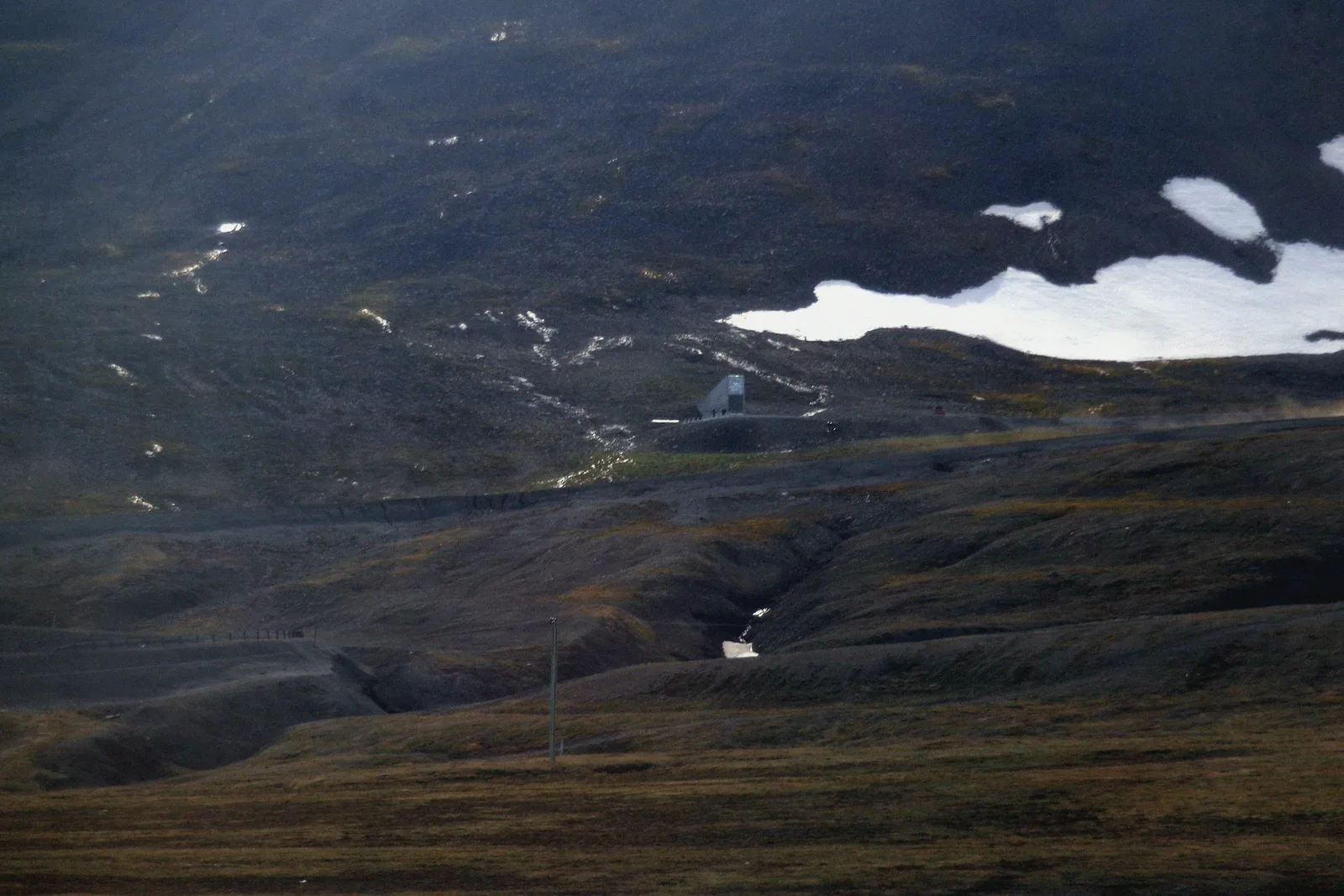
The Svalbard Global Seed Vault entrance building on a hillside near Longyearbyen, with melting snow. File picture, July 2015. Photo: Superchilum, CC BY-SA 4.0, Wikimedia Commons.
Seed samples from 21 institutions were placed in the Svalbard Global Seed Vault on 13 October, SeedWorld reports. The vault already holds more than 1.4 million samples. Contributors included six CGIAR genebanks, the national genebank of Ukraine and, for the first time, an institution from Italy. According to a press release, the deposit came before a ceremony in late October for the 2026 Princess of Asturias Award, which recognises the vault's work on crop diversity.
Each sample duplicates material kept in an existing genebank collection, so originals can be recovered if they are damaged, destroyed or become inaccessible. The seeds stay the property of the depositing institutions. The vault offers long-term storage and does not replace the genebanks that maintain, study and distribute the collections.
Ukraine's National Academy of Agrarian Sciences deposited 773 samples, including buckwheat. The head of Ukraine's plant genebank, Viktor K. Riabchoun, said the hardest part was organising the work: seeds were prepared close to military hostilities, documents were completed and transport was arranged. Buckwheat has a short growing season, so farmers can plant it when winter crops fail.
The six CGIAR genebanks deposited 8,917 samples together. CIMMYT in Mexico gave the most, 3,370 samples of wheat, triticale and maize. ICARDA in Lebanon deposited 2,039, IRRI 1,890 and CIP 1,027. Also taking part were ILRI and one more genebank group, the Alliance of Bioversity International and CIAT. IRRI included 410 rice samples deposited for the first time, from Madagascar, Costa Rica and Nepal, and now has 99.59% of its fully curated collection backed up. CIP now has 91% of its seed collection in Svalbard. ICARDA earlier withdrew seeds from the vault to rebuild its collections after conflict disrupted its genebank, then returned duplicates. Guerrilla groups threatened the Alliance's genebank, and staff had to leave two bean field stations.
Italy's CREA deposited 272 samples of historic wheat and rice varieties. They include Mentana, a wheat developed in the early 20th century by the breeder Nazareno Strampelli. Other depositors were NordGen, the World Vegetable Center, the Southern African Development Community genebank, and institutions in New Zealand, Portugal, the United Kingdom, Latvia, Thailand, Lithuania, Uruguay and Peru.
Norway's minister for agriculture and food, Nils Kristen Sandtrøen, said the deposit showed that countries continue to cooperate on genetic resources. The executive directors of NordGen and the Crop Trust also commented, as did the secretary of the plant genetic resources treaty.
The vault outside Longyearbyen keeps 1.4 million seed samples from 135 genebanks in 84 countries and the international centres.
Each square is one genebank. Its area is the number of seed samples it keeps in the vault; the smallest are drawn at the smallest size that can be seen.
The vault has opened for deposits on 73 days since 26 February 2008; the largest day, 26 February 2008, brought 237,106 samples, and the latest, 13 October 2026, 16,514.
Each mark is one day the vault opened; its area is the samples that came in. The smallest days are drawn at the smallest size that can be seen. An outlined mark is a day the portal lists with no samples under it.
SeedWorld, Press, 19 October 2026, 10:09. Thousands of Seed Samples Added to Svalbard Global Seed Vault. https://www.seedworld.com/europe/2026/10/19/svalbard-global-seed-vault-october-2026-deposit/
 Svalbard